Sixty-four years ago this week, a young nation rose to the front rank of Asia’s space ambitions—and its story still inspires today.
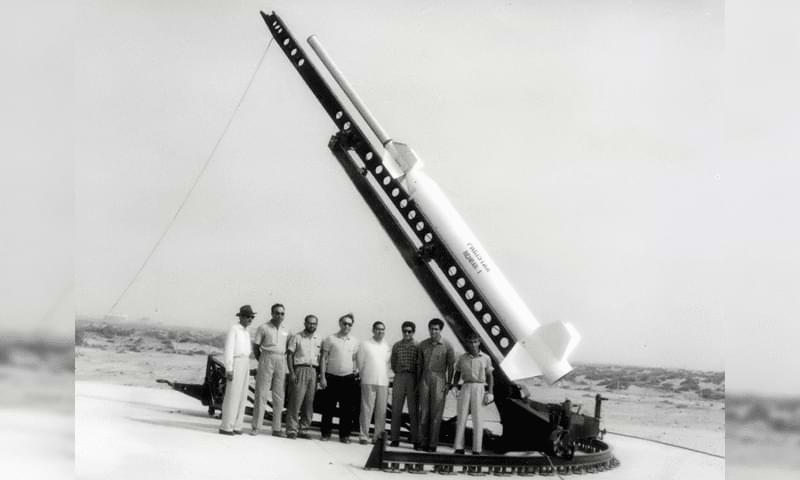
On the evening of June 7, 1962, a plume of fire rose over the Arabian Sea coast west of Karachi. A two-stage, solid-fuel sounding rocket named Rehbar-I—Urdu for “the one who leads the way”—climbed to roughly 130 kilometres, released a glowing cloud of sodium vapour, and let scientists on the ground chart the winds of the upper atmosphere. With the launch, Pakistan became the first country in South Asia, and among the first ten in the world, to send a rocket toward space.
The achievement was as much about speed as ambition. SUPARCO, Pakistan’s space commission, had been established only in September 1961, under the physicist and future Nobel laureate Abdus Salam. Within nine months the team was assembled, trained at US facilities, the Sonmiani range built from scratch, payloads selected, and the first rocket launched—a tempo that reportedly impressed even American specialists, who marvelled that a newly independent nation could accomplish so much, so fast.
That early burst of energy carried the programme through a remarkable decade. Between 1962 and 1972, SUPARCO launched more than 200 sounding rockets, steadily mapping the upper atmosphere and building a generation of homegrown scientific talent. In 1967, Pakistan opened its first rocket plant in Karachi, producing indigenous Rehnuma and Shahpar rockets that flew by 1969—proof that the country was reaching beyond simple assembly toward genuine technological capability.
That spirit endures in Pakistan’s modern space ambitions. In May 2024, Pakistan joined the small club of nations to fly a satellite in lunar orbit—the ICUBE-Q, a roughly 9-kilogram CubeSat built by students at the Institute of Space Technology, which transmitted images of the Moon’s surface. In early 2026, SUPARCO announced it had shortlisted two astronaut candidates, now training in China, for a journey to the Tiangong space station—with one potentially becoming the first foreign visitor to the orbiting outpost.
More than six decades later, Rehbar-I remains a touchstone of national pride—the moment a young country proved it could stand among the world’s spacefaring nations. The rockets that followed, and the lunar missions taking shape today, are all heirs to that first flight over the Arabian Sea. Its true payload was never the sodium it carried, but the conviction it left behind: that Pakistan belongs among the stars.