

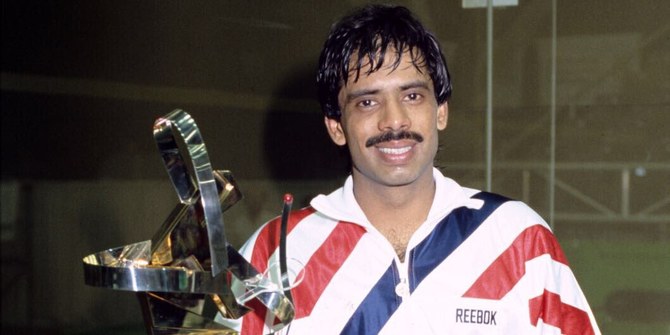
His name means “conqueror of the world,” and for the better part of a decade, Jahangir Khan made the title literal. Between 1981 and 1986 he did not lose a single competitive squash match — a run of 555 consecutive wins that Guinness World Records still recognises as the longest unbeaten streak by any athlete in top-level professional sport. The most remarkable part? By the verdict of the doctors who examined him as a boy, he was never supposed to play at all.
Born in Karachi on 10 December 1963, with family roots in Peshawar, Jahangir arrived into squash royalty. His father, Roshan Khan, won the British Open in 1957; his elder brother Torsam was a touring professional. But the youngest hope was frail — born with a double hernia, sickly through childhood, and warned by doctors to stay off the court. He had his first hernia operation at five. His father chose a gentler route back, handing him a short-shafted racket on his eighth birthday and, after a successful second operation at twelve, beginning to train him in earnest.
The rise was breathless. In 1979, aged just fifteen, Jahangir became the youngest-ever World Amateur Champion. That triumph carried a wound: the same year, his brother Torsam collapsed and died of a heart attack during a match in Australia. Jahangir nearly walked away from the game — then returned to carry his brother’s dream. In 1981, still only seventeen, he beat Australia’s Geoff Hunt to become the youngest World Open champion in history.
After that title, he simply stopped losing. For five years and eight months Jahangir was untouchable, sweeping five consecutive World Open crowns and a procession of British Opens. In 1982 he won an International Squash Players Association final without conceding a single point. Built by cousin and coach Rahmat Khan’s punishing fitness regime, he wore opponents into dust in rallies that seemed to have no end, widely regarded as the fittest man in the sport.
The streak finally broke on 11 November 1986, in the World Open final in Toulouse. New Zealand’s Ross Norman — who had lost to Jahangir perhaps thirty times and vowed, “One day Jahangir will be slightly off his game, and I will get him” — won in four games. It made headlines worldwide precisely because a Jahangir victory had become a foregone conclusion. Even then, he did not crumble: he stayed unbeaten for another nine months, beating Norman again weeks later.
A new Pakistani prodigy, Jansher Khan, soon emerged, and the two ruled the 1980s and early ’90s between them. Jansher edged ahead for a spell, but Jahangir answered — reclaiming the World Open in 1988 by beating his compatriot in the final and winning eleven of their next fifteen meetings. He retired in 1993 with six World Opens and a record ten British Opens to his name.
After retiring, he led the global game itself, serving as President of the World Squash Federation from 2002 to 2008.
Squash today belongs to a new generation, much of it Egyptian, but no one has approached the territory Jahangir once owned. His dominance was never just about winning; it was about the impossibility of imagining him lose. A boy from Karachi conquered the world — and remains, simply, the greatest his sport has known. Pakistan’s pride, undimmed.