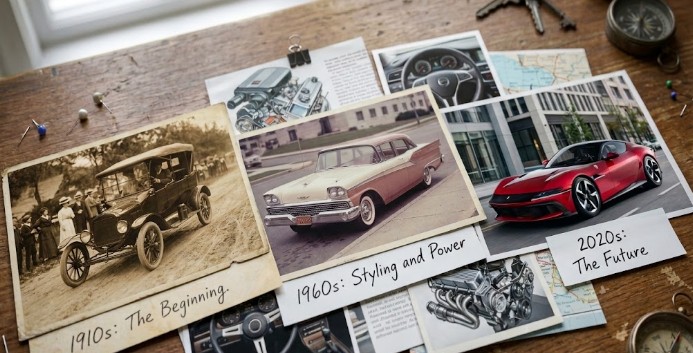
From a wooden steam cart in 1769 to today’s aluminium-wired electric machines, the car has quietly reinvented itself from the inside out
The car in your driveway shares almost nothing with the first one ever built. Across 250 years, engineers have replaced nearly every material inside it, driven by the same three goals: lighter, cheaper, safer. The history of what cars are made of is, in many ways, the history of the car itself.
That history moves in distinct waves. Wood gave way to steel, steel eventually made room for aluminium and carbon fiber, and now even the copper wiring hidden inside the dashboard is being swapped out. Each shift was prompted by the pressures of its day, whether cheap fuel, an oil crisis, or a global metal shortage. Follow the materials, and the whole story of the automobile falls into place.
From Wood to Steel: The First Car Bodies
The earliest cars were built by the same craftsmen who made horse carriages, and they used the same material. Early bodies were shaped from wood, which is why vintage models still carry carriage names like phaeton and tonneau.
The first self-propelled vehicle was neither sleek nor fast. French engineer Nicolas-Joseph Cugnot built a steam-powered tractor in 1769 that moved at roughly 2.5 miles per hour and needed to stop every 20 minutes to rebuild steam. Gasoline power arrived more than a century later. Karl Benz patented the first practical gasoline car in 1886, combining engine and chassis into a single unit for the first time.
Wood carried a serious flaw. It was heavy, difficult to shape, and prone to warping in bad weather. As metalworking advanced around 1900, steel replaced it.
- 1908: Ford’s Model T used heat-treated steel and a moving assembly line, making cars affordable for ordinary families.
- 1914: The Dodge Brothers produced the first all-steel car body, and steel would dominate for the next 60 years.
- Even now, steel still accounts for around 60 percent of a modern car’s weight.
The Shift to Aluminium and Carbon Fiber
For decades, weight was an afterthought. Fuel was cheap, so a heavy steel body posed no problem. The 1970s oil crisis changed that, pushing carmakers toward efficiency and moving lighter materials from the race track into everyday production.
Aluminium led the transition. It is roughly a third lighter than steel while remaining strong, so it appeared first in hoods, doors, and trunk lids, then in full bodies. Audi built an all-aluminium A8 sedan, and Ford switched its best-selling F-150 truck to an aluminium body in 2015, cutting about 700 pounds.
Carbon fiber followed as the high-performance option. First used on a McLaren Formula One car in 1981, it is up to 50 percent lighter than steel and considerably stronger. According to the US Department of Energy, carbon fiber composites can reduce a vehicle’s weight by as much as 70 percent. Its high cost has largely confined it to supercars and luxury models.
The focus on weight is not cosmetic. A 10 percent reduction in weight can improve fuel economy by 6 to 8 percent, which matters even more in electric cars, where every kilogram affects driving range.
The Copper to Aluminium Switch Happening Now
The most recent change is one drivers will never see, because it sits inside the wiring.
Copper has carried electricity through cars since the electric battery was invented two centuries ago, serving as the default for 200 years. That long run is now ending.
According to Reuters, Ferrari and BMW have begun replacing copper wiring with aluminium, following Tesla and several Chinese EV makers.
- Cost: Aluminium is roughly a quarter of copper’s price.
- Weight: Ferrari said the switch cut up to 20 percent of its wiring weight, which helps extend EV range.
- Supply: Copper prices spiked near $15,000 a ton in early 2026, and demand is forecast to outpace supply for more than a decade as green energy and data centers compete for it.
The logic is the same one that has shaped the car for 250 years: find a material that is lighter, cheaper, and just as capable, then build it in.
The full arc is striking. The car evolved from a wooden cart moving at walking pace, to a steel workhorse for the masses, to a carbon-and-aluminium machine capable of driving itself. Each shift was largely invisible to the people behind the wheel, yet each one changed how far, how fast, and how affordably the world travels.
The next major change, like the ones before it, will most likely be one drivers never notice.