


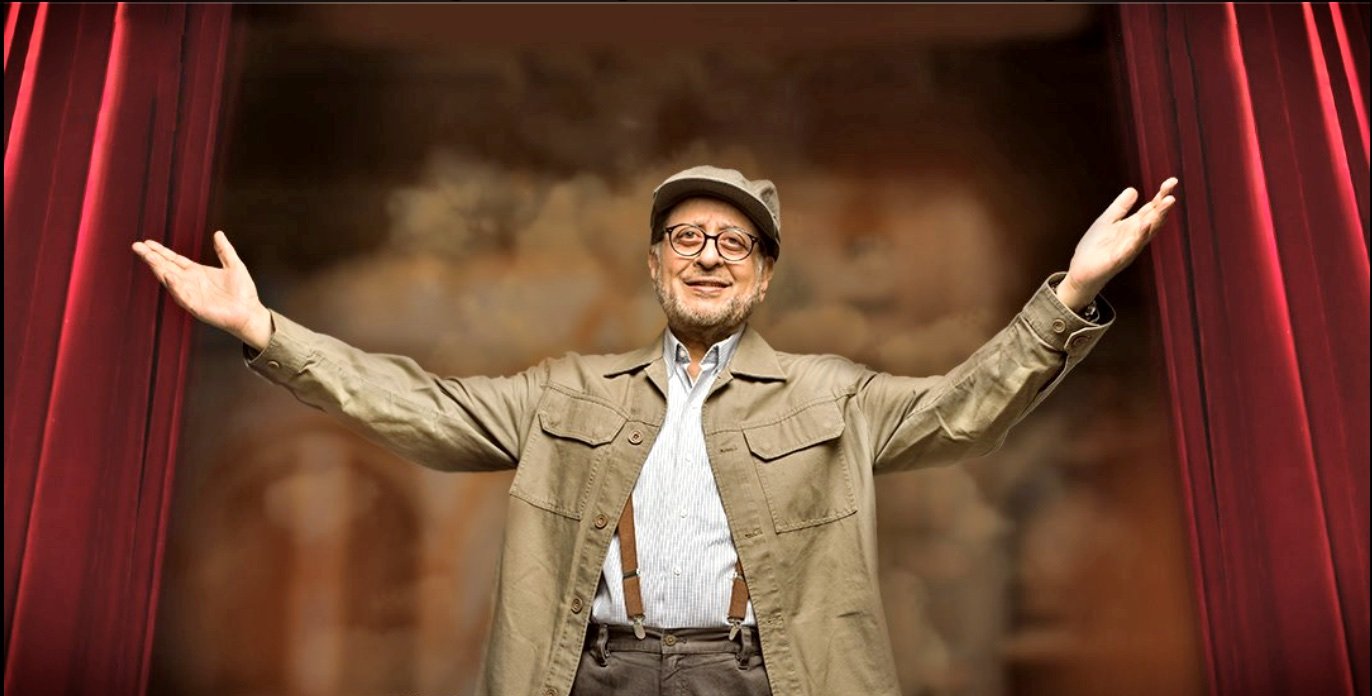
What if I told you that Pakistan has an actor who has worked in more than 200 films over nearly 60 years, appeared in an Indian film as the antagonist, and enjoys the same status in Pakistan as Amitabh Bachchan does in India? That’s Nadeem Baig, active in film, TV, and advertisements since the late 1960s. Not only is he considered one of the finest actors produced by Pakistan, but he is also a role model we are lucky to have amongst us. Today is his 85th birthday!
Turning 85 is an achievement in itself, but remaining relevant, respected, and admired after nearly six decades in the entertainment industry is rare and remarkable. Only a handful of artists worldwide can claim that distinction, and Nadeem Baig is one of them. If Helen of Troy launched a thousand ships, Nadeem Baig launched a thousand careers. Most actors who debuted after him tried to emulate him to succeed, and many did make a name for themselves in the process.
My question for his millions of followers is simple: Why are we lucky to breathe the same air as he does? The answer lies not only in the number of films and television dramas he has made, nor in the countless awards and accolades he has received. It lies in the fact that Nadeem has lived through every era of Pakistani entertainment, adapting to changing times without compromising quality. He is not merely a witness to Pakistan’s cinematic history — he is one of its principal architects.
For generations of Pakistanis, both at home and abroad, Nadeem represents something even greater. His films, and later his TV dramas, have become cultural touchstones, connecting overseas Pakistanis with the language, emotions, and values they left behind. Whether someone grew up in Karachi, London, Toronto, or Dubai, Nadeem was likely already a familiar face in their household.
Why Nadeem Baig remains special to me is another matter altogether. The first Pakistani film I saw in theaters featured the great man; the first Urdu feature film I saw on TV had him in the lead role; and the first one I had to watch in theaters for review purposes when I began my career. That’s not all; I was lucky enough to interview him at the start of my journalistic career in the late 90s, write my comeback piece (after a six-month hiatus) for Dawn Images about him, interview him again four to five times over the next 15 years, and, best of all, he knows me by name. That’s even better than any award!
That is why celebrating his 85th birthday is not merely paying tribute to another actor. It honors the career of a living legend and the history of Pakistani entertainment.
Nadeem is not even his real name!
It might sound surprising today, but the legendary ‘Nadeem’ never dreamed of becoming an actor. In fact, Nadeem is not even his real name – that’s Mirza Nazir Baig.
Born on July 19, 1941, in Vijayawada near Madras (now Chennai), he migrated to Pakistan after Partition with his father and younger brother. Having lost his mother at age four, he grew up in Karachi, attending Nazimabad High School, Sindh Madrasa-tul-Islam, and later Islamia College.
“I was quite fond of singing,” Nadeem once recalled. “With encouragement from my friends, I met TV producer Zaman Ali Khan, who gave me the opportunity I had been seeking.”
His journey began in Dhaka, where he performed songs in both Urdu and Bengali on Pakistan Television while working at an advertising agency. Despite not knowing Bengali, he worked tirelessly to perfect his pronunciation. The program became popular, and Radio Pakistan followed. A singing career appeared to be taking shape.
Then fate intervened. Renowned filmmaker Ehtesham initially offered him a negative role in Chakori, but Nadeem politely declined, opting to sing instead. Ironically, he ended up recording one of the film’s most memorable songs—”Kahan Ho Tum Ko Dhoondh Rahi Hain.”
Soon afterward, the film’s hero, Azeem, withdrew from the project.
“One night, Ehtesham Sahib approached me about the lead role, which I initially declined. After consulting my boss, filmmaker Zahir Raihan, I accepted the offer,” Nadeem recalled in an interview. “As a novice, I simply did whatever the director asked me to do, with the entire crew’s support.”
The gamble paid off spectacularly. Released in 1967, Chakori transformed Mirza Nazeer Baig into “Nadeem” almost overnight. Although audiences initially saw shades of Dilip Kumar in his appearance, it didn’t take long for him to establish an identity entirely his own through effortless performances, understated expressions, and a remarkable screen presence.
Soon, films like Chand Aur Chandni, Sangdil, Daagh, Behen Bhai, Anari, and Nazneen established him as Pakistan’s newest superstar. His smart selection of scripts set him apart from newer actors, and in no time he was being named in the same league as Mohammad Ali and Waheed Murad, once his seniors and now his competitors.
The golden pairing with Shabnam
Every great film industry has its legendary screen couple – Pakistan had Nadeem and Shabnam. Not only did both actors make their debuts in the 1960s, but they also looked so good together that directors cast them in the same films to draw audiences.
Together, they appeared in more than fifty films, including timeless classics such as Aaina, Pehchaan, Bandish, Ehsaas, Do Badan, Sharafat, Dillagi, Zanjeer, Badal Aur Bijli, Aahat, and Faisla. Their chemistry never relied on melodrama or exaggerated romance. Instead, it reflected warmth, grace, and emotional honesty, allowing audiences to grow alongside them.
Over the years, both actors matured into more nuanced characters, making their partnership one of the longest and most successful in South Asian cinema. Although Shabnam hasn’t acted in a Pakistani film since the 1990s and Nadeem Baig is on hiatus, their fans would love to see them together, given their excellent track record.
Reinventing himself when cinema changed
The 1980s were challenging for Urdu cinema. Punjabi action films dominated the box office, piracy devastated theaters, and many established stars faded away. Nadeem chose reinvention over resistance, which gave his career a new direction.
By changing his hairstyle, choosing age-appropriate roles, and embracing more nuanced characters, he smoothly transitioned from romantic hero to mature leading man. His collaborations with Babra Sharif marked another successful chapter, while he continued to deliver memorable performances opposite Shabnam.
Yet despite his own remarkable consistency, Nadeem has never hidden his disappointment over Pakistani cinema’s decline.
“When a handful of Punjabi films became blockbusters,” he once reflected, “producers abandoned Urdu cinema. Audiences rejected the shift and simply stopped going to theaters.”
He has often argued that the industry’s downfall wasn’t inevitable but self-inflicted.
“When I entered the industry, we produced nearly 200 films each year from Karachi, Lahore, and Dhaka. Fifty years later, we produce only a fraction of that, often with strange titles and outrageous storylines.”
Instead of blaming budgets, Nadeem points to countries like Iran.
“They make films on excellent subjects and market them internationally. We can follow that example to drive positive change.”
Representing Pakistan beyond its borders
Long before international collaborations became fashionable, Nadeem represented Pakistan in the Indo-Bangladesh co-production Door Desh (Gehri Chot), sharing the screen with Shashi Kapoor, Raj Babbar, Parveen Babi, and Sharmila Tagore.
“I chose the role of Tony because it let me show another side of my acting,” he explained. “Although the film didn’t do well commercially, the role itself was appreciated.”
Interestingly, he is the only Pakistani actor to have worked with multiple international stars, including Nazan Sachi from Turkey and Diana Christina from Indonesia, as well as actors from India, Bangladesh, Sri Lanka, and Pakistan.
Many of his hit films were later remade in India, most notably alongside his contemporary, Rajesh Khanna. These films include Qurbani, Kamyabi, and even Sargam, though the actor refuses to take credit.
“It is merely a coincidence,” he modestly says. “The filmmakers deserve more credit than I do.”
That humility has remained one of the defining traits of his personality.
A second innings that few actors achieve
When Pakistani cinema entered one of its darkest periods during the 1990s, Nadeem refused to disappear. Instead, he first helped filmmakers like Syed Noor who had fresh ideas, and then, after heralding a mini revival, embraced TV and made it his second home.
From Bisaat to countless acclaimed dramas that followed, he introduced himself to an entirely new generation as a father, a mentor, a politician, a doctor, and even a family patriarch, roles he hardly excelled in during his first innings.
Later, he returned to cinema in films such as Bhai Log, Main Hoon Shahid Afridi, Parey Hut Love, and Superstar, where his portrayal of Mahira Khan’s grandfather proved that commanding performances are not dependent on screen time. His career has become a masterclass in evolution.
More than an actor
Away from acting, Nadeem has also worked as a singer, producer, and occasional TV host. He produced Mitti Kay Putlay and Mukhra, sang memorable songs such as Zinda Hoon, Nadaan Thay Hum, and Mundiya, in addition to his earlier film hits, and even revived classic melodies on his television program Teri Yaad Aagayi.
When a quiz show on the lines of Kaun Banega Crorepati was envisioned in Pakistan, the only person considered for a Big B-type grand host was Nadeem Baig.
Although directing has always fascinated him, he acknowledges its enormous responsibility.
“Directing is more difficult than writing or acting,” he once said. “It is the director’s responsibility to anchor the entire film.”
His admiration for world cinema also reflects his commitment to excellence.
“I am a great admirer of Al Pacino and Robert De Niro,” he says. “I haven’t seen another actress perform like Meryl Streep. She may not fit conventional standards of beauty, but her performances are simply amazing.”
A living legend
Perhaps Nadeem’s greatest achievement isn’t merely surviving changing eras. It is elevating every era he has been part of.
He has worked with legends such as Waheed Murad, Mohammad Ali, and Santosh Kumar, acted opposite stars across multiple generations, and later shared the screen with actors born decades after his debut.
His career mirrors Pakistan’s entertainment industry—its golden years, its decline, its resilience, and its revival.
At 85, younger actors continue to study his performances, filmmakers still seek his presence, and audiences instinctively associate his name with quality. That is precisely why we are lucky to breathe the same air as Nadeem Baig.


