

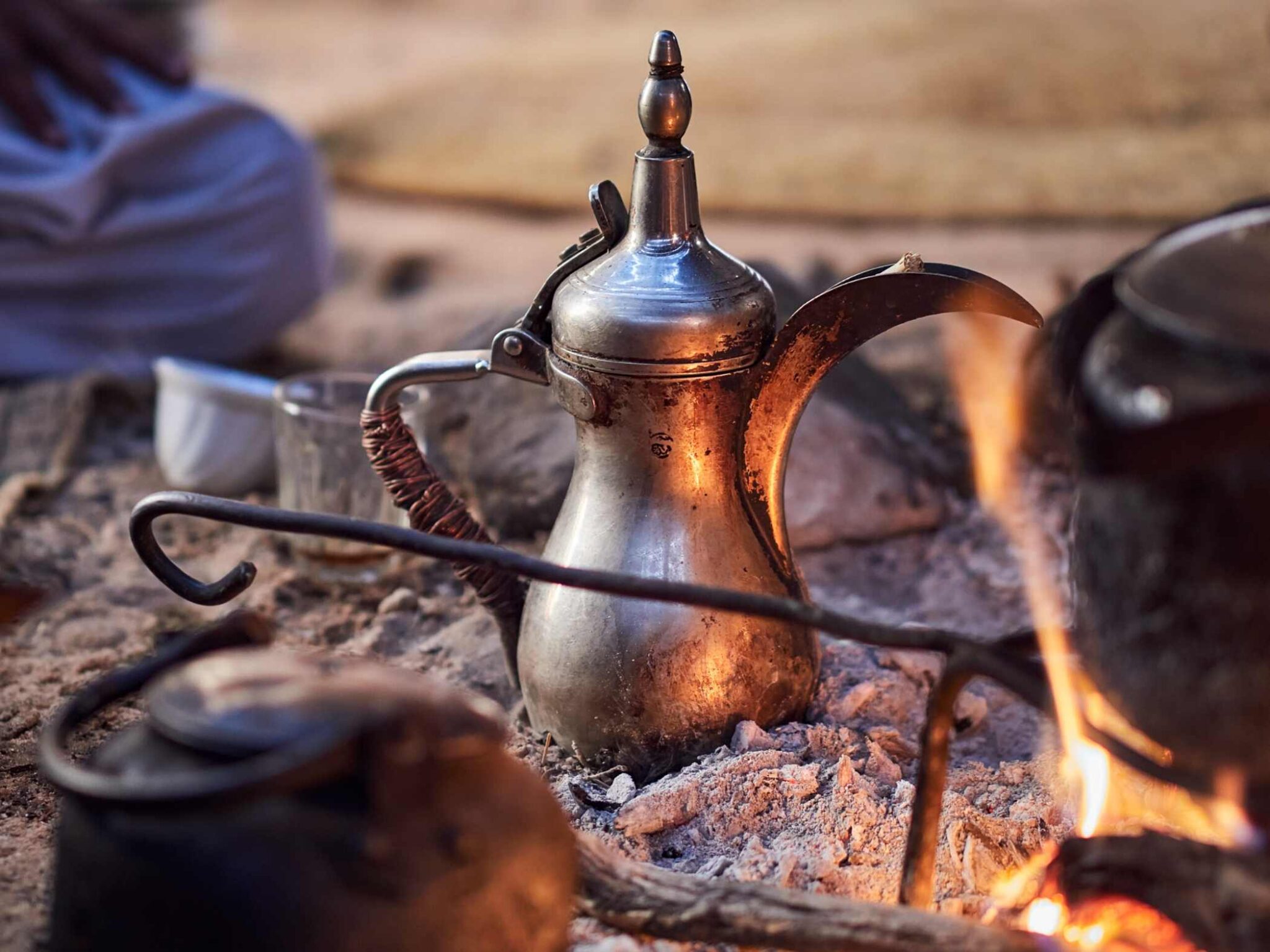
The coffee plant is Ethiopian. The drink is Yemeni. Almost nobody knows the difference.
Everyone knows the goats. Kaldi the Ethiopian goatherd, his animals bouncing around after chewing some red berries, the legend retold so often it has quietly eaten the actual history. The plant really is Ethiopian. It grew wild in the forests of the southwest, and people there chewed the beans, boiled the leaves, made something weak out of it.
But chewing a berry is not coffee. Somebody had to look at the seed inside a fruit, decide to burn it, crush the burnt thing into dust, pour boiling water over the dust, and then drink the black liquid that came out. That is not an obvious sequence of moves. It happened across the water, in Yemen, in the 15th century, and every cup poured since has come out of that decision.
The men who made it were not chefs. They were mystics with a scheduling problem.
Sufi nights ran long. The dhikr went past midnight and into the hours when the body simply quits, and staying conscious through it was a real and recurring defeat. First they brewed the dried husks of the cherry into a thin drink called qishr.
Then someone tried the beans alone, and the result was strong enough to need a name. They called it qahwa, an old Arabic word that had meant wine. The wine that did the opposite of wine. It kept them upright, and it kept them praying. Tradition hands the credit to Ali ibn Omar al-Shadhili of Mocha, remembered ever since as the Monk of Mokha.
How Yemen Turned Coffee Into the World’s First Coffeehouses
A secret this good does not stay inside a monastery.
It walked out into Yemeni towns, and by the middle of the 15th century something new existed on earth: the qahveh khaneh, the first coffeehouses in history. They were never really about coffee. They were rooms where men argued, closed deals, traded gossip, and nursed one cup for three hours. Every cafe that has ever existed is a copy of a copy of those rooms.
Then the pilgrims got hold of it. Yemen sat on the road to Mecca, and every Hajj season brought men from Bukhara, Cairo, Fez and Delhi through the country. They drank the black stuff. They liked the black stuff. They took it home. Sufi travelers carried it into Egypt and Syria, merchants pushed it up the Red Sea, and by the early 1500s Mecca, Cairo and Constantinople all had coffeehouses.
Not everyone was thrilled. In 1511 the governor of Mecca banned coffee, and reading between the lines, the drink was never the problem. The rooms were. Rooms full of men, awake at odd hours, talking. The ban collapsed. The Ottoman sultan overturned it in 1517, and after that an empire drank.
How Mocha Port Held the Coffee Monopoly for Two Centuries
Yemen knew precisely what it had.
For close to two hundred years, every bean consumed anywhere on the planet left through a single Red Sea port called al-Mukha. The world mangled the pronunciation into Mocha and never let go of it. The highlands were terraced for coffee by the 1540s, and for generations those farms were the only commercial coffee on earth.
The monopoly had teeth. No live seed left Yemen. Beans were boiled or parched before export, deliberately killed, so nothing shipped out of Mocha could ever grow into a tree somewhere else. The coffee could be bought. The coffee could not be reproduced.
It leaked anyway. It always does.
Around 1670 a Sufi named Baba Budan came home from Hajj through Mocha with seven live beans hidden in his beard. Seven, because the number is sacred. He planted them in the hills of Mysore, and those hills carry his name today. The Dutch had already smuggled plants out and were shipping them to Java. Seven beans and a beard, and two centuries of control were finished.
Only the name survived. Europeans decided Yemeni beans tasted faintly of chocolate, so mocha now means chocolate, which is a bizarre afterlife for a port town.
How Coffee Reached Venice, London and Vienna
Europe met coffee through the Ottomans and did not trust it one bit.
Venice imported it as a costly novelty by 1615 and opened Italy’s first coffeehouse in 1645. Oxford followed in 1650. Then London, 1652, a shed in St Michael’s Alley run by a servant named Pasqua Rosee who had learned the craft making coffee for his master in Smyrna. Within a year the shed was selling six hundred cups a day.
What happened next in London had nothing to do with caffeine. Merchants, lawyers and speculators colonized those rooms and did business in them. One coffeehouse, run by a man named Edward Lloyd, filled up with shipping men and eventually became Lloyd’s of London. A Sufi devotional aid had turned into the global insurance industry.
Vienna’s cafes come with a siege story from 1683 and abandoned Ottoman coffee sacks, which historians have been dismantling for decades. The cafes are real regardless.
Two billion cups a day now. Nobody thinks about Mocha. Nobody thinks about a handful of Yemeni mystics who just wanted to stay awake long enough to finish praying.