

The self-taught visionary who revived Islamic calligraphy left his mark from Karachi to the UAE.
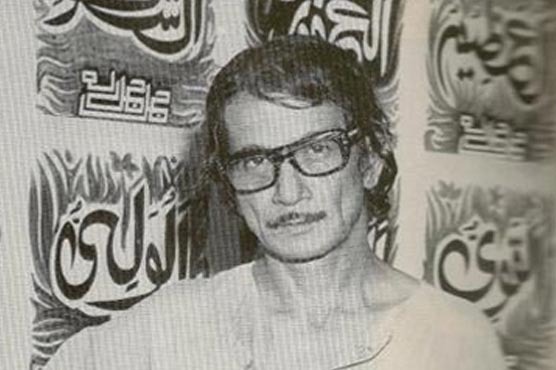
Sadequain is among the most revered artists South Asia has produced, a painter, calligrapher, muralist, and poet whose work reshaped modern art in Pakistan. Born in 1930 and largely self-taught, he elevated Islamic calligraphy from a decorative craft into a celebrated art form and adorned the walls and ceilings of public buildings across three continents with monumental murals. His reach extended to the UAE, where his work found a home in Abu Dhabi, giving the Gulf a lasting connection to one of Pakistan’s most treasured creative figures.
Decades after his passing, his art continues to move audiences across the world. His works are held in collections and shown in galleries far beyond Pakistan, from Paris to the Gulf, and exhibitions such as The Holy Sinner in Dubai have introduced new generations in the UAE to his vision. His legacy endures not in a single show or moment, but in the murals, calligraphy, and paintings he left behind for ordinary people to treasure.
Sadequain’s early life and rise
Sadequain was born on June 30, 1930, in Amroha, in present-day Uttar Pradesh, India, into a distinguished family of Quran calligraphers. His gift revealed itself early. By the age of eleven he was said to have copied an entire geography textbook by hand. In the early 1940s he joined his brother at All India Radio in Delhi, working as a calligrapher-copyist.
After graduating from Agra University in 1948, he migrated to the newly created Pakistan and settled in Karachi. He worked briefly as a college teacher and at Radio Pakistan before committing fully to art. In Karachi he joined the Progressive Writers and Artists Movement, aligning himself with intellectuals who saw art as a vehicle for social conscience, a commitment that would define his career.
His breakthrough came in 1955, when a solo exhibition at the residence of Huseyn Shaheed Suhrawardy, who would become prime minister of Pakistan, earned him wide recognition and his first commissions. Around this time he secluded himself in the seaside town of Gadani, where the resilient desert cacti he observed became a lifelong motif in his work, a symbol of survival, defiance, and human resilience.
Sadequain’s calligraphy and murals
Sadequain’s signature achievement was the revival of Islamic calligraphy. Before his work in the late 1960s, calligraphy held a second-class status in Pakistani art. He elevated it into a modern, expressive medium, developing a style so distinct it became known as Khat-e-Sadequain. As a central figure in the Hurufiyya movement, he freed the Arabic letter from its traditional role, using calligraphic forms to depict cities, forests, and human figures. His paintings of Surah Rahman from the Quran, produced in several series, introduced an entirely new visual language.
He was equally renowned as a muralist, and is credited with introducing mural painting to Pakistan. He produced more than thirty-five monumental murals. The Treasures of Time, painted in 1961 for the State Bank of Pakistan, traced human intellectual history from Socrates to Iqbal and Einstein. The Saga of Labour at the Mangla Dam power house, measuring 180 feet by 23 feet, stands as the largest mural in Pakistan and pays tribute to workers. He also painted the ceiling of the Lahore Museum and the Quest for Knowledge mural at Punjab University.
He created at an astonishing pace, leaving behind more than 15,000 works in his lifetime. He was known for declining to sell his art, often giving pieces away freely to friends, admirers, and institutions. He considered his work a gift of thanks for his blessings and believed art belonged to ordinary people rather than the wealthy.
Sadequain’s legacy in Abu Dhabi
Sadequain’s connection to the UAE runs through his later career. In 1979 he carried out fresco work in Abu Dhabi, and his art at the Abu Dhabi Power House stands alongside his murals in Pakistan, India, and Paris as a testament to his international reach. His work abroad extended from the Champs-Elysees in Paris to institutions across India, the Middle East, Europe, and North America.
His international recognition came early. He won the Laureate award at the Biennale de Paris in 1961, and French critics compared him to Picasso, with the newspaper Le Figaro praising the vastness and truth in his work. At home, Pakistan honored him with some of its highest civilian awards, including the Tamgha-e-Imtiaz, the Pride of Performance, and the Sitara-e-Imtiaz.
Sadequain was a thinker as much as a painter, forever drawn to classical poetry. He created visual interpretations of the verses of Ghalib, Iqbal, and Faiz Ahmed Faiz, and was a poet himself, composing more than a thousand rubaiyat. His final mural, Man and his Universe on the ceiling of Frere Hall in Karachi, remained unfinished at the time of his death on February 10, 1987.
Sadequain never married and lived almost entirely for his art. The letters and forms he painted, he once said, each carried their own personality, as though every character had a soul. That devotion left South Asia and the wider Islamic world a body of work few have matched. From the ceilings of Karachi and Lahore to the walls of Abu Dhabi, his art remains a bridge between Pakistan and the Gulf, and a reminder of a man who gave his genius freely to the world.


