


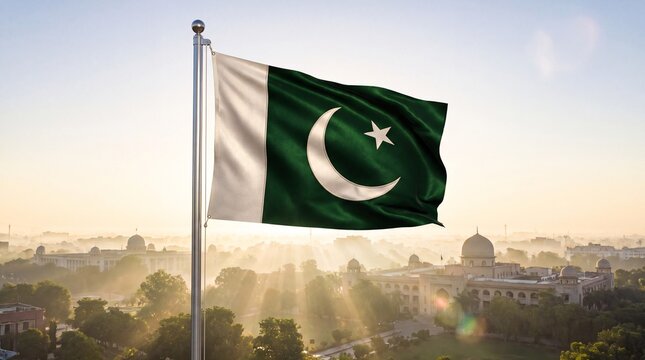
The story of Pakistan’s national flag—officially designated as Parcham-e-Sitara-o-Hilal (the Flag of the Crescent and Star)—is a fascinating study in visual diplomacy, statecraft, and post-colonial identity. As the partition of British India loomed in the summer of 1947, the incoming leadership of Pakistan faced the immediate challenge of creating a distinct national emblem that could unify a diverse population while asserting sovereignty on the global stage. The result was an understated yet deeply symbolic design that transformed a political party banner into an enduring national icon.
From Party Banner to National Standard
The historical roots of the design trace back to the Muslim League’s party flag used during the late 1930s, which consisted of a solid green banner featuring a white crescent and five-pointed star. When the Constituent Assembly convened in Karachi in August 1947, lawyer and activist Syed Amir-uddin Kedwaii introduced a crucial structural alteration. Recognizing that the new state would encompass substantial religious minority populations, Kedwaii modified the Muslim League standard by adding a prominent vertical white stripe along the hoist side. The Constituent Assembly formally adopted this modified design on August 11, 1947, just three days before independence, following a presentation by Prime Minister Liaquat Ali Khan and the explicit endorsement of Pakistan’s founder, Muhammad Ali Jinnah.
Stitching a Nation’s First Flag
The physical crafting of the original prototype carries its own historical significance. Master Afzal Hussain, a skilled tailor from Delhi who had previously sewn banners for the independence movement, was tasked with bringing Kedwaii’s paper blueprint into tangible form. Working under tight deadlines, Hussain hand-stitched the initial flags using silk and cotton fabric, an effort that later earned him the popular moniker Baba-e-Parcham (Father of the Flag) and institutional recognition from the state. Furthermore, the flag stood as an assertive statement of anti-colonial autonomy; historical accounts note that Jinnah reportedly resisted efforts to tie the flag’s design to British Commonwealth conventions, ensuring the flag remained completely free of imperial symbols.
A Design Built on Constitutional Meaning
From an analytical perspective, every proportion and element of the flag was engineered to communicate a constitutional pledge. The dark green field occupying three-fourths of the canvas represents the Muslim majority and the nation’s Islamic heritage, while the vertical white bar occupying the remaining one-fourth signifies non-Muslim citizens, including Christians, Hindus, Sikhs, and Parsis. This intentional balance framed religious minorities not as an afterthought, but as an integral structural pillar of the state. Positioned within the green field, the white crescent symbolizes continuous progress and historic evolution, while the five-pointed star represents knowledge and enlightenment. Together, the banner operates as both a visual contract of pluralism and a forward-looking emblem of nationhood.


