


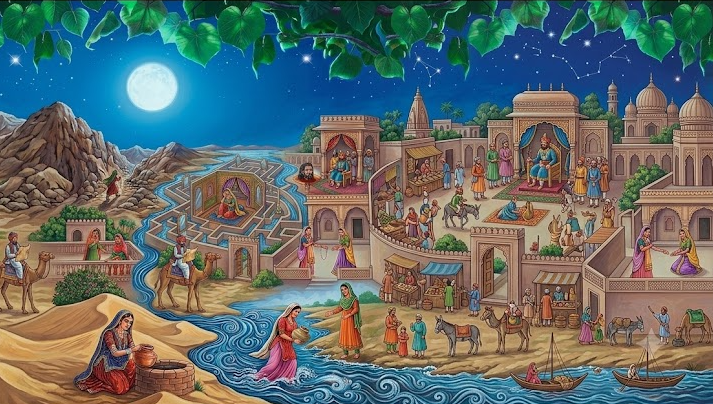
Seven women from Sindhi folktales sit at the centre of Shah Jo Risalo, and their stories are still sung at Bhit Shah every year.
O Lord, let abundance always fall upon Sindh. Beloved, let the whole world flourish.
In two lines, Sufi poet Shah Abdul Latif Bhittai asked for Sindh first, then in the same breath for the whole world. That is the shape of the man, and it is why the province still stops for him.
On 14 Safar, which falls on July 29 this year, Pakistan’s southern province of Sindh observes a public holiday for the annual urs of Shah Abdul Latif Bhittai. For three days the town of Bhit Shah fills with poetry marathons, literary gatherings and the sound of his verses being sung in the ragas he wrote for them. It has been happening, in some form, for almost three hundred years.
What most people outside Sindh do not know is who those verses are about. The Risalo is a Sufi text. It is concerned with the oneness of God, the loss of the self, the ache of a soul separated from what it loves. Bhittai chose to carry all of that through the lives of seven women, and he gave them the standing of queens.
The Poet of Bhit Shah
He was born in 1689 near Hyderabad and died in 1752. He had almost no formal schooling and taught himself, though the Risalo shows he knew Arabic and Persian well. Rumi’s Masnavi was rarely out of his hands.
He is called the greatest poet of the Sindhi language, and he is often credited with being the first to use it as an instrument rather than a tool, the first to make it hold feeling and story. He wrote about the unity of God, love for the Prophet, tolerance, and the worth of ordinary people.
He also built a music that outlived him. The Risalo is arranged into thirty surs, sung as ragas, most often to the damboro. The great statue at Bhit Shah shows him holding one. Faqirs still sing those compositions at his shrine, and the verses telling of the seven women are sung at Sufi shrines across the province.
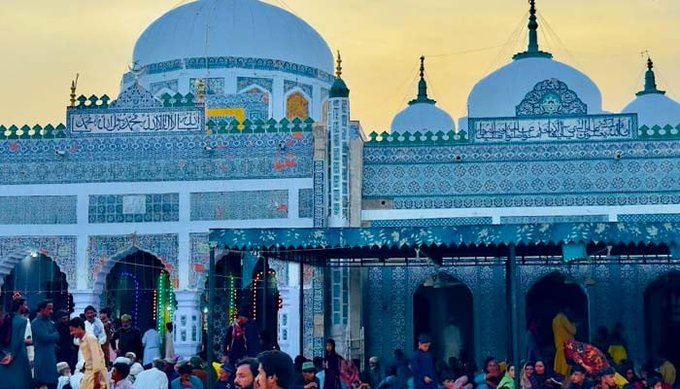
The Shrine of Shah Abdul Latif Bhittai, Bhit Shah, Matiari District, Sindh, Pakistan
The Seven Queens
The tales are older than he is. He did not invent them. He chose them, arranged them, and made each woman’s longing for someone absent stand for the soul’s longing for God. They are known as the Sat Suriyoon, the seven brave women. In his hands the men recede. Very often they barely appear.
Marvi
A desert girl taken from Thar and held at Umarkot by King Umar. He offered her jewels, wealth, the position of queen. She refused all of it and asked only to be returned to her people. Bhittai gives Umar almost nothing. Nearly every line follows what Marvi endures, and what she will not trade away. She is Sindh’s oldest argument that home is not for sale.
Momal
Her story runs between Sindh and Rajasthan and gathers magic, deception and beauty as it goes. She loves Rano, is rejected, waits through a separation that would end most people, and does not give in. She remains among the most loved figures in both Sindhi and Rajasthani literature.
Sassui
Raised in Bhambore, married to the Baloch prince Punhun of Kech Makran. His brothers drugged him on the wedding night and carried him away. She woke to an empty room and walked after him, barefoot, into the desert. Her verses are the ones sung most often, in every Sindhi household. She is the one who kept walking.
Noori
A fisherwoman from Keenjhar Lake who held the attention of King Jam Tamachi, and whom he raised above every other queen he had. The tale is from the fifteenth century and is the most tender of the seven. Her tomb sits in the middle of Keenjhar Lake, and people still go to it.
Sohni
Married against her will, she crossed the river each night on a baked clay pot to reach Mehar, who kept buffaloes on the far bank. One night her sister-in-law swapped the pot for unbaked clay. It softened in the water and she went down in the current. She is the one who chose the river.
Lila
Queen to Raja Chanesar, who ruled at Deval Kot near Thatta. She traded a night with her husband for a necklace, and lost him. The rest of her story is the long work of trying to earn back what she gave away for something that shone. She is the only one of the seven undone by her own hand, and Bhittai does not spare her, but he does not abandon her either.
Sorath
Queen to Rai Diyach of Girnar. A wandering singer asked the king for his head as payment for a song, and the king gave it. Sorath followed him out of this world rather than remain in it without him.
What Sindh Remembers
Put them together and you get almost the full range of what a person can feel. Refusal. Endurance. Devotion. Regret. What they hold in common is that each of them acts. The story turns on what she decides, not on what is decided for her, and that is unusual in any literature, let alone one written in the 1740s.
Scholars have long noted that Bhittai wrote towards the overlooked, and that women held a particular place in that attention. Whether the seven are real or idealised has occupied Sindhi criticism for generations, and it is not a question anyone needs settled. What is beyond argument is what they did. Girls in Sindh grew up on these names. They learned from Marvi that you can stand in front of a king and say no, and from Sassui that you can start walking with nothing.
So the holiday is not only for a poet. It is for seven women who were never queens, and whom he crowned anyway, and whose names are still carried at Bhit Shah on the same ragas he set them to, in a language he taught to sing.
Follow us for more updates and news!


