

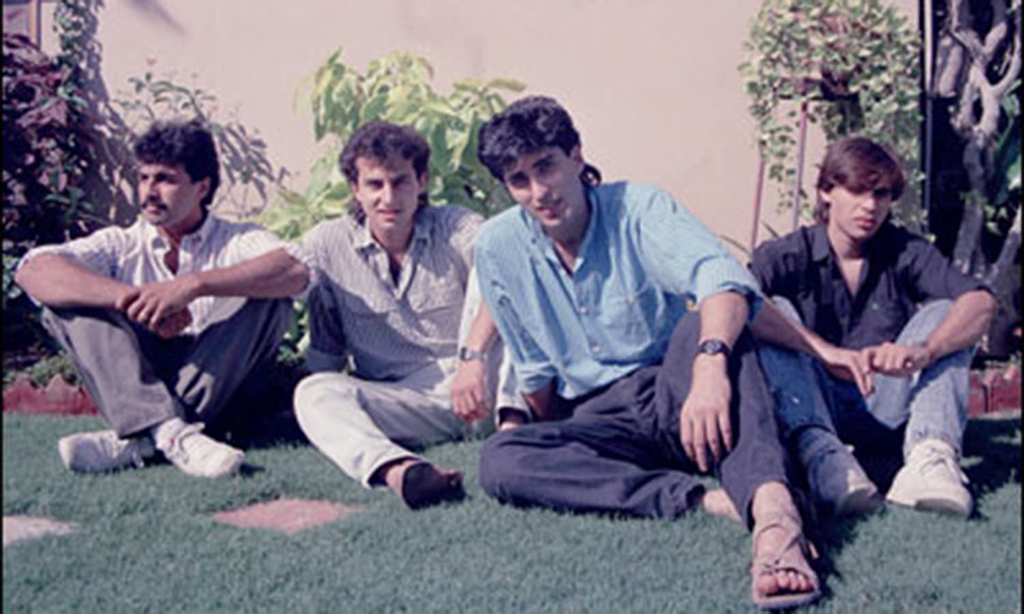
They came, they sang, and they conquered — a line that feels tailor-made for Pakistan’s most iconic pop band, Vital Signs. Decades after they first burst onto the scene, their music continues to resonate across generations. For a band that officially became inactive in 1998, their cultural presence today feels anything but dormant.
Vital Signs was one of the first pop bands to go mainstream; before them, underground bands were popular in the country, but the baton of pop music was in the hands of figures like Alamgir, Mohammad Ali Shyhaki, and the dynamic duo Nazia Hassan and Zoheb Hassan. Before them, it was Ahmed Rushdi who carried the pop music torch alone in the 1960s and 1970s, but he sang mostly for films, a trend followed by Ikhlaq Ahmed and A Nayyar in the 1970s and 1980s.
When Dil Dil Pakistan was released in 1987, the country had only one TV channel, Pakistan Television, which was under the government’s thumb. Pop music was limited to a few singers, and music bands were nonexistent. However, with the arrival of Vital Signs – a peculiarly named pop band – everything changed for the better. Not only did democracy return to Pakistan after 11 years, but the national TV also started promoting young musicians for a change. Through Music 89, which marked the ascent of pop bands in the country, Pakistan suddenly became modern and moved into the 90s as a free country.
However, all this wouldn’t have been possible without the four youngsters who proved themselves to be Vital Signs for the pop music industry in Pakistan. They were Junaid Jamshed, Shehzad Hasan, Nusrat Hussain, and Rohail Hayat, who composed Dil Dil Pakistan and became part of pop culture. By the time the group released their first album, Vital Signs Vol 1, in 1989, Salman Ahmed had replaced Nusrat Hussain, and the four went on to create havoc with their music. Two years after the success of their first album, the band released Vital Signs Vol. 2, and it took them two more years to come up with Aitebaar, which solidified their status as the country’s premier band.
The band’s fourth and final album, Hum Tum, was released in 1995, after which they went on a hiatus, occasionally returning to perform in concerts. However, after the release of their final patriotic number, Maula, the three founding members of Vital Signs – JJ, Shahi, and Rohail – parted ways. While JJ’s career moved in different directions – first he became a successful solo singer and later became an entrepreneur and finally a religious personality – before passing away in a tragic airplane accident in 2016, Shahi and Rohail stayed in the music business. While Shahi was instrumental in launching Rahat Fateh Ali Khan’s Bollywood career through the Mann Ki Lagan song from Paap, Rohail Hyatt is credited with founding the Coke Studio Pakistan, as well as the re-recording of the National Anthem.
One must not forget the band’s members who played an important role in its rise, such as guitarists Nusrat Hussain, Salman Ahmed, Rizwan ul Haq, and Amir Zaki. Even these individuals couldn’t have predicted that the band would become so huge had they been asked about it in its early days. However, thanks to the mentorship of PTV director Shoaib Mansoor, not only did the band become successful, but it has also outlived many of the bands that came after it. Thanks to Dil Dil Pakistan and other patriotic songs that have now become anthems, Vital Signs might stay relevant for a long time. Let’s explore why Vital Signs remains relevant today and what steps helped them carve out a distinct identity in pop culture.
Youth Icons Who Reflected a Generation
The members of Vital Signs represented the very youth they were targeting with their songs. Unlike Alamgir, A Nayyar, Mohammad Ali Shyhaki, and Mujeeb Alam, who were experienced campaigners and in their middle ages, these students-turned-musicians represented freshness. They weren’t classically trained, but they knew what the youth wanted, which was refreshingly different from what their predecessors offered.
Since they all grew up listening to Western music, its influence was evident in most of the Vital Signs’ songs. It wasn’t anything new, considering their predecessors followed the trends during their early days as well, but the generation that was born after Alamgir and Shyhaki made it big wanted something new, which Vital Signs delivered.
Add to that their mannerisms, their way of talking, and their sense of dressing, and the youth got a complete package. It wouldn’t be incorrect to say that by wearing kurtas, band members made the dress a fashion statement, one that went on to help JJ when he turned entrepreneur with his brand J. The relatability factor helped the band gain followers as they came across as boys next door rather than distant stars.
If this relatability made them cultural icons, their music inspired many, and many popular singers and musicians of today credit them for their success. Be it Atif Aslam, Gohar Mumtaz, or Haroon Shahid, everyone rates Vital Signs as one of the biggest influences over their careers.
Ahead of Their Time
Would you believe that long before Fawad Khan, Atif Aslam, and Haroon Shahid turned to acting, it was Vital Signs who kickstarted the trend with Shoaib Mansoor’s Dhundle Raaste. Aired in 1989 on PTV, the telefilm was a brilliant way to introduce the band members to an audience who had no clue who the four good-looking boys were.
And when those dashing debonairs appeared in a path-breaking music show titled Music 89, it not only made them household names but also marked a turning point in Pakistan’s pop culture landscape. It wasn’t just about performing songs — it was about creating a youth-centric media space where music, fashion, and identity intersected.
Four years and three highly successful albums later, they were part of a novel concept: Geetar ’93, a musical journey devised by Shoaib Mansoor to present all their songs. These music videos — casual, energetic, and vibrant — captured a new Pakistan, one that young people could recognize as their own. In many ways, Vital Signs didn’t just perform for the youth; they embodied them.
Long before the digital age reshaped how music was consumed and produced, Vital Signs were experimenting with sounds, themes, and formats that would only become mainstream years later. If their first album seemed targeted at teenagers, their second and third albums featured mature themes, whereas the fourth was their most serious work. In between, they came up with patriotic numbers that we still play on national days like Pakistan Day, Independence Day, and Air Force Day.
Patriotic, But On Their Own Terms
The best thing about Vital Signs was that they didn’t come up with patriotic songs because they had to, but because they wanted to. While all their songs were penned by Shoaib Mansoor, most of their patriotic numbers were either penned by renowned poets Nisar Nasik or Hassan Akbar Kamal. Yes, it wasn’t Shoaib Mansoor who wrote the famous Dil Dil Pakistan, but Nisar Nasik, who became a household name when Junaid Jamshed himself paid tribute to him in one of the many TV appearances they made during the 1990s.
While Dil Dil Pakistan remains their most recognizable patriotic anthem, it was far from their only contribution in that space. Songs like Yehi Zameen reinforced their connection to national identity — but without the heavy-handedness often associated with the current lot of patriotic music. Their patriotism felt organic, not imposed; their love for their country felt real, not fake; and their ability to engage listeners through their patriotic songs touched the heart because it came from the heart.
It was these qualities that made their songs timeless rather than tied to a specific era. For a musical band that started with Dil Dil Pakistan, nothing short of Maula would have felt like a shortcoming. Thankfully, with tracks like Jeetenge (on their final album) and Maula, they left on a high, with a legacy still celebrated after three decades, showcasing a maturity and introspection rarely seen in pop music.
Redefining Pop Music in Pakistan
Pakistan’s music scene changed drastically in the 1990s when new musical bands came up with new and fresh songs, some doing well in the Music Channel Charts and Video Junction – the two popular music shows on TV. However, with Geetar ’93, Vital Signs created their own band and went on to influence folks in both Pakistan and India.
If you take a look at the music video for Woh Kon Thi, you will realize how out-of-this-world the execution was: the unnamed girl wasn’t shown, yet the expressions of all four Vital Signs band members told the story. No wonder the song was blatantly copied in India, where an unknown singer named Jojo tried to cash in on the song’s popularity and failed miserably.
Not only did their experimentation lay the groundwork for future artists to explore genres beyond conventional pop, but it also helped Bollywood, as well, which plagiarized Dil Dil Pakistan as Dil Dil Hindustan; the same thing was done with Sanwali Saloni and Yeh Shaam, which were copied in different films but couldn’t match the original.
Although Alamgir had mixed pop and folk in songs like Main Ne Tumhari Gagar Se, Vital Signs went up a notch and came up with songs led by Goray Rang Ka Zamana, inspired by a folk song but looking fresh and modern at the same time.
Even though Vital Signs borrowed heavily from Led Zeppelin and Phil Collins, their sound remained distinctly Pakistani. That way, they weren’t just making music for their present — they were, in many ways, composing for the future. Listening to these tracks today, one is struck by how contemporary they still feel.
Experimentation Before It Was Trendy
And if you thought Geetar 93 was revolutionary, think again. In an industry that often played it safe, Vital Signs took risks. Even after the band disbanded, Junaid Jamshed was part of the biggest collaboration of pop groups – Tu Hai Kahan – where he represented Vital Signs, as Haroon appeared as an ex-member of Awaz, with Bilal Maqsood and Faisal Kapadia of Strings. The spiritual song could be termed a one last hurrah for Vital Signs, but it reunited Junaid Jamshed with Wasim Akram, the cricket legend, and the frame looked like more than a million dollars!
This willingness to experiment ensured that Vital Signs remained part of modern times. Even though they paid tribute to Nazia Hasan in a concert celebrating her legacy after her death, they never regrouped for another song after this music video.
A Soundtrack to Everyday Life
Perhaps the most compelling reason for their enduring relevance is how deeply embedded their music is in everyday Pakistani life. Vital Signs didn’t limit themselves to albums and concerts; they became part of the cultural fabric. From commercials like Pepsi Pepsi Pakistan to Dil Maange More, they remained popular even when no album was in the works.
Junaid Jamshed’s vocals went on to give memorable tracks such as the EveryDay jingle, where he paired with the ever-youthful Mahnoor Baloch on screen and with Hadiqa Kiani as the co-singer, and Meri Pyari Ammi Jan, which still makes you fall in love despite others trying to recreate the magic.
Before quitting music for religion, Junaid Jamshed also appeared in a Khaleej Times commercial, when Pakistani celebrities weren’t considered international icons. JJ was the first to make it big internationally, opening the door for others to follow.
And then there was the Ufone commercial where JJ teamed up with comedian Faisal Qureshi, launching a journey of classic telecom commercials still remembered today.
The Social Media Revival
In recent years, platforms like YouTube, Instagram, and TikTok have introduced Vital Signs to a new generation. Old videos have found new audiences, and songs that once played on cassette tapes and CDs are now streamed worldwide.
This digital resurgence has not only revived their popularity but also reaffirmed their relevance. In an era dominated by fleeting trends, their music has proven remarkably durable.
More Than Nostalgia
It would be easy to attribute Vital Signs’ continued relevance to nostalgia — but that would be an oversimplification. Nostalgia may bring listeners back, but it is the quality, sincerity, and innovation of their music that keeps them there.
Their songs still speak to universal themes: love, identity, hope, and belonging. These are not bound by time, and neither is the music that expresses them so effectively.
A Legacy That Lives On
Vital Signs were more than just a band; they were a movement. They redefined what Pakistani pop music could be and inspired countless artists to follow in their footsteps.
Today, their legacy can be heard in the work of modern musicians who continue to push boundaries — a testament to the foundation Vital Signs laid decades ago.
So, why are Vital Signs still relevant after so many years? Because they didn’t just create music for their time — they created music that transcended it.