

The largest superconducting magnet ever built for fusion has passed final testing, with China targeting first fusion electricity around 2030.
China has completed and tested the world’s largest superconducting fusion magnet, clearing one of the harder engineering hurdles standing between laboratory physics and a working fusion reactor. The component was developed by the Institute of Plasma Physics under the Chinese Academy of Sciences and has now been formally accepted following full performance testing.
The scale of the thing is difficult to picture. The D-shaped structure measures 21 metres long, 12 metres wide and 3.3 metres high, and weighs 582 tonnes. Researchers say it is the largest fusion reactor superconducting magnet ever built, with 1.3 times the volume and three times the stored energy of the equivalent component made for ITER, the multinational fusion project in France.
Alongside it, engineers tested a high-temperature superconducting central solenoid coil, the part often described as the heart of a fusion reactor and compared in function to the spark plug in a car engine. Every part of both components, from wire to steel, was manufactured domestically.
What the 582-Ton Fusion Magnet Actually Does
Fusion works by forcing hydrogen atoms together at temperatures above 100 million degrees Celsius, releasing energy without producing carbon dioxide. For reference, the core of the Sun sits at roughly 15 million degrees. Nothing solid can hold a substance that hot, which is the central problem the entire field has been trying to solve for seventy years.
The answer is to hold it in a magnetic field instead. The toroidal field magnet generates the confinement that keeps superheated plasma suspended inside the reactor chamber without ever touching the walls. It is the least glamorous component in a tokamak and arguably the most important, because if the confinement fails, nothing else in the machine matters.
Building one at this scale is a manufacturing problem as much as a physics one. Superconducting cable has to be wound with extreme precision, encased in steel, cooled to near absolute zero and then subjected to enormous mechanical stress the moment it is energised. ITER required 35 countries and roughly two decades to get its magnets designed, built and delivered.
China’s Artificial Sun Timeline
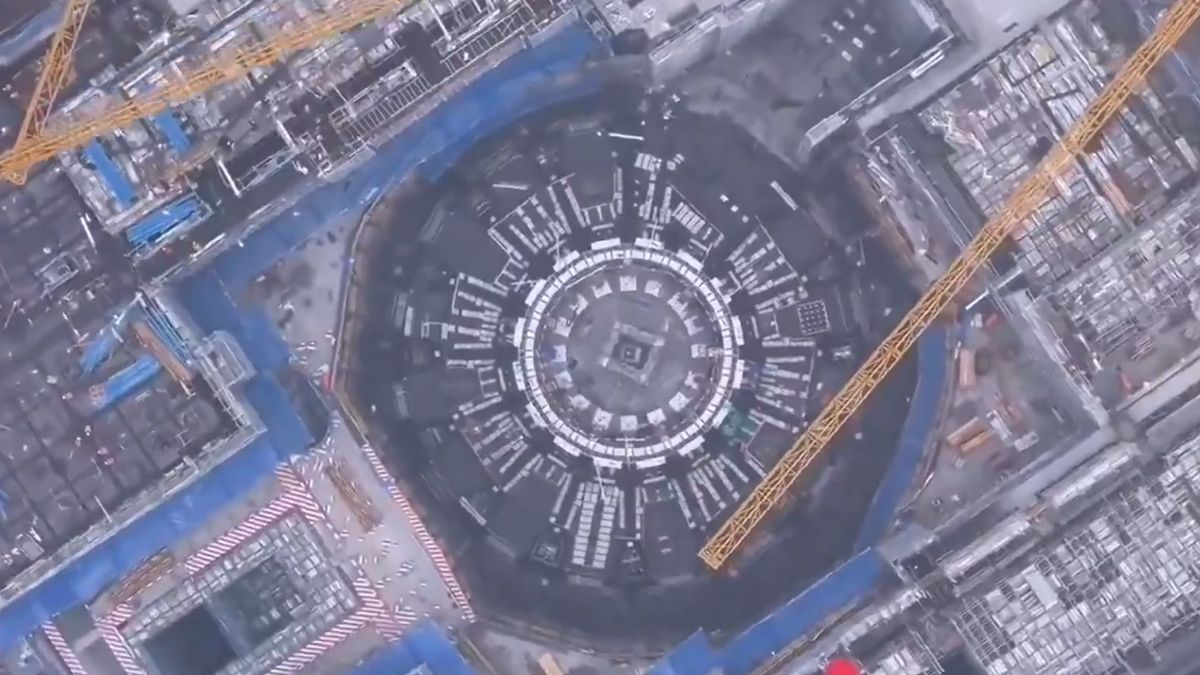
The magnet is destined for BEST, the Burning Plasma Experimental Superconducting Tokamak, a compact fusion device under construction in Hefei, in Anhui province. It sits within a three-step national roadmap.
BEST is scheduled for completion by the end of 2027, with a target of first deuterium plasma that same year. Fusion power generation is targeted for around 2030. If it works, it would represent net fusion energy gain and the first demonstration of electricity produced by fusion, which is the step the field has been chasing since the 1950s.
After BEST comes the China Fusion Engineering Demonstration Reactor, which the country intends to become the world’s first fusion demonstration power station.
Hefei is already the centre of this effort. It hosts EAST, the world’s first fully superconducting tokamak, running since 2006 and nicknamed the artificial sun. In January 2025 that machine sustained plasma for 1,066 seconds, just under eighteen minutes, at temperatures above 100 million degrees.
Why Fusion Energy Matters and What Still Stands in the Way
The appeal of fusion is that its fuel can be drawn from seawater. It produces no carbon dioxide at the point of generation. And unlike fission, it carries no risk of a runaway chain reaction, because if the plasma cools the reaction simply stops on its own. For grids already straining under electrified transport and the power demands of data centres, a dense, clean, always-on source of electricity would change the arithmetic considerably.
The caveats are equally straightforward, and the researchers involved have not hidden them. One prototype coil passing acceptance testing is not a finished reactor. A full tokamak of this design needs sixteen such coils, meaning fifteen more must still be wound, cased and tested. A magnet on its own produces exactly zero watts of fusion power.
Beyond that sit the problems nobody has fully solved anywhere. Materials have to survive sustained neutron bombardment. Cooling systems and remote maintenance have to work reliably. Tritium fuel has to be produced at scale. And eventually the whole thing has to cost less than the alternatives.
Follow us for more updates and news!