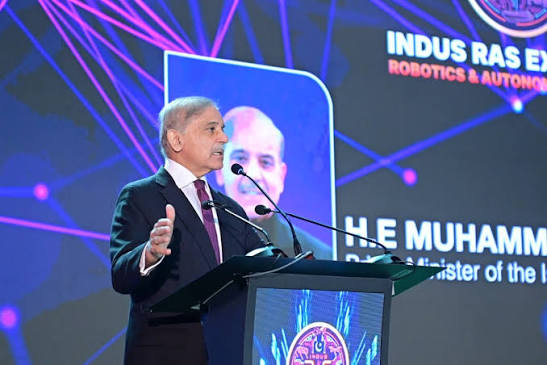
Prime Minister Shehbaz Sharif and Field Marshal Syed Asim Munir, Pakistan’s army chief and chief of defence forces, toured the floor of the Indus Robotics and Autonomous Systems (RAS) Expo 2026 this week at the Pak-China Friendship Centre in Islamabad. The two-day event, held July 22-23 and organized by Ignite under the IT ministry alongside NCRA and NUST’s College of E&ME, brought together defense contractors, universities, and start-ups to showcase Pakistan’s push into indigenous drones, robotics, and autonomous systems.
Footage of the two leaders’ walkthrough showed several specific systems on the floor. Among them was the Super Mushshak, a Pakistani-built trainer aircraft that has been in service since 2001 with Pakistan, Saudi Arabia, and several other air forces, and which can also be armed with laser-guided missiles and rockets for light-attack and counterinsurgency roles. Also spotted was the Blaze 400, a newer addition to Pakistan’s homegrown loitering-munition family, developed by state-owned Global Industrial Defense Solutions (GIDS); details on the system remain limited.
🇵🇰 Pakistan's top brass, Prime Minister Shehbaz Sharif and Army Chief General Syed Asim Munir, were front and center at the expo in Islamabad, personally inspecting the latest hardware. So what exactly caught their eye? Sputnik combed through the footage, and here's what we… pic.twitter.com/Yp904yxR1k
— Sputnik (@SputnikInt) July 24, 2026
On the naval side, the delegation examined the Muhassir, a 10-meter unmanned surface vessel that can hit speeds of up to 40 knots, patrol beyond 400 nautical miles, and carry cameras along with a remote-controlled weapon station for surveillance and defense. Alongside it was the ISRAR, an autonomous underwater vehicle first unveiled in 2025 that marks one of Pakistan’s earliest moves into unmanned subsurface systems. Rounding out the line-up was the Shahpar family of combat drones: the original Shahpar has a roughly 250-km range and seven-hour endurance, while the newer Shahpar-II can stay airborne for up to 20 hours and carry weapons.
Speaking at the inauguration, Sharif said more than 60% of Pakistan’s drones are now manufactured domestically and that every simulator on display had been built in-country. He announced a $20 million Pakistan Venture Fund and a “Spark and Elevate” program aimed at turning local research into commercial products, and pointed to the country’s use of autonomous systems during last year’s conflict with India as evidence the technology has moved from prototype to operational use.
“Pakistan will not be a nation that merely inherits the choices made by others,” Sharif told the crowd. “We will shape our own destiny through innovation, enterprise, self-reliance and untiring efforts.”
Beyond the military hardware, the expo also featured a lighter side — a RoboWars combat-robot tournament, an Innovation Challenge, brain-controlled robotics from university spin-offs, and agritech tools for crop monitoring and irrigation. Organizers framed the event as evidence of a maturing defense-industrial base, though whether the funding and enthusiasm translate into exportable, combat-proven systems beyond the show floor remains to be seen.
The expo comes as Pakistan’s defense sector has increasingly promoted its exports abroad, with GIDS also displaying Shahpar and Blaze-series systems at international shows in Cairo and Riyadh earlier this year, and the navy unveiling several of its unmanned surface and underwater platforms at the Pakistan International Maritime Exhibition and Conference in 2025.