

The Meaning Behind the Title
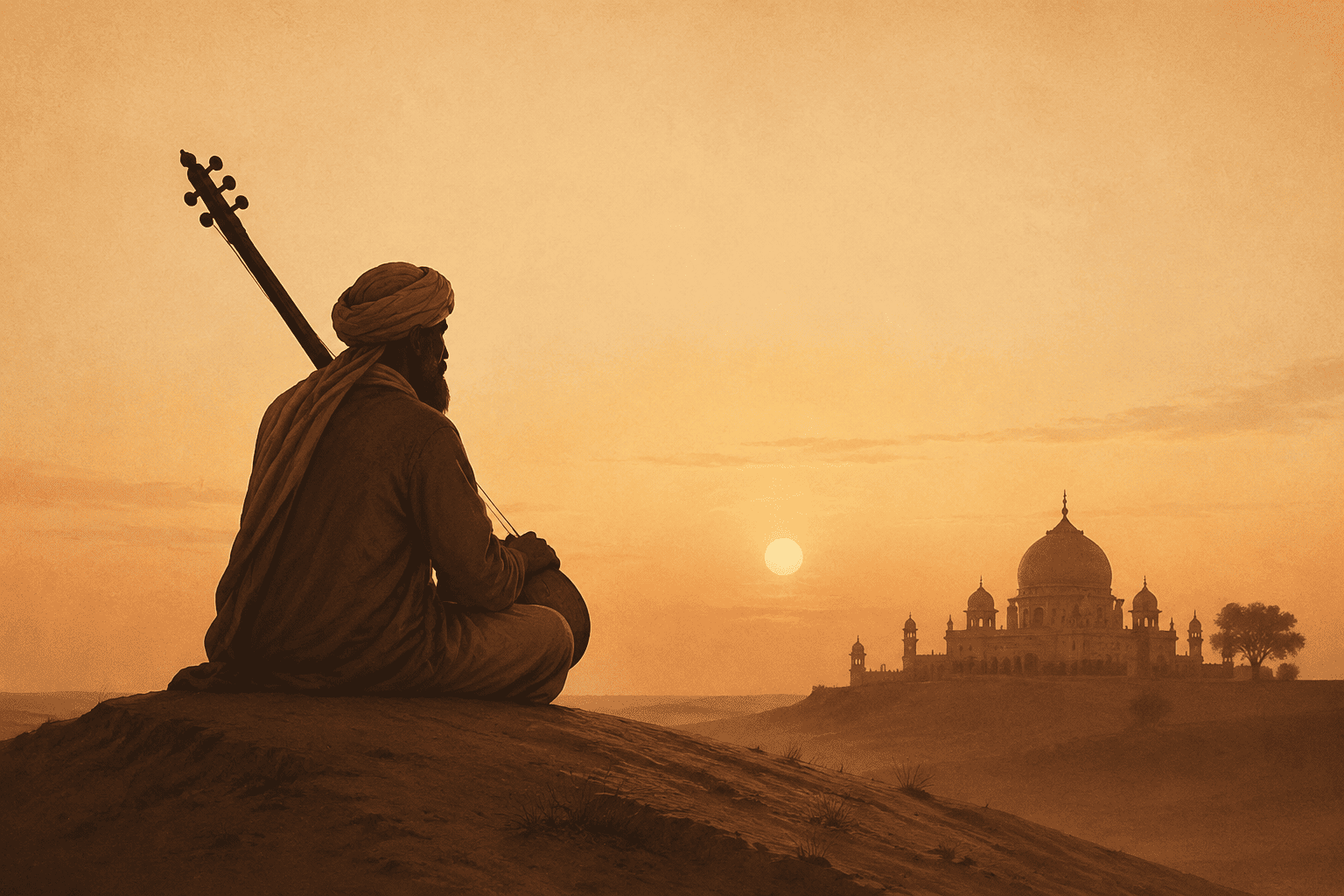
In Sindhi, “Bhit Ja Bhittai” literally means “the one of the sand mound” — a tribute to Shah Abdul Latif, the 18th-century Sufi mystic whose life became inseparable from the dune he chose as his home. Bhit refers to a raised mound of sand, and Bhittai means “belonging to the mound.” The saint earned this title not through birth or lineage, but through a deliberate act of renunciation: he walked away from a comfortable, aristocratic life to sit, meditate, and compose poetry atop a windswept dune in Sindh, now known reverently as Bhit Shah.
The Song Itself: An Ancient Folk Tradition
“Bhit Ja Bhittai” is not a modern composition — it is an old Sindhi devotional folk song, part of an oral tradition of shrine music that has been sung, reshaped, and passed down by generations of folk singers for a very long time, likely stretching back close to the saint’s own era. Like much of Sindh’s devotional folk repertoire, it has no single “composer” in the conventional sense; it grew and evolved through oral transmission at shrines and gatherings, carried forward by countless anonymous singers long before it was ever recorded or commercialized. Much of that transmission has historically happened to the accompaniment of the tambora — a stringed instrument that Latif himself is widely credited, in Sindhi tradition, with inventing or popularizing, and which is still played today at his shrine to accompany the singing of his verses.
At its heart, the song is an act of praise and remembrance. Its lyrics don’t tell a linear story so much as circle around a handful of devotional images and refrains — invoking the sand dune of Bhit Shah as a sacred place and addressing the saint directly with titles of reverence. The lyrics paint the devotee as utterly dependent on the saint — a beggar at his threshold, a shadow following him, a lamp kept burning through the night in his name. Recurring images of mercy falling like rain, robes clung to in hope, and dust gathered beneath his footsteps reinforce this posture of surrender. The song closes on a plea for guidance through darkness, asking the saint’s presence to serve as a steady lamp home — a fitting echo of Latif’s own life spent seeking clarity on a barren dune. The recurring address to “Bhittai” throughout functions almost like a chant or invocation, common in Sufi devotional music (kafi and shrine-qawwali traditions), meant to draw the listener into a meditative, trance-like state rather than simply narrate a story. This is part of why the song has endured so naturally across centuries and singers: its emotional core — reverence for a man who found the sacred in an empty dune — feels timeless rather than tied to any particular era or performer.
By the time it reached recorded media, the song was already a well-established staple of Sindhi Sufi and folk music. It has been performed and recorded by respected traditional artists such as Jalal Chandio, Mai Bhagi, and Suhrab Faqir, among others — singers known for keeping this shrine-music tradition alive in its raw, devotional form: simple instrumentation, repetitive melodic phrases, and lyrics that circle back again and again to the saint’s wisdom and devotion.
Centuries into its life, the song found an unexpected new audience. Pakistani artist Shani Arshad reworked this old folk piece into a modern rendition, describing it as not merely folk music but sacred verse (Qalam). His version first reached the public in an unusual way — as a short 40-second jingle in a Telenor advertisement — before he later released a full-length version of the song.
But this was simply one more chapter in the song’s long life, not its beginning. The episode says something interesting about Sindhi culture: sacred, centuries-old art rarely stays confined to shrines — it keeps resurfacing, generation after generation, in new forms, including advertising and popular media. It’s a fitting continuation of a tradition that, even at its annual peak — the Urs (death anniversary commemoration) at Bhit Shah, one of Sindh’s largest cultural gatherings — has never really stopped evolving, drawing singers, poets, and pilgrims who keep verses and songs like this one alive.
Who Was Shah Abdul Latif Bhittai?
Shah Abdul Latif Bhittai lived from around 1689 or 1690 to 21 December 1752, and is widely regarded as the greatest poet the Sindhi language has ever produced. He was born into a Sayyid family with roots tracing back to Herat, in the town of Kotri Mughal near modern-day Hala.
His life took a dramatic turn in his twenties. Around the age of 20, he left home altogether and spent years wandering across Sindh and neighboring regions, encountering various mystics and wandering ascetics known as Jogis — encounters that left a deep imprint on his poetry. Notably, he had no formal religious schooling; the philosophically dense mystical wisdom that fills his verses came largely from this lived experience, from travel, and from long contemplation on the dune itself, rather than from any classroom or seminary. When he eventually returned home, he married into an aristocratic family but was widowed not long after, and chose never to remarry. His deepening spirituality drew a devoted following, though it also stirred resentment among a few. He spent his final years at Bhit, where he died in 1752, and a mausoleum was later constructed over his grave — a site that remains one of Sindh’s most important pilgrimage destinations to this day.
In the 20th century, Sindhi nationalist thinkers such as G.M. Syed pointed to Latif’s rejection of privilege and his solidarity with the poor as evidence that he was, in spirit, one of Sindh’s earliest voices of collective identity — a reading that remains a subject of scholarly debate, but one that shows how alive his legacy still is in Sindh’s political and cultural imagination.
His Enduring Legacy: The Shah Jo Risalo
Bhittai’s poetry was gathered by his followers into a collection known as the Shah Jo Risalo, first published in 1866, and it has since been translated into Urdu, English, and other languages. The Risalo isn’t a single narrative — it’s structured into “Surs” (musical chapters), many of which reimagine Sindhi folk stories through a mystical lens. Among the most celebrated of these is the theme of the “Seven Queens” — legendary heroines of Sindhi folklore whose courage, sacrifice, and love became enduring symbols of the Sindhi spirit. One of the most haunting is the tale of Moomal, a Rajput beauty who set herself aflame to win back her lover — an episode still performed by folk singers today, much like “Bhit Ja Bhittai” itself.
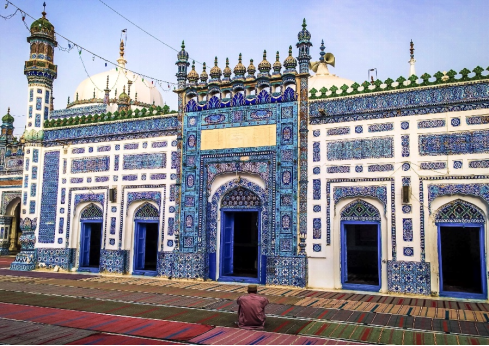
-Shrine of Shah Abdul latif Bhittai
Nearly 275 years after his death, the dune he once sat upon in solitude has become a place of pilgrimage, music, and memory — proof that a single life, and the folk songs written in its honor, can outlast empires.