

Pakistan’s Sialkot has produced Trionda, the official match ball for the FIFA World Cup 2026.
A football made in Sialkot is about to roll across the biggest stage in sport.
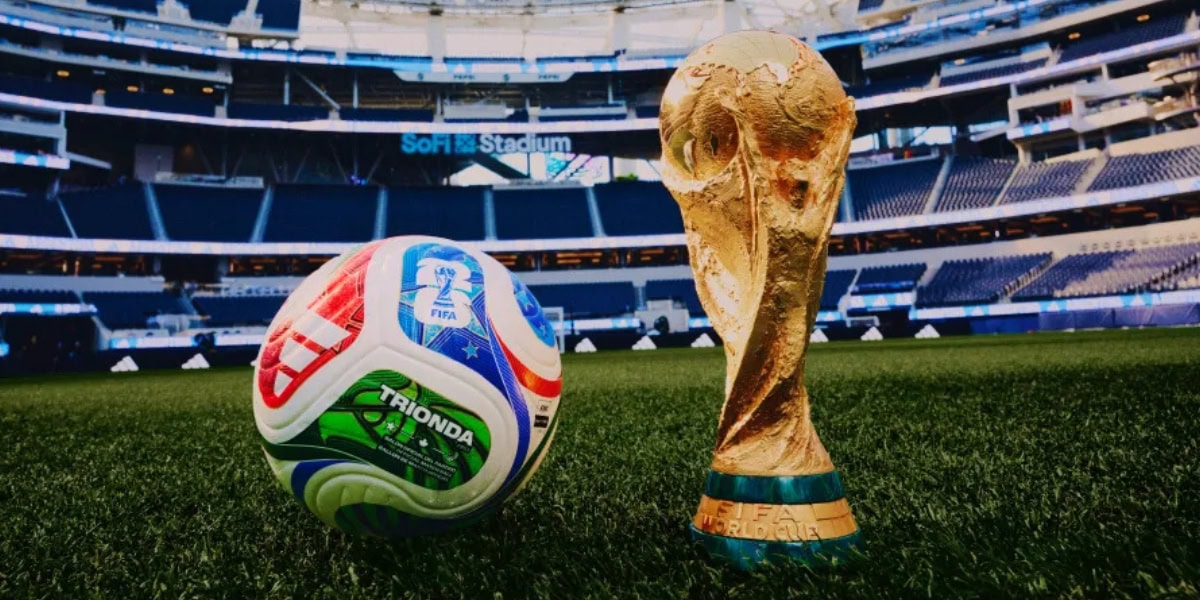
Adidas and FIFA unveiled Trionda, the official match ball for the FIFA World Cup 2026, on October 2, 2025. The ball has been manufactured by Forward Sports, a company based in Sialkot, Pakistan. The tournament will be jointly hosted by the United States, Canada, and Mexico, with the opening match on June 11, 2026 at the Estadio Azteca in Mexico City.
This is the fourth FIFA World Cup ball in a row produced in Sialkot. Forward Sports manufactured Brazuca for the 2014 World Cup in Brazil, Telstar 18 for the 2018 tournament in Russia, and Al Rihla for the 2022 edition in Qatar. The partnership between Forward Sports and Adidas now stretches back more than two decades.
Sialkot Sports Industry History and Global Reach
Sialkot’s sports goods journey began back in 1883 under British colonial rule. Local craftsmen started by repairing footballs for British soldiers, then began producing cricket bats, hockey sticks, and polo sticks. By 1918, the city was shipping footballs to British Army units stationed in Singapore.
The city’s breakout global moment came in 1982. Sialkot-based Sandal Sports, later known as Saga Sports, produced the Tango España football for the FIFA World Cup in Spain. That moment cemented Sialkot’s reputation as a serious player in international sports manufacturing. Every official Adidas World Cup ball since then has been made in the city.
Today, Sialkot factories produce around 60 million footballs a year, covering close to 70 percent of global demand for hand-stitched inflatable balls, according to the Government of Punjab. The city’s sports goods cluster manufactures over 43 million balls annually in non-World Cup years and exports goods worth roughly US$2 billion every year across all categories.
The city’s reach goes well beyond football. Awan Sports, based in Sialkot, produces about 90 percent of the hockey sticks used by professional athletes worldwide, according to company director Jarrar Awan. Sialkot-made cricket gear, boxing gloves, rugby balls, and equestrian equipment have been used at the Olympics, the Cricket World Cup, and almost every major international tournament. MB Malik Sports, also based in the city, has supplied cricket bats to Pakistani legends including Shahid Afridi and Azhar Ali. CA Sports, founded in 1958, has long sponsored international cricketers and supplies players across Asia, Europe, and the Middle East.
Forward Sports Trionda Production and Sialkot Workforce
Forward Sports owner Khawaja Masood told Samaa TV that the Trionda has been built using advanced robotic quality control systems. The aim was consistency, durability, and aerodynamic performance that meets FIFA’s strict standards. “Our labour is skilled, technical, and highly capable,” Masood said. “This project not only showcases Pakistan’s talent but also promotes our sports industry globally.”
According to the Government of Punjab, more than 200,000 people are directly employed in Sialkot’s sports goods sector across roughly 2,400 companies. The industry contributes over 6 percent of Pakistan’s total exports.
Trionda Ball Design and Connected Ball Technology
The name Trionda combines “Tri,” meaning three, with “Onda,” the Spanish word for wave. The design pays tribute to the three host nations.
The ball is built from just four thermally bonded polyurethane panels. According to Adidas, this is the smallest number of panels ever used on a FIFA World Cup match ball. Each panel carries one of the three host country colours, red for Canada, blue for the United States, and green for Mexico. Country icons are featured across the design, a maple leaf for Canada, a star for the United States, and an eagle for Mexico. Gold detailing on the surface is a reference to the FIFA World Cup trophy.
The four-panel construction has intentionally deep seams and debossed lines. Adidas says this produces optimal in-flight stability and gives players elevated grip in wet or humid conditions. The ball was tested in seven of the 16 host cities to make sure it performs the same across different climates and altitudes.
Trionda also carries the latest version of Adidas Connected Ball Technology. A 500Hz inertial measurement unit motion sensor chip is mounted inside one of the four panels rather than the centre. The chip sends real-time movement data to the Video Assistant Referee system, which is then combined with player position data and artificial intelligence to help referees make faster offside calls.
Sam Handy, General Manager at Adidas Football, called Trionda “the most visually playful FIFA World Cup ball we’ve ever created.”
Pakistan’s footprint at the 2026 tournament goes beyond the trophy. The 48-team format expands the World Cup to 104 matches across 16 host cities. Every goal, save, and penalty will be played with a ball stitched, tested, and packed in Sialkot.
The first ball will be kicked off at Estadio Azteca on June 11, 2026.