

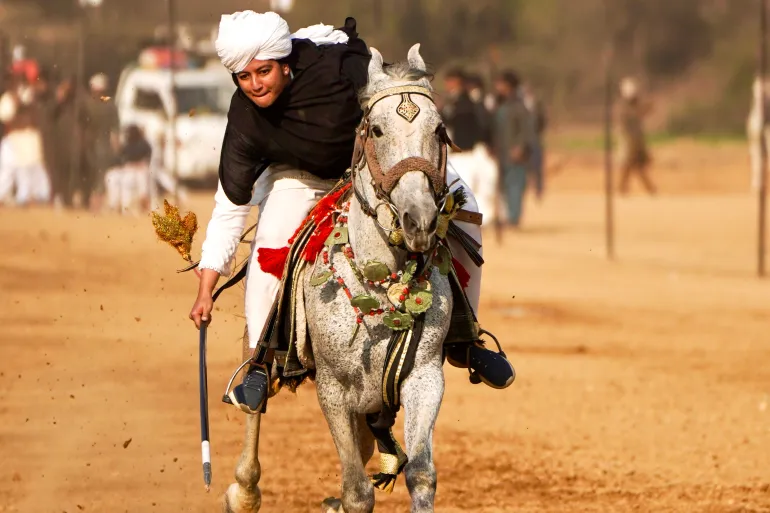
The thunder of hooves tearing through the dry, windswept earth near Pakistan’s capital is a sound deeply intertwined with South Asian heritage. This is the arena of neza baazi, or tent pegging; an ancient, high-stakes equestrian sport where riders gallop at breakneck speeds, lowering a 1.8-meter lance to pierce and carry away a small wooden target buried in the dirt. For centuries, this adrenaline-fueled spectacle has been an aggressively guarded domain of male authority, feudal pride, and traditional turbans. Yet, above the roar of thousands of male spectators, a new sound is emerging: the defiant gallop of female horse riders claiming the arena for themselves.
Far from merely participating, these trailblazing athletes are riding directly into the heart of a patriarchal stronghold, demanding equal respect with every peg they claim.
Anum Shakoor and the Birth of Bint-e-Zahra
At the forefront of this equestrian revolution is Anum Shakoor. A 30-year-old manager for a global microfinance network by day, Shakoor transforms into a fierce competitor on the field, charging down the tracks wrapped in a billowing black shawl, her eyes locked onto the target.
For years, female tent peggers in Pakistan faced an isolating structural barrier: they only ever trained or competed within mixed-gender, male-dominated clubs. Recognizing this deep systemic gap, Shakoor took matters into her own hands. Guided by a frustrating realization that women lacked a dedicated space to build solidarity and thrive, she founded the Bint-e-Zahra Club – Pakistan’s very first all-female tent pegging club.
Named to evoke strength and dignity, Bint-e-Zahra was established to give women a dedicated stage for rigorous training, community building, and mutual protection. Operating just outside the capital city of Islamabad, the club has quickly become a sanctuary for diverse generations of female riders. Its roster includes 16-year-old prodigies like Eshal Ibrahim and Noor un Nisa Malik, alongside Sehrish Awan, a 32-year-old mother of two who discovered the club on Instagram and decided to pick up a lance for the first time.
Triumphs Amidst the Dust
Shakoor’s vision proved its mettle at a recent major mela (a massive cultural festival and sporting tournament) in northern Pakistan, featuring 74 competing teams. Amidst a literal sea of thousands of men, Bint-e-Zahra stood out as a historic anomaly. While the crowd and vloggers rushed to film them with a mix of awe and skepticism, the riders focused entirely on the sport. Shakoor’s competitive grit was vividly demonstrated during a high-stakes regional tournament in the rural outskirts of the Punjab province, where she fought her way into the final seven of the highly competitive team captains’ rounds; the only woman to do so.
Her success is built on profound personal and financial sacrifice. In a sport deeply tied to class and wealth. Where a horse costs around $1,500 and monthly upkeep easily doubles the local minimum wage. Shakoor saved from her salary to purchase her own horse. “You can’t put a price on passion,” she reflects, admitting she routinely prioritizes her horse’s health and well-being over her own.
A Catalyst for International Vision
While Shakoor’s competitive trophies are currently rooted in these hard-fought national and regional victories, her true triumph has reached a global scale. Her pioneering work has captured the attention of international media forums, placing Pakistan’s changing gender dynamics under a global lens.
By building a self-sustaining ecosystem of female riders, the Bint-e-Zahra club is laying the essential groundwork required to eventually field a Pakistani women’s team for global stages overseen by the International Tent Pegging Federation (ITPF). Shakoor’s focus remains on institutional progress—proving that local roots are required to grow international contenders.
Riding Beyond the Backlash
The path for Bint-e-Zahra is paved with steep social hurdles. Shakoor regularly navigates intense familial pressure to conform to traditional domestic roles, facing worries from relatives about how a “manly sport” might impact her marriage prospects. Furthermore, the club’s digital visibility has brought both immense popularity and fierce patriarchal pushback. While slow-motion videos of the women plucking pegs mid-gallop garner millions of views on TikTok and Instagram, they also draw vitriol from veteran male riders who accuse them of “polluting the sport”, particularly when the women wear traditional riding turbans, long viewed as symbols of male social status.
Yet, Shakoor and her academy refuse to yield. Backed by forward-thinking mentors and an unshakeable sense of purpose, Bint-e-Zahra is proving that courage recognizes no gender. They are not riding to prove they are superior to men; they are riding to ensure that the next generation of Pakistani girls can look at a wide-open field and know they have every right to gallop toward glory.