

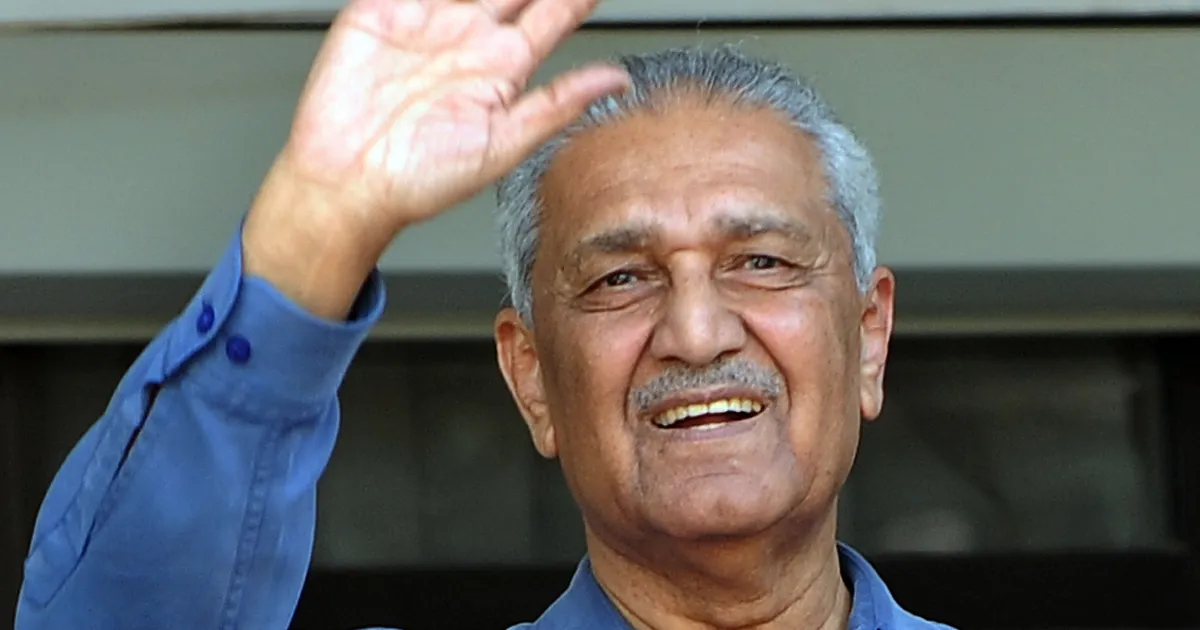
The history of Pakistan’s transformation into a nuclear power is a masterclass in strategic survival. At the absolute centre of this transformation was Dr. Abdul Qadeer Khan, a visionary scientist who reshaped the geopolitical landscape of South Asia. By pivoting the national defense strategy toward uranium enrichment, he successfully built a shield of credible deterrence that continues to define regional stability.
According to Feroz Hassan Khan’s authoritative account in Eating Grass: The Making of the Pakistani Bomb, Pakistan’s program succeeded because of a unique combination of extreme scientific willpower and highly adaptive statecraft.
The Making of a Mastermind
Born in Bhopal in 1936, Dr. Khan migrated to Pakistan following the partition of the subcontinent. Driven by a sharp academic focus on metallurgy, he travelled across Europe to pursue high-level materials engineering. He attended the Technical University of Berlin, earned a master’s degree from Delft University of Technology in the Netherlands, and ultimately completed a PhD in metallurgical engineering from the Catholic University of Leuven in Belgium in 1972.
As documented in historical archives from The Nuclear Weapon Archive, his specialized expertise in uranium metallurgy led him to a position at the Physical Dynamics Research Laboratory (FDO) in Amsterdam. FDO was a key subcontractor for the British-German-Dutch enrichment consortium URENCO. It was here that Dr. Khan mastered the intricate physics of ultra-high-speed gas centrifuges and uranium enrichment.
The Catalyst: A Shift in Nuclear Paths
In May 1974, India conducted its first nuclear test, code-named “Smiling Buddha.” In response, Prime Minister Zulfikar Ali Bhutto famously vowed that Pakistan would develop its own deterrent, even if the nation had to “eat grass” to do it. At the time, the Pakistan Atomic Energy Commission (PAEC) was pursuing a slow, heavily monitored plutonium-239 path via heavy-water reactors.
Watching from Holland, Dr. Khan knew this approach would take too long for Pakistan’s urgent security needs. He wrote directly to Prime Minister Bhutto, volunteering his expertise and offering a mathematically backed alternative: focus on Uranium-235 enrichment via gas centrifuges. Remarkably, his first letter went unanswered by officials who initially dismissed his proposal. Undeterred, he wrote a second time. This second letter changed history; upon reading it, Bhutto famously remarked to his advisors, “The man makes sense.” In December 1975, Dr. Khan made the ultimate sacrifice, leaving his comfortable career and family behind in Holland to return permanently to serve Pakistan.
Project-706 and the Kahuta Breakthrough
Recognizing that traditional bureaucracy would derail national security, Bhutto granted Dr. Khan absolute autonomy in July 1976. The uranium project was split away from PAEC to form the Engineering Research Laboratories (ERL) in Kahuta. On May 1, 1981, President Zia-ul-Haq officially renamed the facility the Dr. A.Q. Khan Research Laboratories (KRL).
Under the codename Project-706, Dr. Khan worked under a cloud of constant hostility. The world worked relentlessly against him—his team was systematically surveilled, sanctioned, and targeted for diplomatic sabotage at every step.
To bypass these strict global supply embargoes, Dr. Khan designed an ingenious, decentralized procurement network. Instead of trying to buy restricted nuclear components, KRL purchased unregulated industrial sub-systems. On Pakistani soil, his team masterfully re-engineered and assembled these pieces into centrifuge cascades. By building specialized centrifuges that spun uranium gas at a dizzying 100,000 rpm, Dr. Khan’s team successfully mastered the extreme engineering needed to separate atoms by weight and secure weapons-grade purity.
Chagai-I and the Modern Shield
The ultimate validation of Dr. Khan’s life work came on May 28, 1998, at 3:16 PM. In direct response to a fresh round of regional nuclear tests, Pakistan detonated five simultaneous underground nuclear devices at the Ras Koh Hills in Chagai, Balochistan. Powered entirely by KRL’s weapons-grade uranium cores, the blasts turned the mountain stark white and instantly thrust Pakistan into the global nuclear club.
Dr. Khan didn’t just build a bomb; he altered the geostrategic relevance of Pakistan forever. According to tracking data compiled in the SIPRI Yearbook, Pakistan stands today as a mature nuclear power with an estimated arsenal of approximately 170 strategic warheads. Managed under the strict oversight of the National Command Authority (NCA) and the Strategic Plans Division (SPD), this foundation has evolved into a sophisticated Full Spectrum Deterrence (FSD) framework. Relying on a robust land, air, and sea nuclear triad, the indigenous technology stack pioneered by Dr. Khan remains the ultimate defensive umbrella, permanently guaranteeing strategic balance and preserving regional peace.