Islamabad steer Washington and Tehran to encouraging progress after a turbulent session at Lake Lucerne.
The United States and Iran wrapped their first high-level session under the Islamabad Memorandum of Understanding early Monday at the Burgenstock resort overlooking Lake Lucerne, with Pakistan and Qatar reporting encouraging progress as co-mediators. The outcome capped a weekend of intensive diplomacy that placed Islamabad squarely at the center of one of the year’s most consequential negotiations.
Prime Minister Shehbaz Sharif and Army Chief Field Marshal Asim Munir led a high-level Pakistani delegation to Switzerland on Sunday. The Pakistan Foreign Ministry confirmed the technical-level talks followed the signing of the Islamabad Memorandum of Understanding, and said Islamabad would keep facilitating the process as a mediator.
The session brought US Vice President JD Vance, Special Envoy Steve Witkoff and presidential adviser Jared Kushner to the table opposite an Iranian team led by parliamentary speaker Mohammad Bagher Ghalibaf and Foreign Minister Abbas Araghchi.
Pakistan Mediation Role at the Lake Lucerne Summit
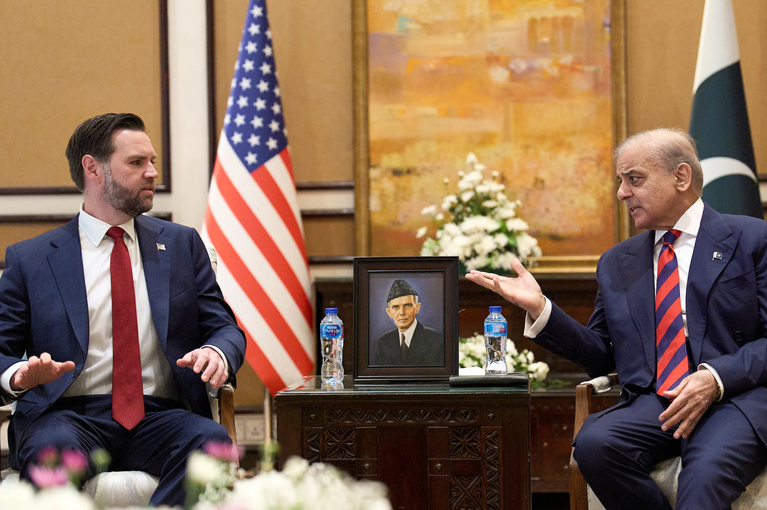
The American team met the Pakistani delegation before the wider quadrilateral session opened, exchanging handshakes with Sharif and Munir at the alpine resort. Sharif later spoke alongside Vance and Qatar’s Prime Minister Sheikh Mohammed bin Abdulrahman bin Jassim Al Thani during the meeting.
The path was not smooth. Iranian negotiators paused their participation Sunday night after President Donald Trump told Fox News the United States could resume strikes and take control of the Strait of Hormuz if no deal was reached. According to Iran International, the parties pressed on for nearly 18 hours before mediators announced a result.
A lighter moment cut through the tension. Speaking to reporters at Burgenstock, Vance recalled his reception in Islamabad and joked that he had two very important people in his life, an Indian and a Pakistani. As Gulf News reported, the Indian was his wife, Usha Vance, and the Pakistani was Field Marshal Munir.
Watch the video below:
Vance added that he had probably spoken with Munir more than anyone else over the past three months, crediting his statesmanship for helping bridge Washington and Tehran. The quip went viral within hours and drew attention precisely because it landed amid such high-stakes diplomacy.
US-Iran Talks Outcome and the 60-Day Roadmap
In a joint statement issued early Monday, Pakistan and Qatar said the Lake Lucerne Summit was conducted in a positive and constructive atmosphere, with encouraging progress made. The mediators announced the creation of a mechanism for further technical talks and confirmed that Iran and the United States had agreed to establish a High Level Committee to provide political oversight of the mediation.
The statement set out concrete structures. Chief negotiators will report regularly to the High Level Committee and lead working groups covering nuclear issues, sanctions, and a monitoring and dispute resolution function to ensure the memorandum is implemented. The committee agreed on a roadmap aimed at reaching a final deal within 60 days, laying the foundation for immediate technical discussions.
The mediators also tackled two flashpoints. They said the parties agreed to create a de-confliction cell involving Lebanon, facilitated by Pakistan and Qatar, to ensure the end of military operations there. On the Strait of Hormuz, the two countries said Iran and the United States formed a line of communication to avoid incidents and miscommunication, aiming for safe passage of commercial vessels during the 60-day period.
Pakistan’s diplomacy extended to its Swiss hosts on the sidelines of the talks. Swiss Vice President and Foreign Minister Ignazio Cassis called on Prime Minister Shehbaz Sharif at Burgenstock, and according to a Prime Minister’s Office statement, appreciated Pakistan’s mediation role in facilitating the negotiations that led to the Islamabad Memorandum of Understanding. Cassis expressed Switzerland’s willingness to support the follow-up process toward implementing the agreement. Sharif thanked the Swiss leadership for its support and constructive engagement, said the successful implementation of the memorandum would contribute to regional peace and global economic prosperity, and invited Cassis to visit Pakistan to strengthen ties between the two countries.
Iran’s Foreign Minister Abbas Araghchi credited the mediators directly. Reuters reported he said Pakistani and Qatari mediation delivered major progress toward ending the Lebanon war and implementing the memorandum, pointing to waivers on oil and petrochemical exports, the lifting of the blockade, the release of some frozen assets, and a reconstruction and development plan for Iran. He described the Lebanon de-confliction cell as the first real test of what was agreed.
The diplomatic groundwork stretched well beyond the resort. Foreign Minister Ishaq Dar held talks in Egypt ahead of the session, while Interior Minister Mohsin Naqvi traveled to Iran, according to Al Jazeera, reflecting a coordinated push across capitals to keep the process moving before formal negotiations opened.
Markets responded to the signs of progress. Iran International reported that oil prices eased and global stock markets steadied on Monday after the encouraging update, calming fears that the negotiations were breaking down. Brent and US crude both held below the highs seen during the conflict.
The Burgenstock session marks the most substantive moment yet for the mediation track since the Islamabad Memorandum of Understanding entered into force. With technical talks set to continue in Switzerland this week and a 60-day clock now running toward a final agreement, the role of the guarantors will stay under close watch as the structures agreed at Lake Lucerne face their first tests.