

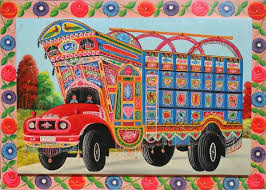
Anyone who has spent time on a Pakistani highway knows the sight. A truck rolls past in a blaze of color, its panels crowded with roses, peacocks, snow-capped peaks, and lines of poetry. Chains and pendants jingle from the bumper. Mirror work catches the sun. The vehicle is hauling cargo, but it is also carrying something else, something deeper. A story.
Pakistani truck art is one of the country’s most recognized folk traditions. It turns ordinary transport vehicles into moving canvases, each one different from the next. To outsiders the trucks can look chaotic. To those who know the visual language, every motif means something.
History Behind the Pakistani Truck Art
The tradition traces back to the early decades of the 20th century. According to multiple cultural histories, Bedford trucks imported from Britain began arriving on the subcontinent in the 1920s. Owners fitted them with tall wooden prows above the truck bed, known as a taj, or crown, along with decorative bumpers and carved wood paneling.
The decoration started as something practical. In the late 1940s, after Partition, trucks began making long-haul deliveries across the new country. Transport companies painted distinct logos and bright designs so that a largely illiterate public could identify who owned a vehicle at a glance. What began as branding slowly turned into competition. Drivers and owners pushed each other to make their trucks more elaborate, more colorful, more personal.
By the 1960s, cities like Karachi, Rawalpindi, and Peshawar had become hubs for the craft. Painters, woodworkers, blacksmiths, and metal beaters worked together in roadside workshops to produce the finished trucks. Distinct regional styles took shape. Karachi became known for bright palettes, bold lettering, and metallic embellishment. Peshawar developed intricate woodwork and mirror mosaics. Punjab leaned into floral patterns and lines of Punjabi poetry. Balochistan favored simpler geometric designs in earthier tones.
American troops stationed in the region later coined the nickname “jingle trucks,” a reference to the sound made by the chains and ornaments swinging from the bumpers. The name stuck.
What these symbols really mean?
The designs are not random. Truck art works as a coded language, and drivers use it to express faith, identity, and hope.
Religious imagery sits at the center of most trucks. The names Allah and Muhammad, Quranic verses, and images of famous mosques appear regularly, meant to provide spiritual protection on long and often dangerous journeys. One of the most striking figures is the Buraq, the winged creature from Islamic tradition, often painted large across the back of a truck.
Protective symbols are everywhere. Stylized eyes on the bumpers are believed to ward off the evil eye, a belief known across the region as nazar. The phrase Chashm-e-Baddoor, meaning roughly “far be the evil eye,” is a common protective slogan. A painted shoe sometimes appears alongside it, a symbol of warding off ill intent.
Other motifs carry their own meanings. Fish represent good fortune. Peacocks stand for beauty and pride. Mountain landscapes often show a driver’s hometown or a longing to return to it. Lions and other powerful animals signal strength.
Then there is the poetry. Truck panels carry couplets that range from romantic to philosophical to humorous. The best-known is “Dekh magar pyaar se,” which translates to “Look, but with love.” Another common line, “Sada khush raho,” means “Always stay happy.” These phrases give each truck a voice, and they have become part of Pakistan’s wider pop culture.
Pakistani Truck Art Today: Global Reach and Challenges
Over the past two decades, truck art has moved well beyond the road. The work of artists like Haider Ali has carried it onto the world stage. A Karachi-based painter trained by his father from the age of seven, Ali first gained international attention in 2002, when he painted an authentic Pakistani truck for the Smithsonian Folklife Festival in Washington. The vehicle was later acquired by the institution.
Ali has since painted murals, cars, benches, and even a small aircraft in the truck art style. In early 2026, photographs of Nike sneakers he hand-painted with floral patterns, peacocks, and mascara-rimmed eyes went viral on social media. He told Arab News that he charges select clients several hundred dollars for a custom pair, and that new orders keep arriving. Ali also runs Phool Patti, an organization that promotes Pakistani truck artists, and has taught at the Indus Valley School of Art and Architecture.
The motifs now appear on clothing, handbags, crockery, and home decor. Designers and lifestyle brands have built whole product lines around the style. Café murals and digital wallpapers borrow its language. The art form has become a kind of soft diplomacy, a colorful shorthand for Pakistan abroad.
The global attention has not solved the problems at home. Cultural researchers and reports from outlets including AP News point to real threats to the craft’s survival.
The most immediate is technology. Some transporters now choose printed vinyl stickers and machine-made designs over hand-painting, drawn by lower costs and faster turnaround. The results are colorful but lack the depth of the original work.
The other concern is people. Truck painters are often underpaid for weeks of demanding labor, and many supplement their income with sign painting or other side jobs. Younger people are turning instead to digital art, gig work, or better-paying construction jobs. The communal, master-to-apprentice system that sustained the craft for generations is thinning out. Recognition inside Pakistan remains limited, even as foreign galleries celebrate the form.
For now, the trucks still roll. They still jingle. And on the back of each one, the painted message holds: look, but with love.