


Long before he became a household name, Alamgir Haq was simply a teenager chasing music with nothing but ambition and an acoustic guitar. Born in August 1955 in East Pakistan, now Bangladesh, he was the son of a politician connected to the All India Muslim League. His early influences were remarkably diverse — he grew up listening to Elvis Presley, the playback legend Mohammad Rafi, and Bengali folk singer Abbasuddin Ahmed, a blend that would later shape his unique sound.
At just fifteen, Alamgir left home and moved to Karachi, a city that would come to define his career. Life was far from easy in those early years. He performed at a small eatery called Café D’Khan in exchange for a single meal a day. By the time he was twenty-one, he could often be found in Karachi’s Hill Park, strumming his guitar for strangers in hopes of earning tea, food, or even just a cigarette.
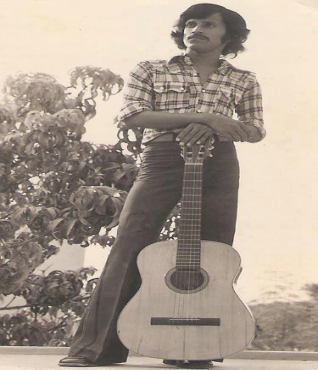
Alamgir in 1973
A Lucky Break on Television
Alamgir’s fortunes changed when he auditioned for a television program hosted by Khushbakht Aliya. Although she couldn’t offer him a role, the audition caught the attention of noted Pakistan Television producer Sohail Rana, who hired him as a guitarist for a children’s show. That opportunity opened the floodgates. Over the course of his career, Alamgir went on to perform in more than 400 songs across television and film, and his popularity soon reached fever pitch, with fans trailing him through the streets of Karachi just to catch a glimpse.
Building a New Pakistani Sound
What set Alamgir apart wasn’t formal training in classical Eastern music — it was his instinct for something fresh. Drawing inspiration from Western pop acts like ABBA and the Bee Gees, he crafted a sound that spoke directly to Pakistan’s urban youth, who were hungry for music that felt modern and global. Yet he never abandoned accessibility: by singing in Urdu and performing regularly on PTV, he made this new pop sensibility available to everyday audiences, not just a niche crowd. His songs were catchy, danceable, and easy to sing along to, and his energetic stage presence gave a generation something it hadn’t quite seen before.
The Rise of the “Albela Rahi”
In 1973, inspired by the Cuban classic “Guantanamera,” Alamgir wrote “Albela Rahi,” which became one of the defining songs of his career. A few years later, in 1978, he composed the soundtrack for the film Bobby and Julie. While the movie itself flopped with critics, its songs, including the hit “Dekha Na Tha,” became instant favourites. That same period saw him collaborate with a young guitarist named Amir Zaki, who would go on to become a celebrated musician in his own right.
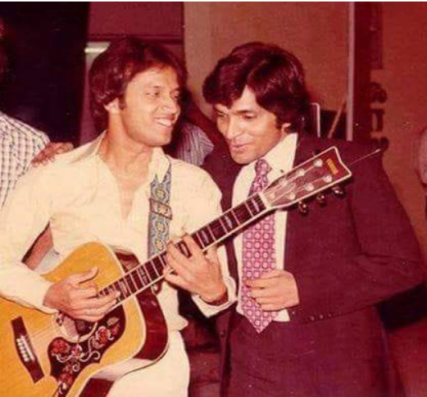
Alamgir and Moin Akhtar
Later Life and Lasting Legacy
In 2004, Alamgir was diagnosed with kidney failure and publicly appealed for support with his surgery, prompting an outpouring of affection from fans old and new. In 2013, the Pakistani government honoured him with the Pride of Performance Award. He now lives in Atlanta with his family, occasionally returning to Pakistan to perform for devoted audiences.
Across more than thirty albums in Urdu and Bengali, Alamgir captured a moment when Pakistani popular culture felt youthful, experimental, and boundary-pushing. Decades later, his songs remain just as easy to dance to as they were in the 1970s — a lasting testament to the boy who once played guitar in a park for spare change and ended up reshaping Pakistan’s musical identity.