


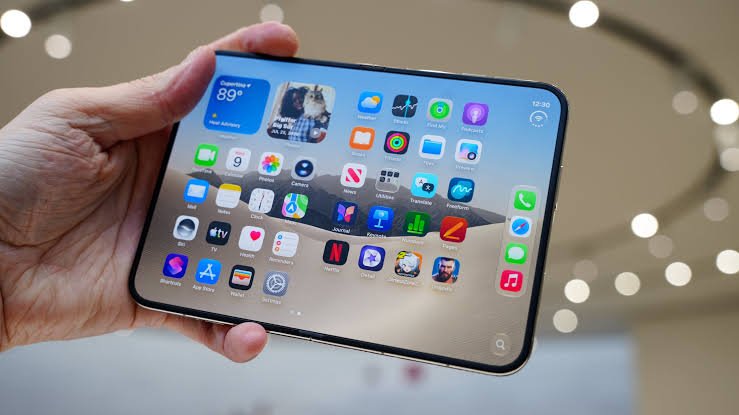
Apple’s iPhone Duo has drawn attention in early reviews for its foldable display, multitasking capabilities and performance, while reviewers have also identified challenges involving app compatibility, device weight and everyday usability.
In a hands-on report published by Forbes on October 25, 2026, technology contributor Ben Sin shared his initial impressions after using the device as his primary phone for several days. He praised the display and overall performance but noted that several aspects of the user experience still require improvement.
The iPhone Duo represents Apple’s entry into the foldable smartphone category, combining a conventional phone format with a larger screen that opens for activities such as multitasking, gaming and video editing.
One of the device’s main strengths, according to the Forbes report, is its 7.4-inch internal display. Sin described the screen as having a barely noticeable crease and an anti-reflective coating designed to reduce glare and reflections.
The display is intended to provide a larger viewing area when the device is unfolded, allowing users to work with more content than they would on a conventional smartphone screen.
However, the display is only one part of the foldable experience. The device’s unusual screen dimensions also create challenges for applications that have not been updated to accommodate its layout.
Several popular applications were not fully optimised for the iPhone Duo at the time of Sin’s testing. The Forbes report identified WhatsApp, Gmail and Google applications among those experiencing display-layout issues.
When applications do not support the device’s screen dimensions, black bars can appear around the content, leaving parts of the available display unused. This can reduce the benefit of having a larger screen, particularly when using applications that were originally designed for conventional smartphones.
Sin suggested that developers would likely update their applications as support for the device improves. Until then, running two applications side by side offers one way to make use of the larger display.
A separate review published by WIRED on October 21 also identified app optimisation as a significant early limitation. It reported that some applications began receiving updates to better accommodate the device’s screen and navigation layout.
The iPhone Duo also changes some familiar elements of the iPhone experience. According to Forbes, the device replaces Face ID with a fingerprint scanner integrated into a side button.
Sin found the unlocking process slower than Face ID because it requires pressing the button and keeping a finger on the scanner briefly before the phone unlocks.
The placement of controls presents another usability consideration. The device positions its main controls along the right side of the screen, which the reviewer found less convenient when operating the phone with his left hand.
These design choices may require existing iPhone users to adjust their habits, particularly if they are accustomed to unlocking their devices using facial recognition.
Despite these limitations, the Forbes report described the iPhone Duo’s performance positively. The device is powered by Apple’s A20 Pro chip, which the reviewer said handled gaming and video editing smoothly during his testing.
Sin also reported that the phone lasted through a 12-hour day outdoors, despite having what he described as a relatively small battery for a foldable device. He observed that the phone became only marginally warm during heavy use.
WIRED similarly praised the device’s battery life, reporting that its reviewer had around 40 per cent charge remaining at bedtime on typical days. However, the publication also noted that the phone could become noticeably warm at times.
These findings reflect individual testing experiences rather than standardised battery or performance measurements.
The initial reviews highlight both the potential and the limitations of Apple’s foldable smartphone. Its large internal display, multitasking features and reported performance offer advantages for users who frequently work across multiple applications.
At the same time, app compatibility, control placement and the transition from Face ID to fingerprint unlocking remain notable drawbacks.
The findings also come from relatively short testing periods. Forbes explicitly described its report as early impressions rather than a full review, noting that the user experience could change as software support develops.
For now, the iPhone Duo’s reception suggests that hardware design is only one part of delivering a successful foldable smartphone. Application developers’ ability to adapt their software to the device’s two screen formats will also influence how effectively users can take advantage of its larger display.