


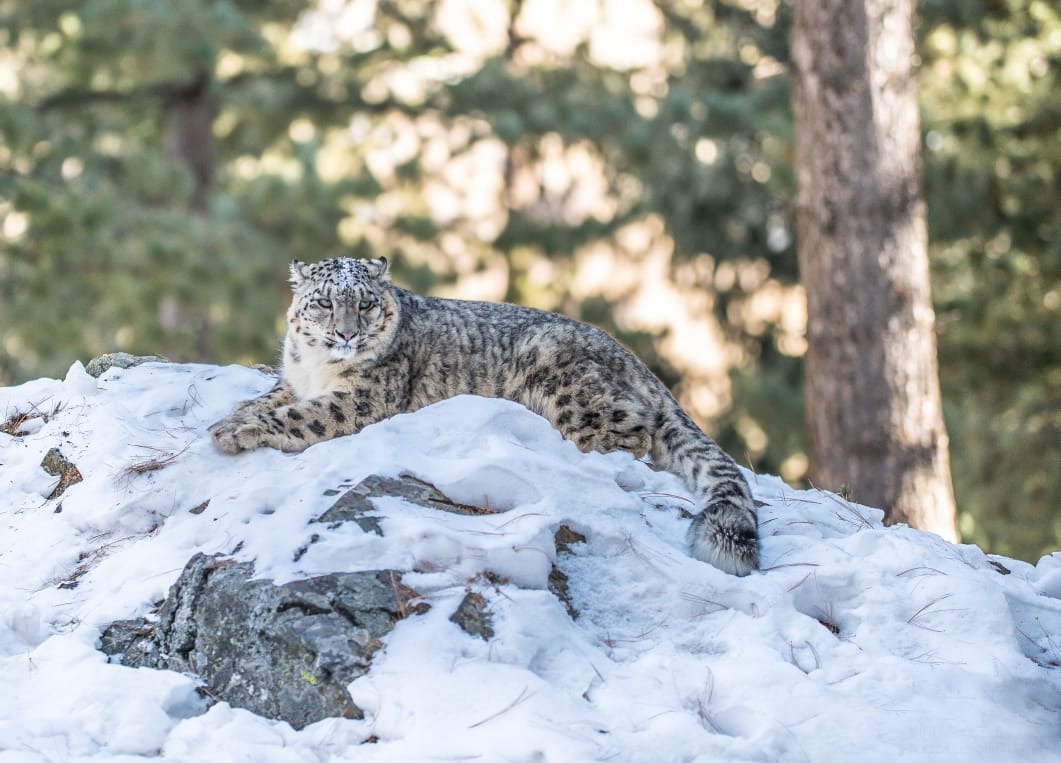
Snow leopards are known as the ghosts of the mountains for good reason. They live in some of the highest and harshest terrain on Earth, blend almost perfectly into rocky slopes and are rarely seen even by people who spend their lives in the mountains. That is what made a set of videos shared on International Snow Leopard Day so striking.
International Snow Leopard Day is marked every year on October 23. The date marks the anniversary of the Bishkek Declaration, signed in 2013 at the first Global Forum on the Conservation of the Snow Leopard in Kyrgyzstan, the Global Environment Facility noted.
Twelve countries signed on to protect the species and its habitat. These are Afghanistan, Bhutan, China, India, Kazakhstan, Kyrgyzstan, Mongolia, Nepal, Pakistan, Russia, Tajikistan and Uzbekistan. The forum also produced the Global Snow Leopard and Ecosystem Protection Program (GSLEP), which brings these countries together on conservation.
The clips, posted on social media by Syed Rizwan Mehboob and filmed by Sakhawat and Liaqat of the Gilgit-Baltistan Wildlife Department, show snow leopards moving in groups of four and two across the snowy slopes of Gilgit-Baltistan, from the Mashabrum area to the famous Passu Cones.
How Many Snow Leopards Live in Pakistan
In 2025, Pakistan released its first scientific estimate of its snow leopard population, putting the number at 167. The figure was announced by the Snow Leopard Foundation and the Ministry of Climate Change and Environmental Coordination, and places Pakistan fourth among range countries, after China, Mongolia and India, the Associated Press of Pakistan reported.
The estimate came from 15 years of field surveys, camera trapping and data analysis. A related scientific study, published in the journal Ecography, used 828 cameras across 19 valley surveys between 2010 and 2019, collecting 4,712 images and identifying 53 individual snow leopards.
The study found the highest densities in the Karakoram, which it estimated holds about 103 adult snow leopards, followed by the Hindu Kush and the Himalaya. Areas with more snow leopards were linked to protected areas and higher numbers of prey, especially Himalayan ibex.
In Pakistan, snow leopards range across more than 80,000 square kilometers of the Hindu Kush, Karakoram, Pamir and Himalayan mountains, mostly in Gilgit-Baltistan and northern Khyber Pakhtunkhwa, with smaller numbers in Azad Jammu and Kashmir. Worldwide, an estimated 3,500 to 7,000 snow leopards remain in the wild across the 12 range countries.
Protecting Snow Leopards in Pakistan’s Northern Mountains
The snow leopard is listed as Vulnerable on the IUCN Red List. Its main threats include habitat loss, climate change, shrinking prey populations, poaching and retaliatory killings by herders who lose livestock to attacks.
Pakistan’s conservation work has focused heavily on the communities that share the mountains with these cats. Under the National Snow Leopard and Ecosystem Protection Program, the ministry runs community-based projects in Gilgit-Baltistan and Chitral that offer compensation and alternative livelihoods to herders.
The Snow Leopard Foundation also runs a Livestock Insurance Scheme, which reimburses herding families who lose animals to snow leopards. The insurance pools are started with seed grants, sustained by premiums paid by families and managed by local communities. A single attack can kill up to 25 domestic animals, the Snow Leopard Trust noted, so assured compensation helps reduce the risk of herders killing the cats in return.
Field staff remain central to this work. At the Pakistan Wildlife Protection Awards 2025, seven rangers and field staff from Gilgit-Baltistan, Khyber Pakhtunkhwa and Azad Jammu and Kashmir were recognized for their efforts. Minister of State for Climate Change Dr. Shezra Mansab Kharal described field officers as “the true heroes of our wildlife.”
The ministry has described the national estimate as the first reliable baseline for long-term planning, giving conservationists a way to track how Pakistan’s snow leopards fare in the years ahead.