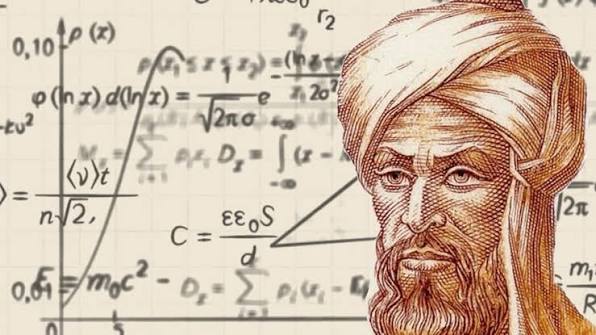
More than 1,200 years ago, a scholar working in Baghdad laid the foundations for mathematics as we know it today. Muhammad ibn Musa al-Khwarizmi was a Persian Muslim mathematician, astronomer and geographer whose discoveries transformed science and continue to shape the modern world. Today, he is remembered as the Father of Algebra, but his influence extends far beyond mathematics.
Living during the early ninth century under the Abbasid Caliphate, Al-Khwarizmi worked at the renowned House of Wisdom in Baghdad, one of the greatest centres of learning in history. Scholars there translated and expanded knowledge from Greece, India and Persia, creating an environment that fuelled remarkable scientific progress.
The Birth of Algebra
Al-Khwarizmi’s most famous work, Al-Kitab al-Mukhtasar fi Hisab al-Jabr wal-Muqabala (The Compendious Book on Calculation by Completion and Balancing), introduced a systematic method for solving linear and quadratic equations. The Arabic word “al-jabr” from the book’s title later became the English word algebra.
His approach transformed mathematics by treating equations as a separate discipline rather than simply an extension of geometry or arithmetic. The methods he developed remain the foundation of algebra taught in schools across the world today.
The Man Behind Every Algorithm
Al-Khwarizmi’s influence reached far beyond his own era. When his works were translated into Latin during the twelfth century, they became standard mathematical texts across Europe and helped lay the groundwork for the scientific revolution.
Even the word “algorithm”, the backbone of modern computing, comes from the Latinised version of his name, Algoritmi. Every smartphone, search engine, banking system and artificial intelligence application relies on algorithms, making Al-Khwarizmi one of the most influential figures in the history of technology.
Beyond Mathematics
Al-Khwarizmi also played a crucial role in popularising the Hindu-Arabic numeral system, including the use of zero, which gradually replaced Roman numerals in Europe. This made calculations significantly faster and more practical for science, engineering and commerce.
His contributions extended into geography and astronomy as well. He revised maps of the known world, improved geographical coordinates and produced astronomical tables that guided scholars for generations.
A Legacy That Endures
More than a thousand years after his death, Al-Khwarizmi’s ideas continue to shape the modern world. From solving algebraic equations in classrooms to powering artificial intelligence and advanced computing, his work remains woven into everyday life.
His story is a reminder that one scholar working in medieval Baghdad helped lay the intellectual foundations of the digital age. Few individuals in history have left a legacy that continues to influence humanity on such a global scale.