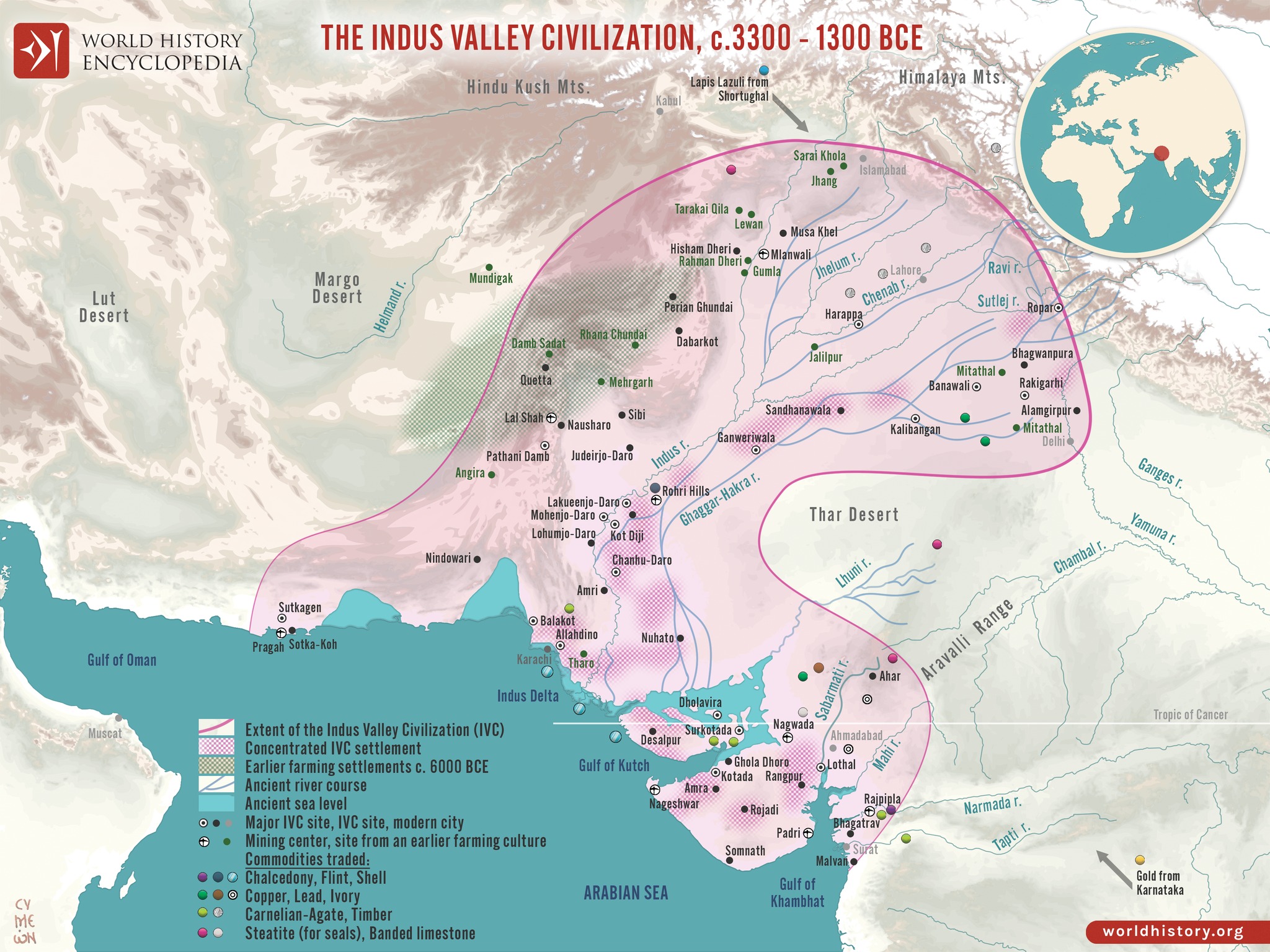
The Bronze Age gave humanity three great riversides where the world’s first cities were born: Egypt along the Nile, Mesopotamia between the Tigris and Euphrates, and the Indus Valley Civilization (IVC). Of these three, the Indus Valley was by far the largest, stretching across an empire bigger than ancient Egypt and Iraq combined.
Discovering this ancient superpower reveals an important historical truth: the geographical, technological, and cultural heart of this civilization sits squarely within the borders of modern Pakistan. Far from being a historical footnote, the country is the custodian of the world’s earliest masters of urban planning.
The Civilisational Spine
The entire blueprint of the IVC (c. 3300–1300 BCE) is anchored to the Indus River network. The river functions as the civilisational spine of Pakistan’s identity, linking prehistoric settlements directly to the modern state.
While trading outposts reached into neighbouring lands, the true weight of the civilization resides within Pakistani borders. Over 1,000 Indus sites, including its most grand urban capitals and over 90% of its inscribed artifacts, are located in Pakistan’s Sindh and Punjab provinces.
- Mohenjo-daro (Sindh): A UNESCO World Heritage site showcasing standard-set baked brick architecture, automated public baths, and sophisticated subterranean sewage systems that European cities would not replicate for millennia.
- Harappa (Punjab): The massive “type-site” discovered in 1921 that revealed this forgotten empire to the modern world.
- Mehrgarh (Balochistan): An invaluable precursor site dating back to 7000 BCE, documenting the actual transition from nomadic herding to the surplus farming that made the Indus cities possible.
The Horned Deity Seal: Fact vs. Nationalist Fiction
For decades, external popular narratives, most notably found in Indian textbooks and nationalist political commentary have sought to project a retrospective cultural monopoly over the IVC. This claim rests heavily on a single, two-inch steatite artifact excavated from Mohenjo-Daro: the Pashupati Seal (officially archived as Seal 420), also widely referred to by objective historians as the Horned Deity Seal.
In 1931, British archaeologist Sir John Marshall casually branded the seal’s central, horned, cross-legged figure as a “Proto-Shiva”, claiming it provided a linear religious bridge to later Hinduism. However, detailed analysis featured by elite educational institutions like Vajiram & Ravi underscores that assigning modern theological identities to these seals remains entirely speculative, anachronistic, and flatly unverified.
Decades of academic scrutiny have unravelled this theory. Indologist Doris Srinivasan demonstrated that the figure possesses bovine (cow-like) ears and a stylized face, pointing toward a pastoral deity rather than a human god, while others suggest the figure is female, interpreting the alleged phallus as a waistband cord. Furthermore, the seal features wild animals (a tiger, rhinoceros, elephant, and water buffalo) rather than the domesticated livestock associated with the Vedic Pashupati. Similar horned motifs are found across ancient Mesopotamian and Celtic mythologies, showing it is a widespread shamanic archetype rather than something unique to South Asia.
The Myth of Vedic Continuity
The popular assertion that the Indus Valley Civilization directly birthed later Hindu Vedic culture is fundamentally contradicted by physical evidence. The Indus script remains entirely undeciphered, but the material culture left behind paints a completely different picture of society than the one described in early Sanskrit literature.
The meticulously planned cities of Harappa and Mohenjo-Daro featured advanced public health infrastructure, yet archaeologists have found zero evidence of temples, religious monuments, or structural shrines. Furthermore, while Vedic culture was defined by the horse, chariot warfare, and the Sanskrit language, the material remains of the IVC reveal an urban society with no horses and no evidence of Indo-Aryan linguistic roots. When pastoral tribes composed the Rigveda centuries after the collapse of the Indus cities (~1900–1300 BCE), the texts showed no awareness of the grand, brick-built metropolises that preceded them. The narrative framing the Indus Valley as a “Vedic civilization” is a contemporary, politically motivated projection rather than a historically accurate fact.
A Lasting Legacy
The Indus Valley Civilization did not simply vanish into the sands of time; its sophisticated DNA remains deeply woven into the daily life, culture, and technology of modern Pakistan. When the cities declined, their inhabitants adapted, carrying their generational knowledge out into the surrounding floodplains and establishing a structural continuity that survives to this day.
This ancient inheritance is visible in the most fundamental aspects of regional life. The precise, mathematically calculated brick-making techniques discovered at Harappa established a standard that endures today, as local kilns across rural Punjab and Sindh still churn out structural bricks in those exact proportional dimensions. Similarly, the Harappans were among the very first in human history to cultivate cotton and master large scale textile production. Today, cotton forms the bedrock of Pakistan’s agricultural economy and global export industry, fuelled by irrigation networks that trace paths carved out by ancient engineers. Even the iconic wooden bullock carts still used by farmers across rural Sindh feature a wheel track width and structural alignment virtually identical to the toy terracotta carts excavated from the ruins of Mohenjo-Daro.
This extraordinary continuity shows that the Indus Valley Civilization was built on civic coordination, public health, and peaceful trade rather than monumental palaces or warlike spectacles. As travellers look to discover heritage destinations off the beaten path, Pakistan’s preservation of these ancient ruins offers a rare, untamed window into human origin. The Horned Deity Seal remains a masterpiece of antiquity, but its roots belong strictly to the ancient soil of the Indus basin; a timeless heritage Pakistan proudly shares with the world.