

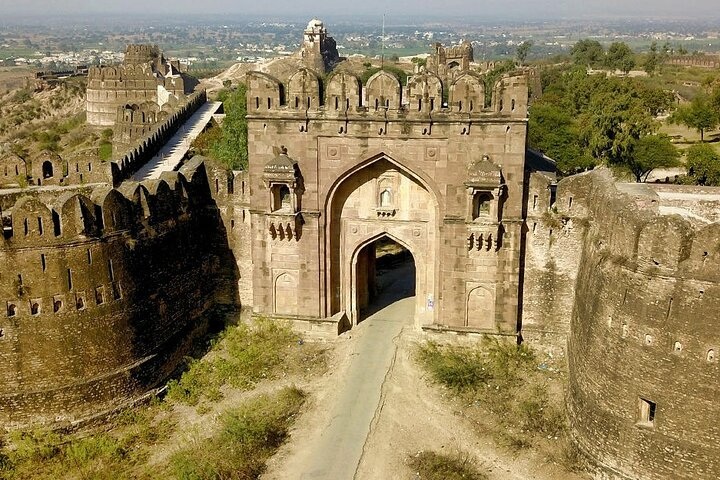
Deep in the heart of Pakistan, situated in the Jhelum District just off the historic Grand Trunk Road, stands a military marvel that accomplished the impossible: it survived 500 years of turbulent South Asian history without ever being breached. Not once. This is Rohtas Fort, a massive stone titan born out of a bitter imperial rivalry.
In 1541, the brilliant Pashtun strategist Sher Shah Suri seized the throne of Delhi, sending the Mughal Emperor Humayun into exile. To guarantee that the deposed monarch could never reclaim his kingdom, Suri ordered the construction of a fortress at the strategic crossroads where the Kahan River meets the historical invasion route from Afghanistan. It was built to block a single man, but it was engineered to withstand the world.
The engineering of Rohtas remains a masterclass in ancient military science. Rather than fighting the rugged terrain, Suri’s builders integrated the fort’s massive foundations directly into the natural contours of the hillock, creating defensive positions that sat up to 300 feet above its surroundings. The walls themselves were architectural marvels, built using incredibly thick layers of ashlar masonry bound with lime mortar, varying in thickness from 10 to 13 meters to easily absorb the shock of heavy artillery fire. The perimeter features four kilometers of these massive walls, punctuated by 68 semi-circular bastions for crossfire, 1,900 fortified battlements, and 9,500 stone stairs.
Soldiers marched through 12 monumental gates, such as the imposing Kabuli Gate and Sohail Gate, each meticulously engineered with trap falls and machicolations to withstand elephant-led charges and heavy artillery. Suri spent millions in regional currency on this architectural project, yet died in 1545 before seeing his masterpiece fully finished.
The fortress was so intimidating that passing armies chose to march around it rather than face its defenses. When Humayun eventually returned with Persian backing to reclaim his empire, he bypassed the fort entirely, knowing a direct siege would be catastrophic. The walls held, remaining entirely unbroken throughout centuries of conflict.
Recognizing this flawless preservation and military perfection, UNESCO inscribed Rohtas Fort as a World Heritage Site in 1997. The international body designated it an exceptional, unadulterated example of early Muslim military architecture at the crossroads of Central and South Asia, noting that it successfully blended artistic Islamic aesthetics with raw, functional defensive engineering.
Yet, this fortress was only half of Suri’s enduring legacy. While building it, he engineered the Grand Trunk Road; a 1,500-mile highway connecting Calcutta to Peshawar, complete with shaded rest inns and step-wells every 12 miles. Today, millions of drivers still commute along the famous “GT Road.”
Ultimately, Rohtas Fort represents something far greater than an ancient border outpost; it is a monument to a king who built for the future. While the fortress reflects his unmatched genius in denying entry to his enemies, the adjacent highway mirrors his visionary commitment to connecting his people. Five centuries later, the empire Suri fought to secure has dissolved into the pages of history, but his twin triumphs, an impenetrable shield of stone and a timeless corridor of commerce, endure as foundational pillars of Pakistan’s heritage, waiting for the rest of the world to finally take notice.