


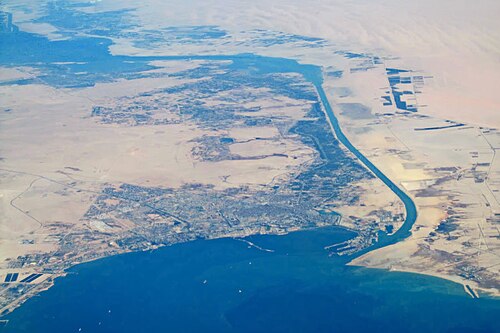
A Shortcut That Changed the World
Few engineering projects have transformed global trade as profoundly as the Suez Canal. Stretching approximately 193 kilometres (120 miles) across Egypt, the canal connects the Mediterranean Sea with the Red Sea, creating the shortest maritime route between Europe and Asia. Before its construction, ships travelling between the two continents had to sail around the Cape of Good Hope at the southern tip of Africa, adding thousands of kilometres and weeks to their journeys.
Since opening in 1869, the Suez Canal has become one of the world’s most strategically important waterways, carrying around 12–15% of global trade and nearly a third of the world’s container shipping each year.
A Dream Centuries in the Making
The idea of linking the Mediterranean and Red Seas dates back to ancient Egypt, where early canals connected the Nile River to the Red Sea. However, a direct sea-level canal remained impossible until the nineteenth century.
Construction officially began in 1859 under the leadership of French diplomat Ferdinand de Lesseps. Tens of thousands of Egyptian labourers worked on the project for a decade before the canal was inaugurated on 17 November 1869. The opening ceremony attracted royalty, diplomats and dignitaries from around the world, marking one of the greatest engineering achievements of its era.
The Lifeline of Global Commerce
The Suez Canal immediately reshaped international trade. Shipping companies no longer needed to navigate the long and dangerous route around southern Africa, reducing travel time between Europe and Asia by nearly two weeks for many voyages.
Today, the canal serves as a vital corridor for container ships, oil tankers, liquefied natural gas carriers and bulk cargo vessels transporting everything from electronics and automobiles to grain and energy supplies. For countries in Europe, the Middle East and Asia, the canal remains essential to maintaining efficient global supply chains.
A Strategic Waterway
Beyond commerce, the Suez Canal has played a central role in international politics. Its strategic importance was highlighted during the 1956 Suez Crisis, when Egyptian President Gamal Abdel Nasser nationalised the canal, triggering military intervention by Britain, France and Israel. The crisis marked a turning point in post-colonial geopolitics and signalled the declining influence of the old European empires.
More recently, the canal made headlines in March, 2021 when the container ship Ever Given became lodged across the waterway, blocking traffic for six days. Hundreds of vessels were delayed, exposing just how dependent the global economy had become on a single shipping route.
A Waterway That Still Shapes the World
More than 150 years after its opening, the Suez Canal remains one of the most important arteries of international trade. Every day, goods worth billions of dollars pass through its waters, linking factories, markets and consumers across continents.
Its history is more than the story of an engineering marvel. It is the story of how a single canal transformed global commerce, reshaped geopolitics and continues to influence the world economy in the twenty-first century.


