


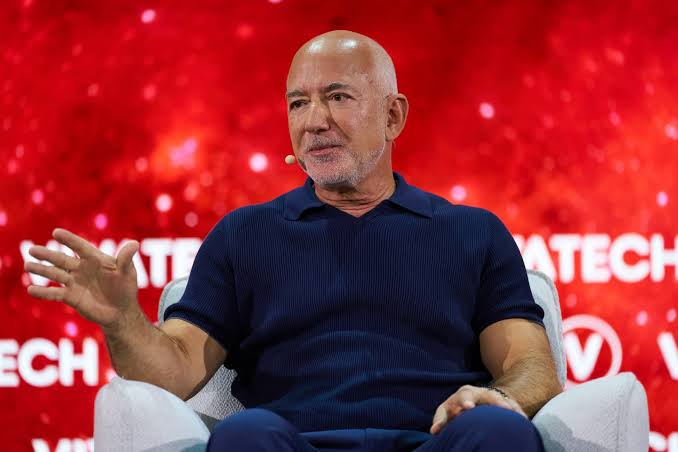
Jeff Bezos has predicted that artificial intelligence will cause a labor shortage rather than mass unemployment.
Amazon founder Jeff Bezos has pushed back on fears that artificial intelligence will wipe out large numbers of jobs. Speaking at the VivaTech conference in Paris on June 17, Bezos argued that AI will bring more jobs than there are people to fill them, according to Fortune. He told the audience that concerns about AI-driven unemployment are overblown.
His central claim is that productivity gains expand the economy rather than shrink the workforce. Bezos said AI makes individual workers far more productive, which in turn generates more total work to be done. He framed the outcome as a labor shortage, not a wave of layoffs.
Bezos repeated the argument in an interview with CNBC earlier in June. He used the image of a worker digging out a basement with a shovel who is then handed a bulldozer, saying the worker should be glad rather than worried because the same person can accomplish far more with better tools. He predicted that the resulting productivity would lift living standards and lower the cost of goods. He also suggested that productivity gains could let some two-income households shift to a single earner, tightening labor supply further.
Jeff Bezos AI Jobs View Meets Rising Layoff Data
The optimism arrives during a period of significant job cuts across the technology sector. Reporting from TheStreet noted that tech layoffs topped 115,000 through May 2026, approaching the total recorded across all of 2025, with companies including Meta, Amazon, and Snap citing AI as a factor in the cuts.
Other data points in the same direction. The executive coaching firm Challenger, Gray & Christmas reported that AI accounted for more than a quarter of US job cuts in April alone, with 21,490 positions lost to the technology that month. Goldman Sachs has estimated that AI is eliminating roughly 16,000 US jobs per month, with entry-level and younger workers absorbing much of the impact. A survey of chief financial officers found that AI-related layoffs in 2026 could run several times higher than the previous year.
Bezos’s own company sits at the center of that contrast. Amazon, where Bezos remains executive chairman and the largest individual shareholder, employs more than 1.5 million people worldwide and has cut tens of thousands of roles over the past year while accelerating automation under chief executive Andy Jassy. Analysts have noted that a company reducing headcount through automation can coexist with an economy-wide labor shortage if displaced workers move into new roles, though the transition is not guaranteed to be smooth.
Jeff Bezos AI Jobs Bet Backed by Prometheus Startup
Bezos is putting money behind his position. Entrepreneur reported that he is co-leading a new AI startup called Prometheus, which aims to build what its founders call an artificial general engineer capable of designing and manufacturing complex physical products such as jet engines.
The venture is heavily funded. Prometheus launched in November 2025 with backing of $6.2 billion and has since raised an additional $12 billion at a valuation of $41 billion, according to TechCrunch. Bezos co-leads the company with Vik Bajaj, a former Google scientist. The startup is positioned to move AI beyond text and content generation toward engineering and physical production.
The debate around Bezos’s comments reflects a wider divide. One side counts the roles that AI software will erase, while the other points to historical patterns in which new technologies eventually created more work than they removed. Some technology executives have shifted their public positions on the issue, with OpenAI chief executive Sam Altman recently softening earlier warnings about AI-driven job losses.