Excerpt: NASA’s Curiosity rover spent five days with a Martian rock lodged on its robotic arm before engineers successfully freed it.
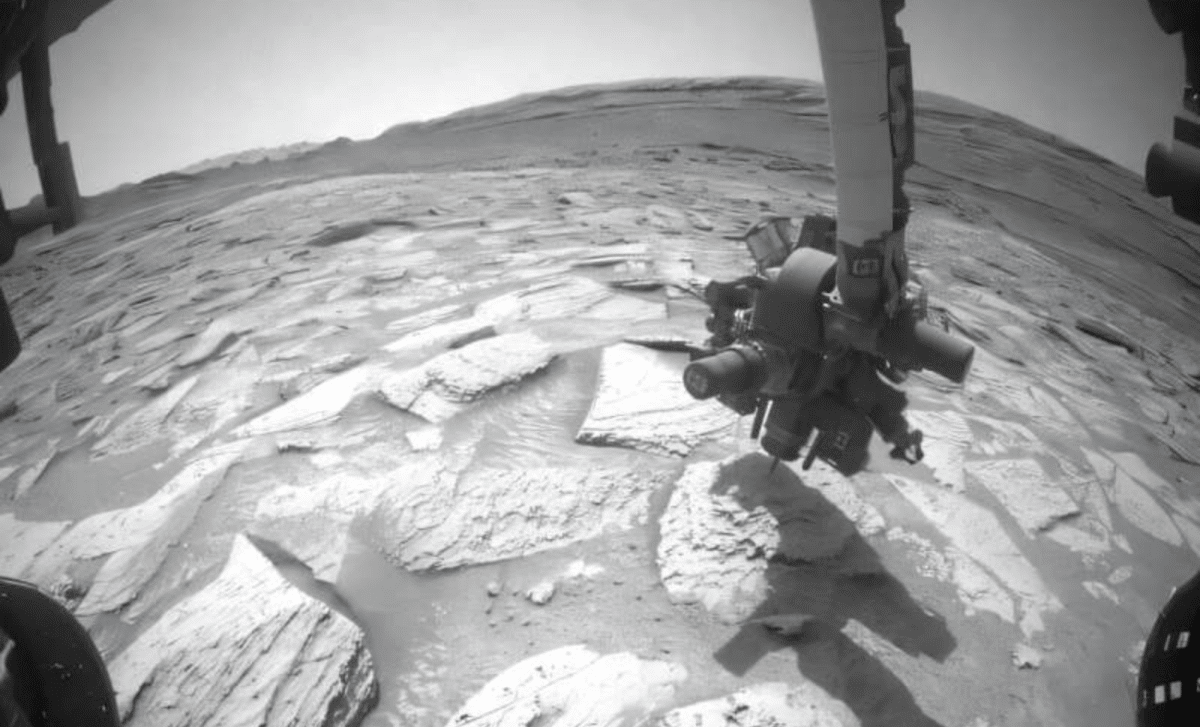
The universe is more fascinating than we can ever imagine and the latest example of this emerged after NASA’s Curiosity rover ran into an unusual problem on Mars last month. Apparently, a rock it was drilling got stuck to its arm and refused to let go. The rover had been collecting a sample from a rock nicknamed Atacama in late April when the situation took an unexpected turn. As Curiosity retracted its robotic arm after drilling, the entire rock came loose from the Martian surface. Instead of staying on the ground, Atacama was lifted into the air and became lodged on the fixed sleeve surrounding the rotating drill bit. The rover was essentially shackled to a 28.6-pound rock.
NASA released a series of images documenting the ordeal, captured by the black-and-white hazard cameras on the front of Curiosity’s chassis and by navigation cameras mounted on its mast. The images show the rock suspended on the arm and the rover’s subsequent attempts to shake it free.
Atacama measures roughly 1.5 feet wide at its base, about 6 inches thick, and weighs approximately 28.6 pounds, or 13 kilograms. The drill at the end of Curiosity’s robotic arm weighs 6 pounds and is specifically designed to probe Martian rocks, collecting powdered samples that the rover stores and analyzes on board.
NASA Had Never Seen an Entire Rock Latch Onto the Rover’s Arm
The incident was unlike anything the Curiosity mission team had dealt with before. Drilling on Mars has occasionally caused the upper layers of rocks to fracture or separate, but a complete rock lifting off the surface and attaching itself to the rover’s arm had never happened before in the mission’s history.
The team’s first response was to vibrate the drill. The logic was that the vibration might be enough to loosen Atacama’s grip. It was not. The rock held firm.
On April 29, engineers took a different approach. They reoriented Curiosity’s robotic arm and tried vibrating the drill again. Atacama still refused to budge.
It was not until May 1 that the team made real progress. Mission members tilted the drill at a steeper angle, then rotated, vibrated, and spun it in combination. They went in expecting to have to repeat the process multiple times before the rock gave way. Instead, Atacama came off during the very first round of maneuvers. It fractured when it hit the Martian ground.
The entire episode lasted five days, from the moment the rock attached itself to the arm to the moment it finally came loose.
Curiosity Has Been on Mars for Nearly 13 Years
Curiosity landed on Mars on August 5, 2012, and has been exploring the Red Planet ever since. The mission is focused on gathering evidence about Mars’ ancient past and whether the planet once had environmental conditions capable of supporting microbial life. Over more than a decade of operations, the rover has drilled dozens of rock samples across the Martian surface.
The Atacama incident is a reminder of the unpredictable challenges facing robotic exploration on another planet, where the mission team on Earth has to troubleshoot problems from roughly 140 million miles away, with a communication delay that makes real-time intervention impossible.
NASA confirmed the rover is operating normally following the incident, and the mission continues.