


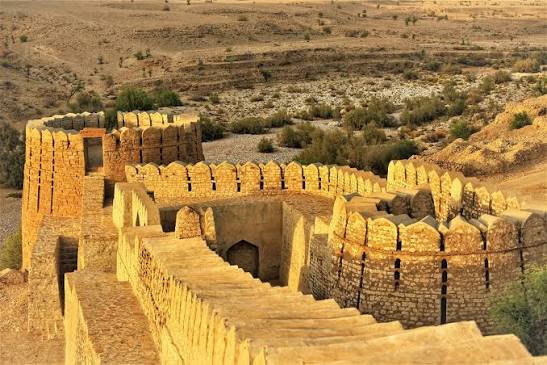
In the barren, sun-scorched hills of Jamshoro District, Sindh, stands one of Pakistan’s most mysterious and awe-inspiring structures — Ranikot Fort, popularly known as the “Great Wall of Sindh.” Stretching across roughly 31 kilometers of rugged terrain, it is widely believed to be the largest fort in the world, its scale so vast that comparisons to China’s Great Wall feel almost inevitable.
What makes Ranikot truly remarkable isn’t just its size, but the uncertainty surrounding its origins. For decades, popular belief credited its construction entirely to the Talpur dynasty, who ruled Sindh in the 18th and 19th centuries. But historical and archaeological evidence suggests the story goes back much further — possibly to the 4th or 5th century AD, during the Gupta era, making the fort’s foundations far older than the Talpur reconstruction that gave it its current form. Earlier theories even attributed the fort to the Sassanians, Scythians, Parthians, or Bactrian Greeks, though none of these have been conclusively proven.
The fort isn’t a single continuous wall, but a complex of three inner strongholds — Miri Kot, Sher Garh, and Mohan Kot — enclosed within an outer defensive perimeter. Built from stone and lime mortar, the walls snake along the contours of the Kirthar hills, punctuated by watchtowers and bastions, encircling a total area exceeding 65 square kilometers.
One of the most puzzling aspects of Ranikot is its purpose. Positioned far from any major city or settlement, the fort seems disconnected from the trade routes or population centers it might have been built to defend. One widely cited theory suggests it may have been constructed as a stronghold against advancing British colonial forces, meant to serve as a refuge for the Talpur Mirs if their resistance failed. In a cruel twist of timing, the British ultimately gained control of Sindh before the fort’s construction was even complete.
Despite its grandeur, Ranikot remains under-researched, and no definitive record survives explaining who first built it or why such an enormous structure was needed in such an isolated location. In 1993, the Pakistan National Commission nominated Ranikot Fort for UNESCO World Heritage status, and it continues to sit on UNESCO’s tentative list today. It is also protected under Pakistan’s Antiquities Act of 1975.
For travelers and historians alike, Ranikot offers something rare: a monument whose scale rivals the world’s greatest fortifications, yet whose story remains largely untold — a genuine architectural enigma hiding in plain sight in the heart of Sindh.