



Long before television, cinema and social media gave people new ways to tell stories, love travelled across the lands of present-day Pakistan through poetry and song. In villages, deserts, mountains and river valleys, stories of lovers were passed from one generation to another, carried by wandering singers, poets and storytellers. Some of these tales are celebrated across the country. Others remain rooted in the regions that gave them birth. Together, they form a rich folk tradition in which love is rarely just about romance. It becomes a story of loyalty, honour, sacrifice, social boundaries and attachment to homeland.
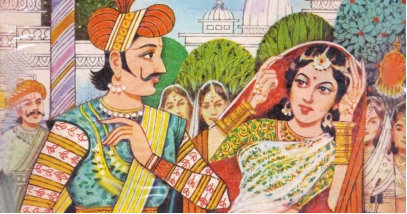
In Sindh, few figures have done more to preserve these stories than the eighteenth-century poet Shah Abdul Latif Bhittai. His Shah Jo Risalo transformed traditional folk tales into enduring poetry.
Among its best-known characters is Umar Marvi, the village woman taken from her homeland by the ruler Umar. Despite his wealth and power, Marvi refuses to forget her village, family and beloved. Her story became a powerful symbol of dignity and love for one’s homeland.
Then there is Momal Rano, a tale of love complicated by jealousy and misunderstanding. Momal, celebrated for her beauty and intelligence, falls in love with Rano, but a moment of suspicion separates the two. Their story became one of Sindh’s enduring romantic legends, remembered in poetry and folk singing.
Noori Jam Tamachi offers a different kind of romance. Noori, a fisherman’s daughter, captures the heart of King Jam Tamachi. Her humility, rather than wealth or status, becomes central to the story. In Bhittai’s poetry, the tale carries a deeper message: greatness can be found in humility, while love can cross the boundaries of class.
Another Sindhi legend, Lilan Chanesar, explores the destructive power of pride, desire and misunderstanding. Like many folk romances, it survived not because it offered a simple happy ending, but because its characters reflected human weaknesses that audiences could recognise in their own lives.
Further west, Balochistan has its own great romantic tradition in Hani and Sheh Mureed.
”Hani and Shey Mureed “is beloved epic balled of balochi folklore . Sheh Mureed and the Hani are symbols of pure and tragic love.The story dates back to the 15th century, which is considered to be the heroic age of Balochistan and the classical period of Balochi literature. pic.twitter.com/5Zds3hxoFM
— Meena Majeed Baloch, MPA (@Meena_Majeed) June 18, 2019
Their story is woven into Balochi oral literature and poetry.
Sheh Mureed loves Hani, but tribal obligations and circumstances prevent their union. Their separation turns personal love into a story of loyalty, honour and sacrifice, ensuring that the two remain among the most remembered figures in Balochi folklore.
In the northwest, Adam Khan and Durkhanai occupy a similar place in Pashtun cultural memory. Their love faces family and tribal opposition, and their story has been preserved through Pashto poetry and folk singing. Like many such tales, it reflects the tension between individual desire and the expectations of society.
Punjab, too, has stories beyond its most famous romances. Mirza Sahiban remains one of the region’s celebrated folk tales, while Puran Bhagat combines romance, betrayal, spirituality and redemption. Their stories became part of the qissa tradition through which Punjabi storytellers preserved history, morality and imagination in verse.
And in Kashmir, Habba Khatoon represents perhaps an especially powerful meeting of love and poetry. Remembered as one of Kashmir’s great poetesses, her verses and life became intertwined with the story of Sultan Yusuf Shah Chak. Her poetry gave personal emotion a lasting place in Kashmiri cultural memory.
These stories survived because they were never confined to books. They were sung at gatherings, recited by storytellers and carried through generations by memory. Pakistan’s folk romances are therefore more than tales of lovers who were separated by fate. They are an archive of the emotions, values and identities of the societies that created them. The lovers may have lived centuries ago, but through the voices of poets and singers, their stories never truly disappeared.


