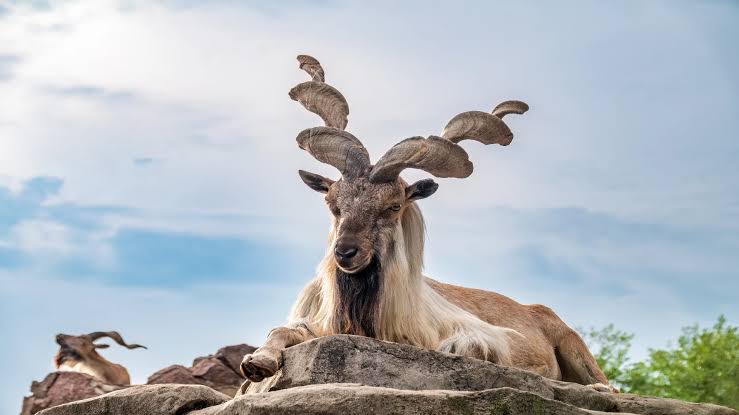
As Pakistan prepares to celebrate another Independence Day, the nation’s story of resilience finds an unlikely but fitting mirror in the mountains of the north — in the form of a wild goat with spiralling horns that has come to stand for something much bigger than itself.
The markhor is more than a remarkable creature of the mountains. It is a living emblem of the same qualities that carried Pakistan through its own struggle for survival and sovereignty: endurance, adaptability, and the will to reclaim what was nearly lost.
A Name Rooted in Legend
The markhor gets its name from the Persian words mar, meaning snake, and khor, meaning eater. Folklore held that the animal killed and devoured snakes — more myth than biology, but a fitting legend for a creature that has always seemed larger than life to the people who share its mountains.
Born of the Same Rugged Land
Markhor roam some of Pakistan’s most formidable terrain — the high passes of Khyber Pakhtunkhwa, Gilgit-Baltistan, Balochistan and the northern reaches of the country. Their powerful hooves carry them across steep rock faces where few other large mammals could hope to survive. In this, they embody the same spirit that has defined Pakistan since its founding: the ability to thrive in unforgiving conditions, on land fought for and cherished.
A Struggle for Survival
The markhor itself faced a period of grave uncertainty. Unregulated hunting, shrinking habitat, and competition with livestock pushed populations into steep decline through much of the 20th century. By the 1990s, conservationists feared the animal might not endure.
But Pakistan did not let that happen.
A National Response Built on Ownership and Pride
Just as independence was won and defended through the collective will of a people determined to shape their own future, the markhor’s recovery was built on giving Pakistanis a direct stake in protecting their own natural heritage. Stronger wildlife protections and community-based conservation programmes gave local communities ownership over the species’ fate. Regulated trophy hunting initiatives channelled substantial revenue back into the very communities guarding these mountains, turning conservation into a shared national project rather than a policy imposed from above.
The result was a gradual, hard-won recovery across several regions of the country — proof that when Pakistanis unite behind a cause, even the steepest odds can be overcome.
A Symbol Worthy of the Nation
In recognition of its resilience, the markhor was declared Pakistan’s national animal, taking its place as one of the country’s most recognisable emblems. Its image has featured on official representations including a commemorative gold coin issued in 1976 and the reverse of the commemorative 75-rupee banknote released in 2022 to mark 75 years of independence — a mountain-dwelling survivor honoured as a symbol of the nation’s endurance.
Pakistan’s pride in the markhor reached the world stage in 2018, when the animal was featured on the logo of the International Union for Conservation of Nature (IUCN) — a moment of quiet national pride, placing a distinctly Pakistani icon at the heart of a global movement.
A Story Worth Celebrating
The markhor’s journey stands as a fitting tribute to the nation it represents. Both were shaped by the same rugged, unforgiving land. Both were carried forward by the determination, unity, and foresight of people who refused to let something precious slip away. Both now stand — on the mountainside and on the world stage — as symbols of what Pakistan can achieve when it commits to protecting what is its own.
From a threatened mountain goat to a national icon, the markhor’s story is, in the truest sense, Pakistan’s story: one of strength drawn from hardship, pride earned through unity, and a legacy renewed by every generation.