
The Pakistan Air Force pilot is the first foreign astronaut to fly on a Chinese space mission and will be the first to board the Tiangong space station.
Pakistani astronaut Muhammad Zeeshan Ali has launched into space aboard China’s Shenzhou-24 spacecraft, becoming the first foreign astronaut to fly on a Chinese crewed mission.
The spacecraft lifted off on a Long March-2F rocket at 8:18am Beijing time (5:18am Pakistan time) on Wednesday, November 25, from the Jiuquan Satellite Launch Center in northwest China. It separated from the rocket about 10 minutes after launch and entered its planned orbit.
The China Manned Space Agency declared the launch a “complete success,” saying the crew was in good condition.
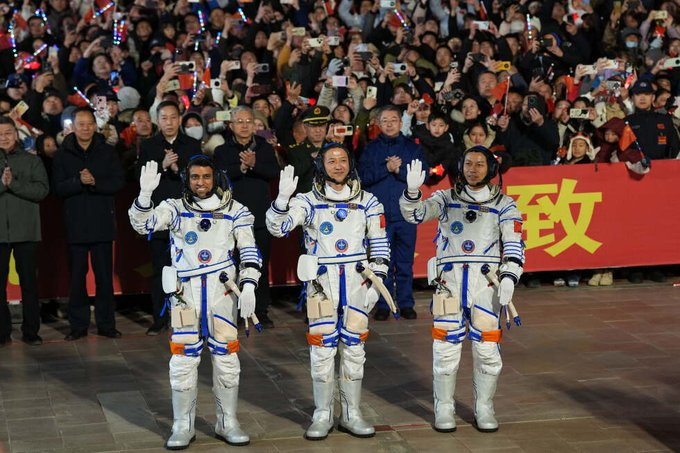
Ali, a 40-year-old wing commander in the Pakistan Air Force, is flying as a payload specialist alongside Chinese commander Tang Hongbo and flight engineer Wu Yi. When the spacecraft docks with Tiangong, he will become the first foreign national to board China’s space station.
He is also the first Pakistani to travel to orbit. Pakistani-born adventurer Namira Salim flew to the edge of space on Virgin Galactic’s suborbital Galactic 04 flight in October 2023.
Speaking to CGTN ahead of the launch, Ali described the mission as “not a finish line” but “a launchpad” for space cooperation between Pakistan and China.
Zeeshan Ali’s Experiments on China’s Tiangong Space Station
After docking, the Shenzhou-24 crew will join the three astronauts of the Shenzhou-23 mission, who have been aboard Tiangong since May.
Ali is expected to spend five to 10 days on the space station before returning to Earth aboard the Shenzhou-23 spacecraft.
During his stay, he will carry out four Pakistani biotechnology experiments. Amer Gilani, who oversees human spaceflight cooperation at Pakistan’s space agency, SUPARCO, told Reuters that Chinese institutions selected four biotechnology experiments from more than 300 university proposals. The research focuses on food security and climate change.
The experiments include growing microalgae as a potential source of food and oxygen for future space missions, and studying how spaceflight affects quinoa seeds.
The mission’s wider objectives include an in-orbit crew rotation with Shenzhou-23, routine operations and maintenance of the space station, and continued space science research, including payload experiments.
Ali was selected for the flight after months of preparation in China. He and fellow Pakistani pilot Khurram Daud emerged from three rounds of screening that assessed candidates’ medical fitness, psychological resilience and ability to withstand the forces experienced during launch. Both trained at the Astronaut Centre of China in Beijing, and Ali was given the Shenzhou-24 seat, with Daud named as his backup.
Training included working in weightlessness, handling emergencies in orbit and learning Mandarin to communicate with his crewmates. In a video shared by the Chinese embassy in Pakistan, Ali said the “real challenge” was mastering the Chinese language, rather than centrifuge training.
At a press briefing in Jiuquan the day before the launch, he spoke in Chinese and quoted Chinese poetry to describe his training. “During my training, I grew especially fond of a line by the Chinese poet Wang Zhihuan: ‘You can enjoy a grander sight by climbing to a greater height.’ That captures what training was like for me.”
The three astronauts attended a send-off ceremony at the launch center before boarding the spacecraft.
PM Shehbaz Sharif Hails Pakistan’s First Astronaut in Orbit
Prime Minister Shehbaz Sharif congratulated the nation on the mission, calling it “a historic first” and saying Pakistan had begun its journey “beyond the stars.”
In a statement, he said the mission represents the hopes of 240 million Pakistanis, especially the country’s youth and scientific community. He thanked Chinese President Xi Jinping, writing that “Pakistan-China friendship is surpassing the heights of the Himalayas, in its journey to outer space.”
He also described the mission as a reflection of the “exceptional trust, mutual respect and enduring brotherhood” between the two countries.
The prime minister praised both Ali and Daud for completing their training in China with hard work and dedication.
Ali and Daud were selected as the first two international astronaut candidates for China’s space program after Pakistan and China signed an agreement in February 2025 to select and train Pakistani astronauts for missions to the station.
China’s crewed space program began in 2003, when Yang Liwei became the country’s first astronaut on the Shenzhou-5 mission. The country completed the core structure of its Tiangong space station in 2022, and the station has been permanently crewed since then.
Pakistan’s space partnership with China has grown in recent years. In May 2024, China’s Chang’e-6 lunar mission carried Pakistan’s first lunar satellite, ICUBE-Q, to the Moon.
Stay tuned for more updates and news!