

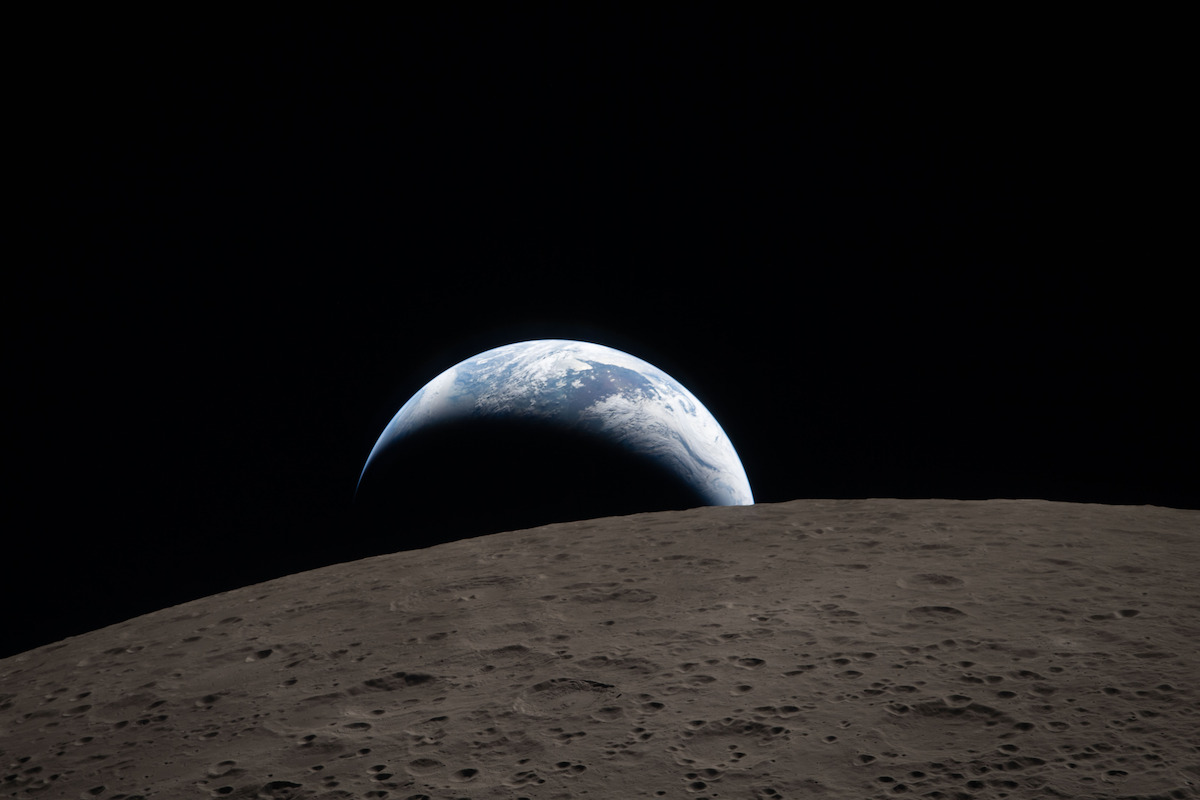
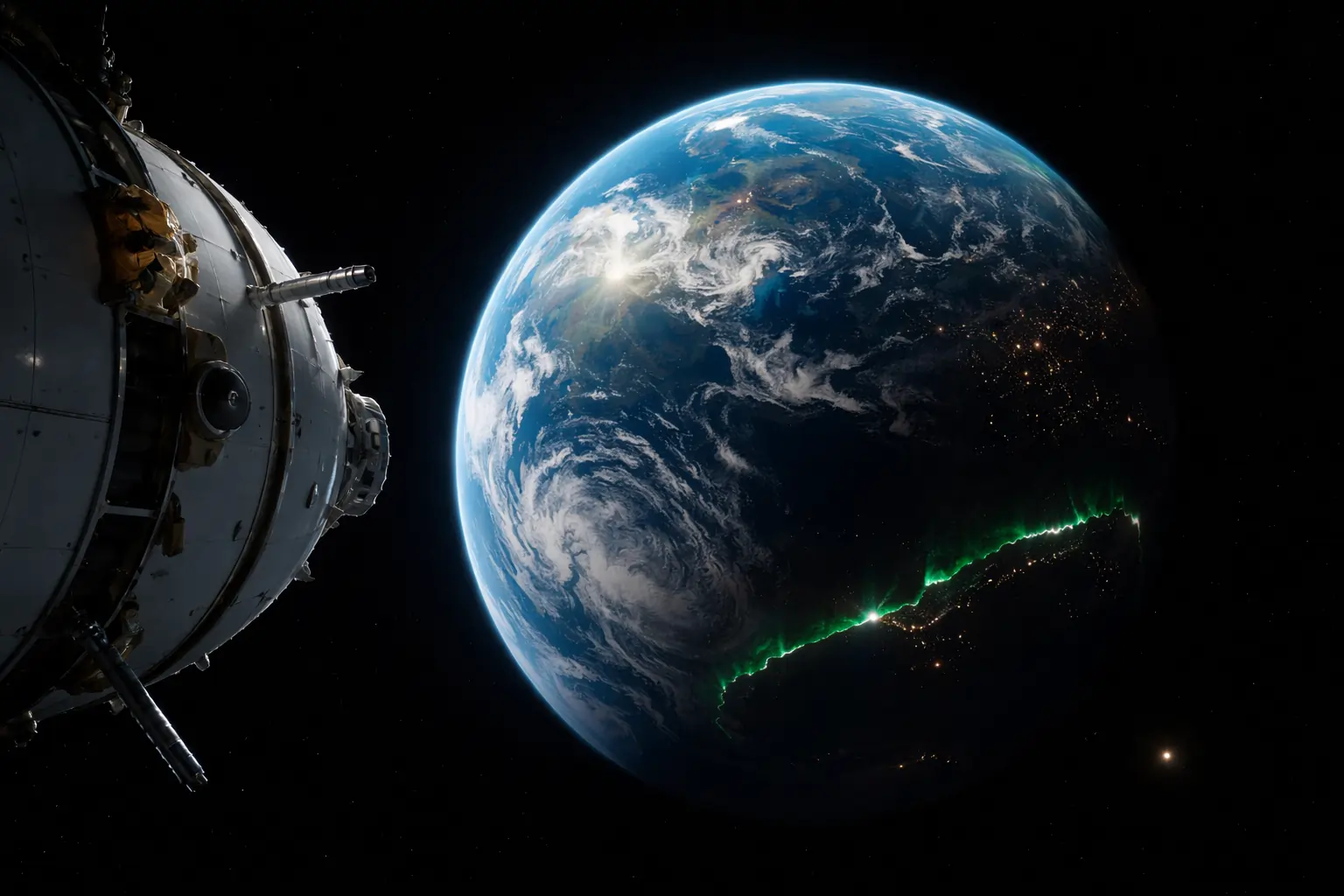
NASA released the first high-resolution images of Earth captured by the Artemis II crew as they travel toward the Moon. The agency shared the photos on social media alongside the original 1972 photograph, writing:
“We’ve come so far in the last 54 years, but one thing hasn’t changed: Our home looks gorgeous from space.”
The 1972 image, called The Blue Marble, was taken on December 7, 1972, by astronaut Harrison Schmitt aboard the Apollo 17 spacecraft on its way to the Moon. It remains one of the most reproduced photographs in history.
The 2026 image is titled Hello, World. Artemis II Commander Reid Wiseman took it through the Orion spacecraft’s window after completing the translunar injection burn. Like the original Blue Marble, the photo was taken with the South Pole facing upward.
The image shows the wide blue Atlantic Ocean surrounded by a thin glowing layer of Earth’s atmosphere. Green auroras are visible near both poles. NASA also identified a bright object at the bottom right of the frame as Venus. Additional photos from Wiseman show the divide between night and day cutting across Earth’s surface, and another captures the planet lit by the electric lights of human activity, with sunlight glowing along its edge.
Why the NASA Artemis II Earth Image Looks Different from 1972
The visual difference between the two photos became an instant talking point online. The 1972 image looks vivid and sharp. The 2026 image appears darker and hazier. The explanation comes down to lighting and camera technology, not the condition of the planet.
The newer photo captures the night side of Earth. The Apollo 17 image shows the fully illuminated day side. Zodiacal light is visible at the bottom right of the Artemis II image as Earth eclipses the Sun.
Apollo 17 used film cameras, which naturally boosted color and contrast. The Artemis II crew used a Nikon D5 DSLR camera with a 14-24 mm lens, shot at an ISO of 51,200, and the image was later processed in Adobe Photoshop Lightroom Classic. Modern digital sensors also apply atmospheric correction and color calibration, and most contemporary Earth images are composites rather than single shots. That combination tends to produce a less punchy result compared to analog film.
Artemis II Mission: First Crewed Lunar Flight Since Apollo
The Artemis II crew includes NASA astronauts Reid Wiseman, Christina Koch, and Victor Glover, along with Jeremy Hansen of the Canadian Space Agency. The mission marks the first time since 1972 that humans have traveled beyond Earth’s orbit.
Glover becomes the first Black man to venture within the vicinity of the Moon. Koch becomes the first woman to do so, and Hansen the first Canadian. All three NASA astronauts have previously been to the International Space Station. Hansen is making his first spaceflight.
The crew is on a 10-day mission aboard the Orion spacecraft, launched on a Space Launch System rocket. If the schedule holds, Artemis II will make its historic lunar flyby on April 6, swinging around the far side of the Moon. At its farthest point, the crew is expected to travel farther from Earth than any humans ever have, breaking the record of 248,655 miles set during Apollo 13 in 1970.
After the flyby, the crew will make a four-day return journey to Earth, using the planet’s gravity to pull Orion home without additional propulsion. A heat shield will protect the capsule during re-entry before parachutes deploy for splashdown.
Artemis II is a crewed flight test, verifying the systems needed for long-duration lunar exploration. NASA’s broader goal is a crewed Moon landing in 2028.