


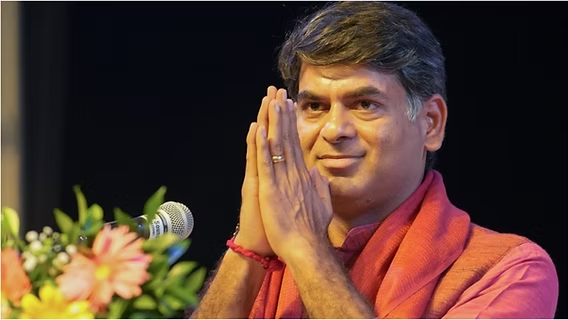
Karma is not a bad thing when it hits someone who deserves it. At the Screen Awards 2026, host Saurabh Dwivedi mocked comedian Rajpal Yadav over his jail term for failing to repay the amount he owed. It was an insensitive remark, especially toward a veteran actor who has delivered many hit films and has braved the ordeal with a smily face.
One month later, Rajpal Yadav got his chance to troll the journalist for his terrible acting debut in the Netflix film Kartavya, where his expressions never changed, even as he played the villain. I am not going into the debate over Rajpal Yadav’s antics, but it proves one thing: just as journalism is a profession, so is acting, and it should be treated as one.
Why performance deserves more respect in the age of celebrity culture
There is a growing misconception worldwide, especially in the subcontinent, that acting is easy. If someone can host a television show, read the news, dominate social media, or become a viral celebrity, many assume they can naturally become actors as well. History and reality say otherwise.
Acting is not simply about appearing on camera. It is about creating emotional truth and responding to the other character. It requires timing, control, vulnerability, body language, voice modulation, discipline, and often years of training. The camera can immediately expose the difference between a personality and a performer, which is why so many public figures who enter acting struggle to make the transition.
Saurabh Dwivedi isn’t the first journalist or TV anchor to transition to acting, and he won’t be the last. But his emotionless, monotonous performance in front of hardworking actors like Saif Ali Khan and Sanjay Mishra has sparked an uproar on social media. People are making fun of his acting style, which is reminiscent of newsreading rather than emoting. In fact, he has been compared to the OG Arjun Kapoor, who is considered one of Bollywood’s worst actors.
The criticism wouldn’t have hit hard had he not ridiculed Rajpal Yadav. However, he did that and then landed an acting gig himself, which gave everyone a chance to expose his hypocrisy. It seems people who were angry about his comments got the license to troll him, and that’s exactly what he did.
When Visibility Is Mistaken for Talent
Modern celebrity culture has blurred the line between popularity and ability. Producers increasingly cast influencers, anchors, YouTubers, and internet personalities, believing their fan following will automatically translate into screen presence. According to Pakistani director Syed Noor, his decision to cast influencer Jannat Mirza as the heroine in Bajray Di Rakhi was one of the worst decisions of his career.
That doesn’t mean it doesn’t work; sometimes it does commercially. Hania Aamir and Dananeer Mobeen are two prime examples who transitioned to acting like pros and are now doing well for themselves. However, the results are often disappointing, as seen with the former Lallantop host.
A person can be intelligent, articulate, and charismatic yet still fail as an actor because the skill sets are entirely different. Similarly, a person who doesn’t fit the mold of a hero can sometimes shock the audience and carve out a distinct identity for himself, as Nawazuddin Siddiqui did.
Social Media Fame Cannot Replace Craft
Casting someone based on their social media followers or popularity is a misconception that needs to be addressed because if you aren’t talented, you can’t succeed in acting. You might get good projects, be cast opposite bigger names, or even get protocol once in a while, but once the secret is out that you can’t act, everything would fizzle out.
Craft is something you develop along the way. Look at how American talk show host Stephen Colbert performed in the current season of Elsbeth, where he played a talk show host who was mean to everyone, and his murder wasn’t mourned by his team.
Rather than playing himself, Colbert adapted to the show’s tone with remarkable ease. His timing, expressions, and understanding of scene dynamics reflected someone who respects the mechanics of performance. That distinction is important.
From Newsrooms to Film Sets
History shows that transitioning from journalism or television presenting to acting is possible — but only for those who genuinely respect the craft.
In Pakistan, Tariq Aziz remains one of the strongest examples. His larger-than-life personality carried theatrical depth, and he understood how to command both audiences and characters. Qurban Jeelani and Bindiya also successfully made the crossover by embracing performance rather than relying solely on familiarity.
Tauseeq Haider has recently made a comeback as an actor and is now part of the TV scene thanks to his ability to play any character, whether rich or poor, young or old. His former PTV colleagues, Saba Faisal and Noor ul Hassan, perhaps represent the finest modern example. Many younger viewers do not even realize that Saba Faisal began her career as a news anchor and Noor ul Hassan as a talk show host, because they worked hard enough to reinvent themselves completely as actors.
India has produced similar success stories. Smita Patil started as a television newsreader before becoming one of Indian cinema’s most respected performers. Her success stemmed from dedication, observation, and artistic seriousness.
But for every success story, many have to struggle. Although veteran actor Rizwan Wasti had a lengthy career, he was often cast as a rich man or a foreign returnee because of his heavy English accent. The same goes for Adnan Jaffar, who is making Pakistan proud at home and internationally, but is typecast for his tall stature, fair skin, and perfect English accent.
Celebrity Comes With Responsibility
The problem extends beyond acting itself. In today’s entertainment culture, celebrities often make casual statements about cinema, performance, and art without understanding the weight their words carry.
Pakistani social media star and actor Dananeer Mobeen recently faced criticism for her remarks about Devdas, which many film lovers found shallow and historically uninformed. The issue wasn’t merely whether one likes or dislikes the film; it’s part of Urdu literature and shouldn’t be judged by its adaptation.
When celebrities speak, millions listen. That influence creates responsibility. A public figure cannot afford to treat art carelessly, particularly when discussing iconic films that shaped cinematic history across generations. Statements made casually online can quickly shape public opinion, especially among younger audiences who may never have read the original novel or watched the earlier versions before SRK’s.
Acting Isn’t Easy, and That’s the Point
The entertainment industry often celebrates overnight fame while ignoring years of artistic labor. Yet acting remains one of the most demanding professions in the media.
Actors must repeatedly perform emotions under pressure, in front of lights, with retakes, cameras, deadlines, and public scrutiny. They must become believable in entirely artificial situations. They must disappear into characters while still maintaining technical precision.
That is not easy. The careers of people like Tariq Aziz, Smita Patil, and Saba Faisal prove that transitioning into acting can be successful. But their journeys also prove something else: success comes only when performers respect the profession enough to learn it properly.
Because acting is not a shortcut. It is not a side hustle. And it is certainly not easy. It is a profession — and it deserves to be treated like one.