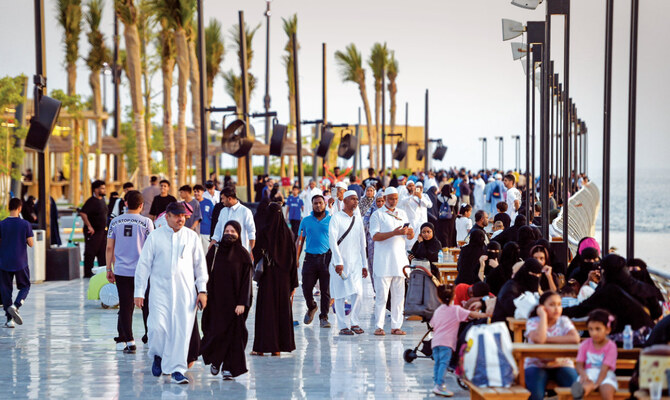
Nearly 35 million expatriates live and work across the six Gulf Cooperation Council countries, forming the backbone of every major industry in the region.
The Gulf is home to one of the world’s most diverse working populations, with expatriates living and working alongside local nationals to shape the region’s modern economies. From construction workers helping build Dubai’s skyline to engineers contributing to Saudi Arabia’s Vision 2030 mega-projects, foreign workers are an important part of the workforce that drives growth across the GCC.
According to recent figures published by Al Jazeera, sourced from Global Media Insight, KUNA, and Kuwait Times, the six GCC countries together host approximately 35 million expatriates. They live in Saudi Arabia, the UAE, Oman, Kuwait, Qatar, and Bahrain. They come from every continent. And they have, over decades, transformed the Gulf into one of the most diverse working regions in the world.
The Largest Expatriate Communities Across the GCC
The largest groups of non-nationals living across all six GCC countries are:
- India: 9.1 million
- Bangladesh: 5.04 million
- Pakistan: 4.9 million
- Egypt: 3.3 million
- Philippines: 2.2 million
Indians make up the single largest expatriate community across the Gulf, with a presence so substantial that they constitute the largest foreign workforce in five of the six GCC countries. The only exception is Saudi Arabia, where Bangladeshi nationals form the largest expatriate group.
Saudi Arabia
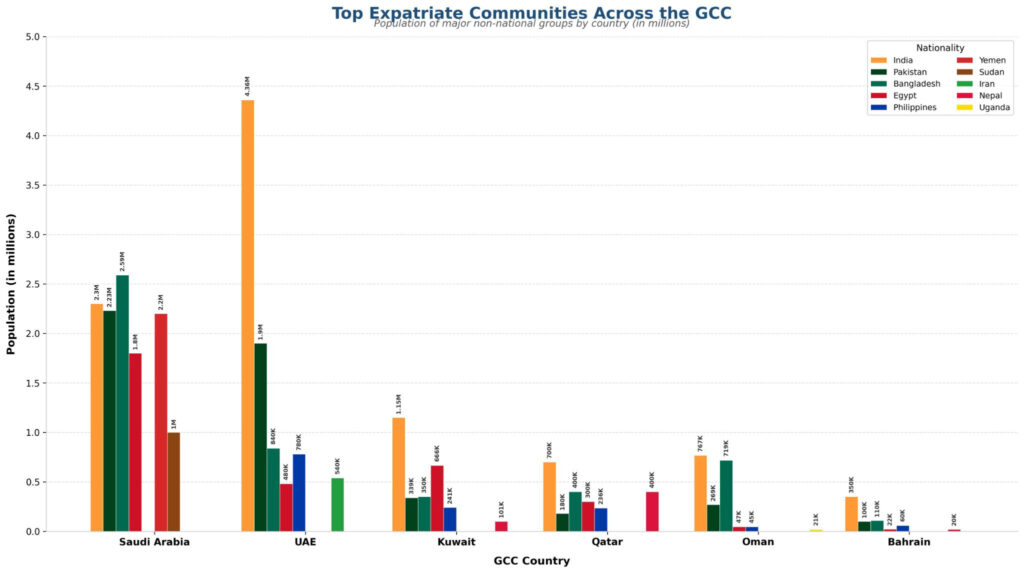
With a total population of approximately 37 million, Saudi Arabia is the largest of the six GCC nations. Of this, around 20.5 million are Saudi nationals, and 16.4 million are non-nationals.
The six largest expatriate communities in Saudi Arabia are:
- Bangladesh: 2.59 million
- India: 2.3 million
- Pakistan: 2.23 million
- Yemen: 2.2 million
- Egypt: 1.8 million
- Sudan: 1 million
Saudi Arabia remains the top destination for Bangladeshi migrant workers globally, with nearly 100,000 Bangladeshis migrating to the kingdom in the final quarter of 2022 alone. The Pakistani diaspora in Saudi Arabia stood at approximately 1.81 million as of the 2022 census, with continued growth since.
United Arab Emirates
The UAE is home to approximately 11.5 million people. Emiratis make up around 12 per cent of the population, while non-nationals account for nearly 88 per cent, one of the highest expatriate ratios in the world.
The six largest expatriate communities in the UAE are:
- India: 4.36 million
- Pakistan: 1.9 million
- Bangladesh: 840,000
- Philippines: 780,000
- Iran: 540,000
- Egypt: 480,000
The Indian community in the UAE is the largest single national group in the country, dominating sectors ranging from finance and technology to retail, healthcare, and hospitality.
Kuwait
Kuwait has a population of around 4.8 million, with 1.56 million nationals and approximately 3.3 million non-nationals. Expatriates account for nearly 79 per cent of Kuwait’s total workforce.
The six largest expatriate communities in Kuwait are:
- India: 1.15 million
- Egypt: 666,000
- Bangladesh: 350,000
- Pakistan: 339,000
- Philippines: 241,000
- Nepal: 101,193
Indian workers topped Kuwait’s workforce in recent figures, accounting for around 25 per cent of all employees in the country. Kuwait has actively pursued a policy known as “Kuwaitisation” to gradually replace foreign workers with citizens in certain sectors.
Qatar
Qatar has a population of approximately 3.2 million, of whom only 330,000 are Qatari nationals. Expatriates form 88 per cent of the total population.
The six largest expatriate communities in Qatar are:
- India: 700,000
- Bangladesh: 400,000
- Nepal: 400,000
- Egypt: 300,000
- Philippines: 236,000
- Pakistan: 180,000
Qatar’s South Asian workforce, particularly from India, Bangladesh, and Nepal, played a central role in the country’s preparations for major international events including the 2022 FIFA World Cup.
Oman
Oman is somewhat unique in the GCC, with foreign workers making up around 41 per cent of the population rather than the overwhelming majority seen in other Gulf states. Of Oman’s 4.7 million residents, 2.8 million are Omani nationals and 1.8 million are non-nationals.
The six largest expatriate communities in Oman are:
- India: 766,735
- Bangladesh: 718,856
- Pakistan: 268,868
- Egypt: 46,970
- Philippines: 45,213
- Uganda: 20,886
Indian and Bangladeshi residents together contribute more than a quarter of Oman’s total population, particularly in construction, retail, logistics, hospitality, and the energy sector.
Bahrain
Bahrain has the smallest population of all six GCC countries, with approximately 1.58 million residents. Of this, 739,736 are Bahraini nationals and 848,934 are non-nationals.
The six largest expatriate communities in Bahrain are:
- India: 350,000
- Bangladesh: 110,000
- Pakistan: 100,000
- Philippines: 60,000
- Egypt: 22,000
- Nepal: 20,000
Indians dominate Bahrain’s expatriate population, with a long-established community engaged in trade, banking, healthcare, and engineering.
South Asians, particularly from India, Pakistan, and Bangladesh, dominate construction, retail, logistics, domestic services, and energy. Filipino workers are heavily represented in healthcare, hospitality, and customer service. Egyptians fill key roles in education, engineering, and media. African and Arab expatriates round out a diverse working population that has, over the decades, made the Gulf one of the most internationally connected regions on Earth.
For many of these workers, the Gulf is home in every sense except citizenship. Generations have lived, married, raised children, and built careers across Riyadh, Dubai, Doha, Kuwait City, Manama, and Muscat. Their remittances form the financial lifeline of millions of families back home, contributing tens of billions of dollars annually to the economies of India, Pakistan, Bangladesh, the Philippines, and Egypt.
As GCC countries pursue ambitious Vision strategies, the role of foreign workers remains as crucial as ever.
Stay tuned for more updates and news!