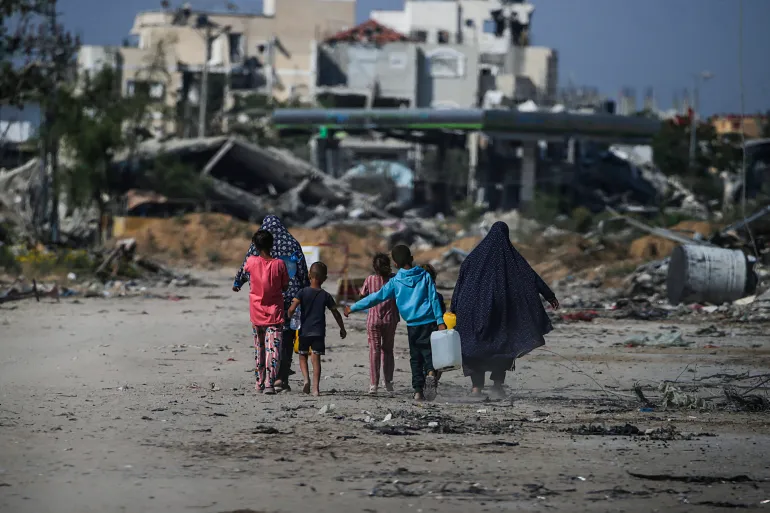
A new study finds the number of active conflicts worldwide reached its highest point since World War II in 2025.
The world recorded more active conflicts in 2025 than in any year since World War II, according to a new study from the Peace Research Institute Oslo. Published this week in the institute’s annual report, Conflict Trends: A Global Overview, 1946 to 2025, the findings draw on data from the Uppsala Conflict Data Program at Uppsala University in Sweden.
The study counted 65 state-based conflicts across 35 countries in 2025, the highest number since systematic records began in 1946. A state-based conflict is one in which at least one party is a government, a category that covers both civil wars and wars between nations.
Interstate conflict, meaning fighting between two or more countries, doubled from the previous year to eight in 2025. That is also the highest total since the data set began. For decades, civil wars made up the bulk of global conflict.
The eight interstate conflicts include the war between Russia and Ukraine, fighting between Iran and Israel, and confrontations between India and Pakistan and between Thailand and Cambodia. The list also covers a border conflict between Afghanistan and Pakistan and clashes in the Red Sea and Gulf of Aden involving the United States.
Several countries were party to more than one conflict at the same time. Israel was linked to conflicts connected to Gaza, Syria, Lebanon, Iran, and Yemen. Myanmar, Pakistan, and Nigeria each faced multiple armed conflicts. Of the 65 conflicts recorded, 13 reached the threshold of war, defined as more than 1,000 battlefield deaths in a single year.
The data is separated into categories. State-based violence includes civil wars and wars between nations, where one or both sides is a government. Non-state violence covers clashes between two groups, neither of which is a state, such as sectarian fighting or organized criminal violence. One-sided violence refers to attacks directed at civilians, which the study reported rising in 2025.
By region, Africa was the most affected by state-based violence, followed by Asia, the Middle East, the Americas, and Europe. The Middle East recorded its highest number of state-based conflicts on record in 2025.
Rising conflict deaths and what comes next
About 245,000 people were killed in battle-related violence in 2025, up from roughly 188,000 the previous year. That figure is the third deadliest annual total since 1989. Much of the increase was tied to the war in Ukraine, the conflict in Gaza, and escalating violence in Sudan, including fighting around the city of El-Fasher.
Over a longer period, more than 930,000 people have been killed in state-based conflicts since 2021, a total that roughly matches the combined figure for the previous two decades.
Lead author Siri Aas Rustad, research director at the institute, described the scale of interstate conflict as deeply concerning. She attributed the increase to geopolitical rivalry, border disputes, and regional escalation, particularly in the Middle East.
Interstate conflicts have climbed sharply over the past decade, a pattern the researchers said predates the current United States administration and cannot be explained by any single policy or political leader. The study framed the shift as part of a wider debate over changes to the international order that has held since the end of the Cold War.
The researchers cautioned that 2026 does not appear likely to be more peaceful than the year before, noting that data collected so far this year points to a continuation of the trend. The full findings, covering state-based violence, non-state violence, and one-sided violence, are set out in the institute’s annual overview spanning 1946 to 2025.