


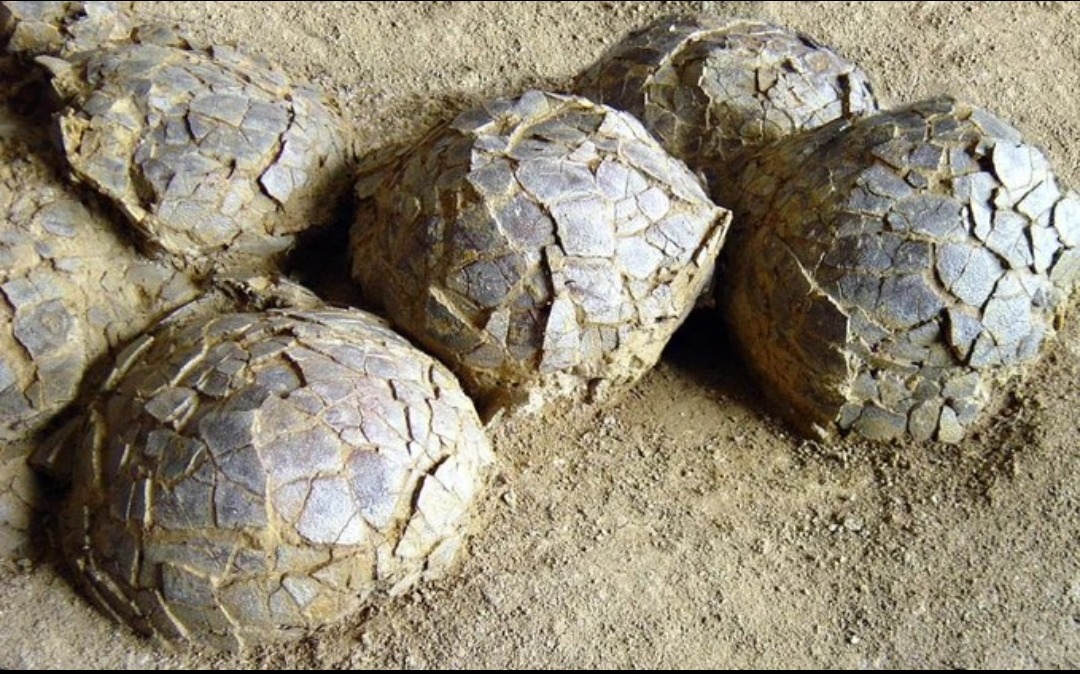
Paleontologists in southern France have uncovered nearly 100 fossilized dinosaur eggs dating back 72 million years.
Paleontologists in southern France have uncovered nearly 100 fossilized dinosaur eggs estimated to be around 72 million years old.
The eggs were found at the Mèze fossil site, on land tied to the Musée-Parc des Dinosaures de Mèze in a coastal town in southern France. Each egg is roughly the size of a small melon. Many are intact, with shells and internal structures still visible.
The discovery was made during winter excavations and announced in late March 2026. Geologist Alain Cabot, the museum’s founder and director-curator, led the work. He established the museum nearly three decades ago.
More than 100 eggs became visible within weeks of digging. Cabot said the egg-bearing rock layer extends beyond the current dig site, and that hundreds more eggs could still lie buried in the sediment. He told The Times the deposit would take generations of paleontologists to study.
Museum officials said the Mèze site is now the largest dinosaur egg deposit in Europe, and among the largest fossil nesting grounds worldwide. They compared it to dinosaur egg sites in Argentina, China, and Mongolia. Some paleontologists said the site’s significance should not be overstated until further analysis is complete.
Titanosaur Eggs and Late Cretaceous Nesting Ground
The eggs date to the Late Cretaceous period, roughly 70 to 72 million years ago, near the end of the age of non-avian dinosaurs.
At that time, the region formed part of the Ibero-Armorican Island, a prehistoric landmass that connected parts of present-day France, Spain, and Portugal. The area was a tropical plain crossed by rivers and wetlands.
Initial studies suggest the eggs belonged to several herbivorous species. The most common type is round, and the team attributes these to titanosaurs, long-necked herbivores that grew up to about 50 feet long and weighed between 15 and 20 tons. Titanosaur remains have been found elsewhere in southern France.
Researchers also reported eggs from smaller dinosaurs, including the herbivore Rhabdodon priscus and small theropods. Earlier work at the site indicates the area was used as a nesting ground by multiple dinosaur species over a period of nearly 10 million years.
How the 72-Million-Year-Old Dinosaur Eggs Were Preserved
Researchers attribute the condition of the eggs to the geological conditions at the site. They believe periodic flooding and river overflows buried the nests under mud and sediment shortly after the eggs were laid. The rapid burial sealed the shells and protected them from erosion. The clay marls that preserved the eggs also slowed the excavation, with mud and winter rain repeatedly stalling the work.
Researchers think titanosaurs nested in shallow pits covered with vegetation, and that they returned to the same area to lay eggs across multiple seasons. Cabot estimated the egg-rich zone covers a large area, with figures cited up to around 15 square miles.
Cabot said studying the eggshells and surrounding fossil layers could provide information about dinosaur reproduction, nesting behavior, prehistoric biodiversity, and the climate of the period. The excavation is ongoing, and Cabot said the egg-bearing layer continues beyond the current dig.