


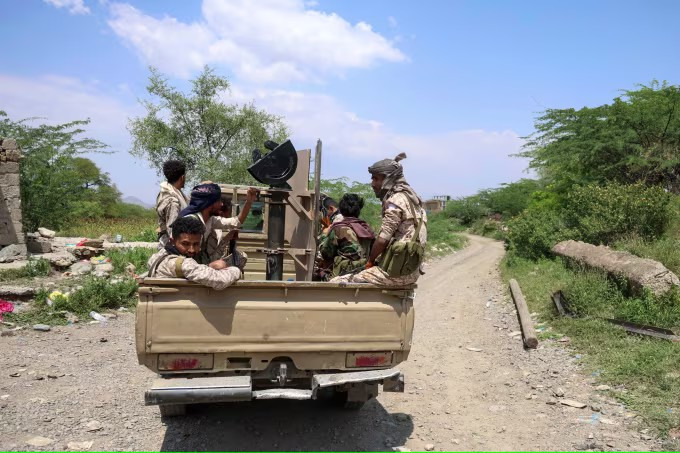
The Houthis, an armed group that controls Yemen’s capital and much of the country’s north, are at the center of renewed fighting. Yemen’s internationally recognized government has announced military operations aimed at retaking Houthi-held territory. Government and Houthi sources have issued competing accounts of developments along Yemen’s Red Sea coast, while Saudi authorities have reported attacks on airports and other facilities. Independent verification of battlefield claims remains limited.
The group calls itself Ansar Allah, meaning “Supporters of God.” It controls Sanaa and much of northern Yemen, where most of the country’s population lives. Yemen’s government, backed by a Saudi-led coalition, controls much of the south and east, with its interim capital in the southern port city of Aden.
The latest escalation marks some of the most intense fighting Yemen has seen in years, following a period of relative calm that began with a UN-brokered truce in 2022.
Who Are the Houthis and Where Did the Group Come From?
The Houthi movement emerged in the 1990s in Saada, a mountainous province in Yemen’s far north near the Saudi border. It began as a religious and political revival movement among the Zaidi community before gradually developing into an armed group.
The movement takes its name from its founder, Hussein Badreddin al-Houthi, who opposed the Yemeni government of the time. He was killed in clashes with government forces in 2004. Since then, the group has been led by his brother, Abdul-Malik al-Houthi.
Between 2004 and 2010, the Houthis fought six rounds of conflict with the Yemeni state. Over those years, the group grew from a regional movement into an organized armed force with a firm hold on much of Saada.
How the Houthis Took Control of Sanaa in 2014
The 2011 protests that swept across the region reached Yemen and led longtime president Ali Abdullah Saleh to hand over power. His successor, Abd-Rabbu Mansour Hadi, took office facing serious economic, political and security challenges.
In September 2014, the Houthis took control of Sanaa. In March 2015, a Saudi-led coalition that included the UAE intervened at the request of Yemen’s government. According to the UAE Ministry of Defence, the UAE’s main military presence ended in 2019, while specialised counterterrorism personnel remained. On 30 December 2025, the ministry announced the end of that remaining deployment.
Years of war have taken a heavy toll on civilians. The United Nations has described Yemen as one of the world’s worst humanitarian crises, and more than 5.2 million people were internally displaced even before the latest escalation, according to the UN refugee agency, UNHCR.
In April 2022, a UN-brokered truce brought a significant drop in fighting. That same month, Yemen’s government formed the Presidential Leadership Council, which is now chaired by Rashad al-Alimi.
Houthi Red Sea Attacks and Regional Tensions
The Houthis are widely described as aligned with Iran. Weapons recovered from the group share characteristics with Iranian-made arms, according to reports by a UN Panel of Experts, and several governments accuse Tehran of arming the group. Iran denies supplying it with weapons.
After the war in Gaza began in October 2023, the group fired missiles and drones toward Israel and targeted commercial shipping in the Red Sea and the Bab el-Mandeb Strait, one of the world’s busiest trade routes. Many shipping companies rerouted vessels around Africa, adding time and cost to global trade.
The attacks led to US and UK strikes on Houthi targets in Yemen. In February 2022, UN Security Council Resolution 2624 described the group as a terrorist group, and in March 2025 the US State Department designated it a foreign terrorist organization.
The UAE has also been directly affected. In January 2022, a Houthi drone and missile attack on Abu Dhabi killed three people, according to UAE authorities.
Latest Yemen War News as Government Forces Launch Offensive
In mid-September, Houthi forces seized the Red Sea port city of Mocha and strategic islands in the Bab el-Mandeb Strait, according to Yemeni military sources. The group has also claimed attacks on Saudi Aramco facilities, including the Jazan refinery.
In a statement dated 8 October 2026, the UAE Ministry of Foreign Affairs condemned Houthi attacks on King Khalid and Abha international airports in Saudi Arabia, which it said killed three people and injured dozens of civilians. The ministry described the attacks as a violation of Saudi sovereignty and reaffirmed the UAE’s solidarity with the Kingdom.
A day earlier, on October 4, Rashad al-Alimi announced military operations to retake the remaining Houthi-held territory. “We have instructed the armed forces, security forces and all military formations to begin carrying out their assigned tasks,” he said in a televised address.
Government forces have since announced an offensive toward Sanaa and are working to reverse recent Houthi gains around Taiz, including in the al-Waziiya district. Government-aligned forces said they had retaken Mocha and Dhubab Airport, a claim the Houthis disputed. Independent verification of front-line claims remains limited.
FLAMES and HEAVY SMOKE rise from Aramco’s Khurais oil facilities following an alleged HOUTHI STRIKE
The oil facility is located southeast of Riyadh and is one of Saudi Arabia’s largest oil fields, with a production capacity of around 1.5 million barrels of crude oil per day https://t.co/KM4H8iR81c
— RT Intl (@RT_on_X) October 7, 2026On 5 October 2026, Pakistan, Saudi Arabia and Türkiye announced measures to implement their collective defence commitments under the Makkah Joint Defense Agreement signed in August. Their joint statement called for the rapid deployment of agreed military forces and capabilities to Saudi Arabia, subject to approved arrangements and each country’s national legislation. The announcement did not itself confirm that deployments had been completed. On 8 October, Turkish Foreign Minister Hakan Fidan said Türkiye was assessing defensive assistance and ruled out participation in offensive operations.
The renewed fighting has deepened Yemen’s humanitarian crisis. At a UN briefing on 6 October 2026, the International Organization for Migration reported that 184,000 people had been displaced in Yemen as of 4 October. Humanitarian agencies continue to face insecurity, damaged infrastructure and restrictions on access as they work to reach affected communities.