
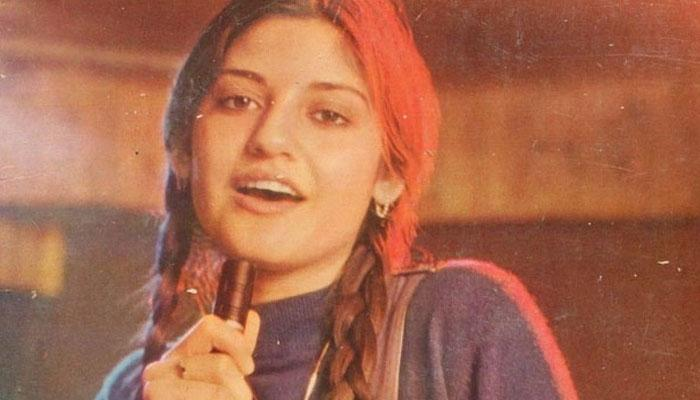
Decades before independent pop went mainstream in South Asia, a teenager from Karachi was topping charts across the globe.
Turn on any streaming playlist of South Asian pop today and you are hearing a sound that traces back, in large part, to one voice. Nazia Hassan was barely a teenager when she started, and by the time she was fifteen she had already changed what pop music could be for an entire region. Born in Karachi, Pakistan, in 1965, she grew up partly in London, and that mix of worlds would shape a career that crossed borders in a way few artists from the subcontinent had managed before.
Her breakthrough came in 1980 with the song “Aap Jaisa Koi,” recorded for the Indian film Qurbani when she was just fifteen. The track was composed by the Indian-British producer Biddu, and it turned Nazia into an overnight star. It also earned her the Filmfare Award for Best Female Playback Singer, making her the youngest recipient of that honor and the first Pakistani to win it. For a newcomer with no prior professional experience, it was a remarkable start.
What came next is what truly set her apart. In 1981, Nazia and her younger brother Zoheb Hassan released Disco Deewane, produced by Biddu and put out through His Master’s Voice in India. It was one of the first major non-film pop albums in South Asia, arriving at a time when film soundtracks completely dominated the music scene. The record did not just sell well. It rewrote the rules.
Aap Jaisa Koi
The song that started it all. Recorded for the film Qurbani in 1980 when Nazia was fifteen, its opening line became one of the most recognized in South Asian pop. The track made her a household name across India and Pakistan overnight and earned her the Filmfare Award that announced her arrival.
Disco Deewane
The title track of her debut album with Zoheb, released in 1981, and the song most associated with her name. Its blend of disco and South Asian melody was unlike anything in the market at the time, and its appeal proved lasting. Decades later it was reworked for the Bollywood film Student of the Year, introducing the song to a new generation.
Boom Boom
From the 1982 Star/Boom Boom soundtrack, this upbeat number showed the duo could follow a massive debut with more of the energy that made them stars. It kept Nazia and Zoheb at the front of the region’s pop scene and remains a favorite among fans of their early work.
Dum Dum Dee Dee
A standout from the 1984 album Young Tarang, remembered as much for its music video as its melody. Presented as the duo’s playful take on Alice in Wonderland, the visuals gave the song a storybook quality that set it apart. The track was later featured in the film Miss Lovely, which premiered at the Cannes Film Festival.
Aankhein Milane Wale
Also from Young Tarang, this ballad is often named among Nazia’s finest performances. Her entrance in the music video, descending a staircase in a pastel dress while holding a masquerade mask, became one of the enduring images of her career, matched by a tender vocal that still moves listeners.
Nazia’s influence went well beyond record sales. She and Zoheb are credited as the pioneers of Pakistani pop, laying the groundwork for the independent pop movement that would grow across the region for decades. Away from music, she worked as a social activist and served as a cultural ambassador for UNICEF, using her fame for causes beyond the stage.
She passed away in 2000 at the age of thirty-five, and her memory has only grown more cherished in the years since. Nearly half a century after she first stepped in front of a microphone, Nazia Hassan is widely celebrated as the ‘Queen of South Asia Pop’ and still recognized as the voice that proved a young Pakistani artist could reach the world, and the sound she helped create continues to echo through the pop music of the subcontinent.
Follow us for more updates and news!