

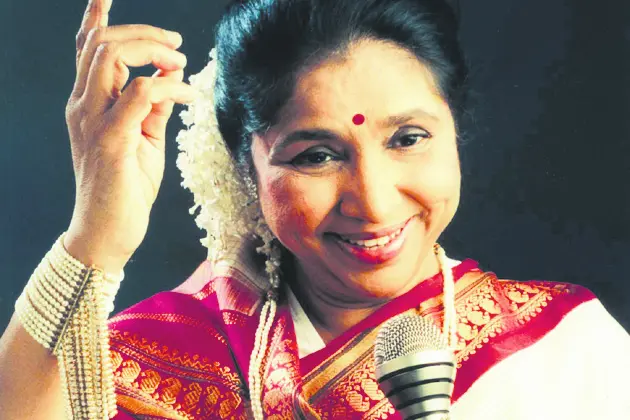
Asha Bhosle may have left this world for her heavenly abode, but the veteran singer’s songs and legacy will keep her alive for a long time. Not only did she help build Bollywood with her vocals, but she was also instrumental in kickstarting the revival of Pakistani cinema.
Seems hard to believe? Well, it’s true, because she was part of the soundtrack of Adnan Sami Khan’s debut film as an actor and music director, Sargam, which remains one of the best soundtracks to come out of Pakistan in the last 40 years, a feat for which Asha Bhosle was partially responsible.
Why did Asha Bhosle agree to work with a Pakistani music composer in the first place?
Before the Sargam soundtrack was released in 1995, Adnan Sami Khan was emerging as a musical talent who could both sing and compose. His heavy vocals reminded listeners of the legendary Bollywood giant R D Burman, who also had a knack for composing songs that sounded brilliant in his own voice. Like all listeners, Asha Bhosle would also have found similarity in the two voices – one of the recently departed R D Burman and the other Adnan Sami Khan.
Since Adnan Sami Khan was a huge fan of R D Burman, and his compositions resembled the late music composer’s, her frequent collaborator and close friend (rumored to be his wife in some publications), Asha Bhosle, would have been surprised when the youngsters asked her to provide vocals for his upcoming film Sargam. In those days, Pakistani artists were not banned from India, and many, including Mohsin Khan, Zeba Bakhtiar, Talat Hussain, and Anita Ayub, worked there as actors, but no Indian – be it a singer, actor, or even choreographer – was allowed to work in Pakistan.
It all changed with Sargam where Asha Bhosle agreed to lend her voice for Zeba Bakhtiar, who was making her film debut in Pakistan, after being part of a hit Bollywood flick Henna where Lata Mangeshkar was her voice in songs. Asha ji didn’t talk much about featuring in a Pakistani film, but when the film came out in 1995, it was reported that the songs were recorded in London, which is why there wasn’t much objection to Asha Bhosle’s involvement.
However, when the songs were aired on TV, they were redubbed by Hadiqa Kiani, who was also part of the soundtrack, because of a long-standing ban on Indian performers in Pakistan. The bond between Adnan Sami Khan and Asha Bhosle is evident in their chemistry in the songs, which no one else has been able to replicate since. It was reported that when Adnan Sami Khan lost his Pakistani citizenship at the turn of the century, Asha Bhosle came to his rescue and advised him to become an Indian citizen.
The duo collaborated not only on Sargam but also on another album, Badaltey Mausam, released in late 1997. The album was also supposed to be the soundtrack of another Pakistani film, but that couldn’t materialize. What did happen was that when Adnan Sami Khan became an Indian citizen, he re-released the same album as Kabhi To Nazar Milao, and it became an instant hit in India. Even those who had listened to the album in Pakistan after its release became hooked on it, especially on songs like Lift Karade and Bheegi Bheegi Raton Main.
Why is the soundtrack of Sargam still relevant after more than 3 decades?
Sargam was not just an iconic music album but also a film in which Adnan Sami Khan made his acting debut. Since he had prior experience directing music videos like Dekho Jaaneman and acting in a TV music show, Raag Time (where he played dual roles in one episode), he excelled in front of the camera, but only because his music was there to support him. Had Asha Bhosle not been there, Sargam would have been just another pleasant-sounding soundtrack that would have faded away when other films came out. It was Asha’s vocals and experience that made Sargam one of the best film soundtracks to come from Pakistan.
The film’s plot revolved around Adnan Sami Khan’s character, an aspiring music enthusiast who wanted to learn from the masters. In his quest for excellence, he ran away from home, met one of the few living Ustaads (played by Maharaj Ghulam Hussain Khattak), and became his disciple. However, he also fell in love with his granddaughter (played by Zeba Bakhtiar), who turned out to be his long-lost cousin, one who was disowned by his uncle (played by Nadeem Baig) on the orders of the family patriarch (played by Mustafa Qureshi).
The film was a rehashed version of another Pakistani classic, Zeenat, in which Mehdi Hassan sang the popular Rafta Rafta song for Shahid and Shabnam. However, writer-director Syed Noor blended the musical element so well that it turned out to be an excellent entertainer, one that established Adnan Sami Khan as a complete entertainer, Zeba Bakhtiar as a classy heroine, and others like Najam uz Zaman, who played the antagonist, in the presence of veteran actors Nadeem Baig, Deeba, and Mustafa Qureshi.
How did the OST help the listeners believe in Pakistani film music?
The songs of Sargam weren’t just a collaboration between Adnan Sami Khan and Asha Bhosle; they brought together some of the country’s best names. A young Hadiqa Kiani lent her vocals to the songs that didn’t require Asha Bhosle’s services, while Ustad Hamid Ali Khan provided vocals for the songs filmed on Maharaj Khattak. Adnan Sami Khan’s famous hamd Aye Khuda featured in the film’s opening credits, which was off-the-books in every way, but in a good way.
Apart from the hamd penned by Muzaffar Warsi, all the songs were written by Riaz ur Rehman Saghar, a veteran journalist turned poet, whose words were beautifully rendered by all the playback singers. The film features as many as 10 romantic numbers, which was huge considering Pakistani films featured just five or six songs in those days, most of which were just forgettable.
There were the classical songs Suhani Rutt Ayi and Kab Se Khili Ho (Hamid Ali Khan, Adnan Sami Khan, Hadiqa Kiani), followed by Chamki Kiran (Adnan Sami Khan and Hamid Ali Khan) and Adnan Sami Khan’s melancholic Bheega Hua Mausam Pyara and Hadiqa Kiani‘s Woh Mujhe Yaad Aaya, her only solo song in the album.
However, the songs featuring Asha Bhosle touched differently – be it the sizzling romantic number Kia Hai, Yeh Uljhan Kia Hai, or the evergreen mehndi song Zara Dholki Bajao Goriyo, each song impacted the listeners like never before. Thirty years later, they are still in the playlists of those who were either growing up at the time or born in those days, which is hardly the case for many of the songs from that era.
In Pyar Bina Jeena Nahi Jeena, there comes a moment when Adnan Sami Khan hums at the end of a verse delivered by Asha Bhosle, and trust me, the way he delivered that one word remains priceless. Similarly, the way Asha Bhosle turns playful in Barse Badal and gives the heroine the margin to go naughty is only something she could have done. Like any R D Burman classic, the song features Adnan Sami Khan being clueless at the very beginning, but falling in love as soon as the heroine hugs him, and the proverbial tables turn emotionally for both the actors and the playback singers.
What helped Sargam the most was its timings – it came at a time when songs were being given importance by all parties involved, right from the producer to the lyricists. Tehseen Javed’s Dil Hogaya Hai Tera Deewana from Jawed Sheik’s Mushkil even made it to the Bollywood charts because it seemed different, fresh, and a lot like Bollywood songs, instead of Pakistani songs.
Director Syed Noor, with his musical films Jeeva, Sargam, Ghoonghat, and Sangam, capitalized on that and heralded an era in which cinegoers returned to Pakistani cinemas. Songs became instrumental to the film’s success because, in the pre-Internet era, the best way to judge a film was its soundtrack and its placement on Lollywood Top 10, PTV’s hit music show featuring the latest film songs.
Sargam didn’t just change the tide for Pakistani cinema and open doors for young filmmakers and music composers; it also won most of the trophies at Nigar Awards that year. While Syed Noor took the Best Film, Best Director, and Best Script Writer trophies home, the heroine Zeba Bakhtiar was adjudged Best Actress, and Maharaj Khattak won the Best Supporting Actor trophy. Adnan Sami Khan was declared the Best Music Director, Riaz Ur Rehman Saghar the Best Lyricist, while the Best Female Singer trophy went to Hadiqa Kiani.
It would have been great had a special award been given to Asha Bhosle for her role in the revival of Pakistani films, but since the relations between India and Pakistan weren’t ideal at the time, she wasn’t acknowledged by the juries at the Nigar Awards. However, her Pakistani films are thankful for her contribution and remember her for reminding them that music has no boundaries and for making them believe that Pakistani films can have great soundtracks.