


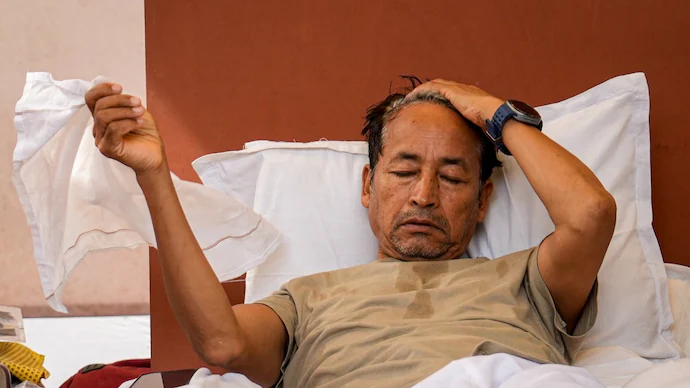
Sonam Wangchuk, the Indian engineer, educator, and social activist widely known for his work in sustainable education and environmental innovation, has completed 19 days of an indefinite hunger strike, raising serious concerns about his health. According to his medical team, Wangchuk has lost approximately 9.1 kilograms since the protest began, prompting doctors to warn that the physical effects of prolonged fasting are becoming increasingly severe.
Wangchuk started his hunger strike on June 28 at Jantar Mantar in New Delhi. His protest is centered on alleged irregularities in India’s competitive examination system, particularly the controversy surrounding the National Eligibility cum Entrance Test (NEET). He has called for greater accountability, reforms to restore confidence in public examinations, and the resignation of India’s Education Minister, Dharmendra Pradhan.
India’s competitive examinations are among the largest in the world, with millions of students appearing for them every year to secure admission to medical colleges, engineering institutions, and other higher education programs. Because these exams often determine academic and professional opportunities, concerns about fairness and transparency have significant implications for students and their families.
The NEET examination has faced intense scrutiny following allegations of paper leaks and other irregularities. The controversy has sparked widespread discussion about the integrity of India’s examination system and has led to demands for stronger safeguards to protect the credibility of national entrance tests. Medical professionals monitoring Wangchuk’s condition have said that although he remains mentally alert, the prolonged fast is taking a visible toll on his body. Doctors have explained that after an extended period without food, the body begins using muscle tissue for energy, increasing the risk of muscle loss and potential damage to vital organs. They have stressed that continued fasting could lead to serious health complications if it persists.
The growing concern over Wangchuk’s condition has also reached the courts. The Delhi High Court recently directed authorities to closely monitor his health and ensure that appropriate medical care is available if his condition worsens. While the court acknowledged the importance of protecting his life and health, it stated that decisions regarding medical intervention should ultimately be guided by healthcare professionals rather than judicial directives. Despite repeated appeals from supporters and public figures, Wangchuk has continued his protest. He has acknowledged that he is physically weaker but has maintained that his fast is intended to draw attention to issues affecting millions of students who depend on a transparent and trustworthy examination system. His protest has remained peaceful, with supporters gathering at the protest site to express solidarity.
Several well-known personalities have urged Wangchuk to end his hunger strike in light of the health risks. Among them is actor Atul Kulkarni, who announced a one-day hunger strike in support of Wangchuk’s cause while encouraging dialogue between the activist and the government. Other public figures have similarly expressed concern for his well-being while recognizing the broader issues surrounding examination reforms.
Sonam Wangchuk has long been associated with educational reform and sustainable development in India’s Himalayan region. He founded the Students’ Educational and Cultural Movement of Ladakh (SECMOL), an organization that focuses on improving learning opportunities through practical, community-based education. His work has received national and international recognition, including the Ramon Magsaysay Award in 2018, often regarded as one of Asia’s highest civilian honors.
Wangchuk is also widely recognized as the inspiration behind the fictional character Phunsukh Wangdu in the 2009 Bollywood film 3 Idiots. While the film introduced his ideas to a global audience, his career has been defined by decades of work in education, innovation, and environmental sustainability.
As his hunger strike enters its third week, public attention remains focused on both his health and the issues that prompted the protest. Doctors continue to monitor his condition closely, while calls for dialogue and examination reforms continue from students, educators, and supporters across the country. The coming days are likely to be significant, not only for Wangchuk’s health but also for the wider conversation surrounding transparency, accountability, and public trust in India’s education system. His protest has become a focal point in a national debate over the integrity of competitive examinations, an issue that directly affects millions of students seeking access to higher education each year.


