

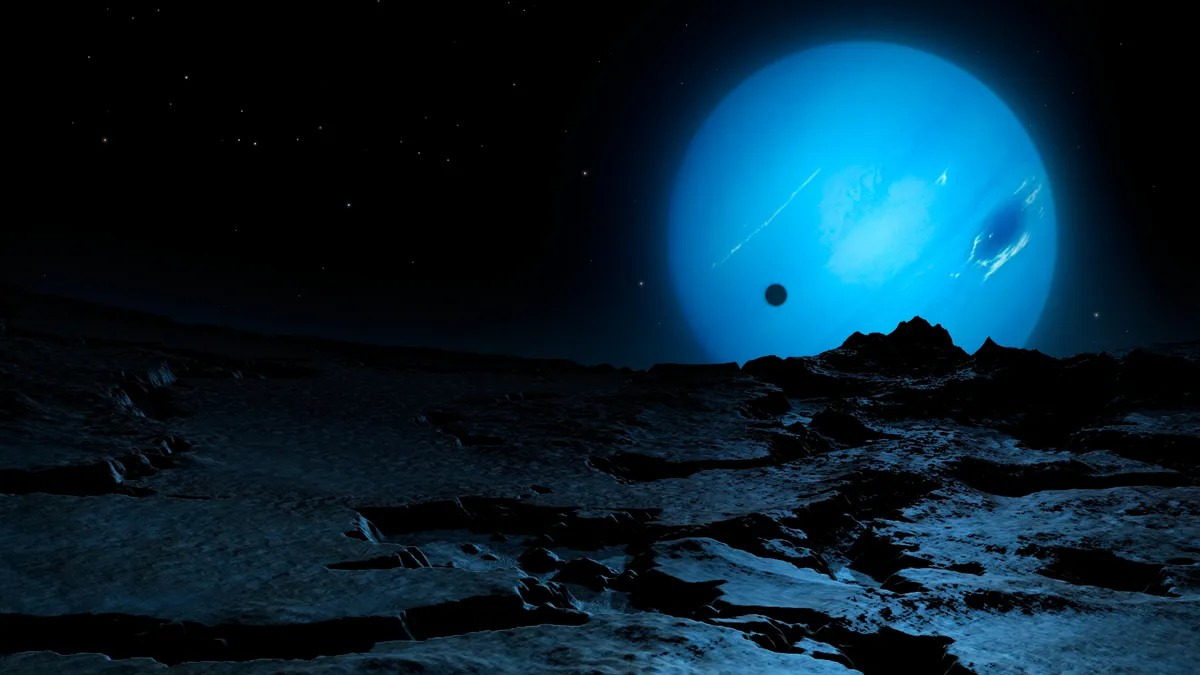
A new study using the James Webb Space Telescope points to Triton as the trigger behind a collision that destroyed Neptune’s original moons billions of years ago.
New observations of Neptune’s moons and rings are providing evidence of a catastrophe that took place billions of years ago around the outermost planet in the solar system, in which a Pluto-sized object set off a chain of destruction that reshaped the entire system.
Researchers used NASA’s James Webb Space Telescope to examine the composition of three of Neptune’s small inner moons, Proteus, Larissa and Galatea, along with the planet’s inner dusty rings. They detected clay minerals of a kind normally found deep inside larger worlds in the outer solar system. These magnesium-rich minerals are known to exist on the dwarf planet Ceres, which orbits in the asteroid belt between Mars and Jupiter, and in some meteorites. The study was published in the journal Science Advances.
Scientists Found Minerals That Should Not Be There
The presence of the clay minerals is the central clue behind the finding. According to the researchers, these minerals require prolonged contact between liquid water and rock to form, a process that takes time and stable conditions.
Ryleigh Davis, a planetary scientist and postdoctoral researcher at the University of California, San Diego, and the study’s lead author, said Neptune’s small inner moons are far too small and cold for that chemistry to have occurred within them. The clay therefore had to come from somewhere else, she said, specifically the deep interior of a much larger ancient world.
Finding this material on Neptune’s inner moons, Davis said, points to a catastrophic event in Neptune’s past that destroyed those ancient worlds and exposed their deep interiors, with the small moons and rings seen today re-forming from that wreckage. Davis carried out the work on the study while at Caltech.
Triton Identified as the Likely Cause
The researchers said the object behind the event appears to be Triton, currently Neptune’s largest moon, which previously resided farther out in a region called the Kuiper Belt.
They said that sometime during the first billion years or so after the solar system formed roughly 4.5 billion years ago, a chaotic period when the large gas planets were still migrating toward their current orbits, Neptune’s gravity captured Triton. Triton is slightly larger than Pluto, another Kuiper Belt object, though smaller than Earth’s moon.
After being captured, Triton’s own gravitational forces stirred up Neptune’s original moons and caused most of them to collide with one another. Neptune’s present inner moons eventually formed from some of the resulting debris.
Davis said the interiors of large icy moons are normally permanently hidden, buried beneath thick shells of water ice and accessible only through models and inference. Neptune’s inner moons, she said, may be the only place in the solar system where that material can be directly observed, because the event essentially turned those ancient worlds inside out.
Evidence That Triton Was Captured
Several features of Triton support the idea that it formed elsewhere and was captured rather than forming alongside Neptune. Triton is the only large moon in the solar system that orbits in the opposite direction to its planet’s spin, a strong indicator of an object that arrived from outside the system.
The other three gas giants, Jupiter, Saturn and Uranus, each have a system of large moons that formed around the planet and orbit in roughly circular paths in the same direction the planet rotates. Davis said Neptune is the only giant planet without such an ordered system of large regular satellites, ending up instead with a captured object dominating its satellite system rather than the orderly family of moons seen at the other giant planets. Triton makes up more than 99 percent of the mass of Neptune’s entire satellite system, meaning its moons and rings combined.
Neptune, located about 30 times farther from the sun than Earth, has 16 known moons. The researchers said the composition of Nereid, one of the planet’s outermost moons and one with among the most elliptical orbits of any moon in the solar system, suggests it was the sole survivor among Neptune’s original moons, somehow avoiding the destruction. Triton, thought to be similar in composition to Pluto, has nitrogen ice, methane ice and carbon dioxide on its surface, along with a thin nitrogen atmosphere.
What’s the other possibility?
The researchers said another possible, though less likely, explanation for their observations is that a different Pluto-sized Kuiper Belt world passed too close to Neptune and was ripped apart by its gravity, rather than Triton being the cause.
Davis said the story of Neptune’s moons serves as a reminder that the solar system has a violent history, and described it as an example of how a single random event can fundamentally alter the architecture of a planetary system.