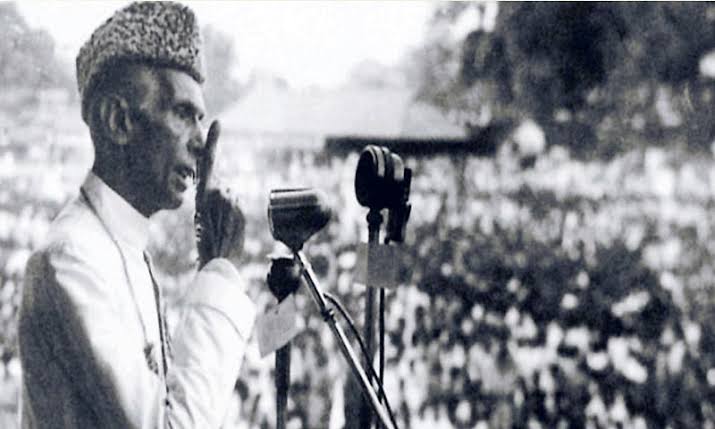
The story of Pakistan’s creation is usually told through political negotiation and constitutional milestones. Equally important, though, were the speeches through which Quaid-e-Azam Muhammad Ali Jinnah communicated his vision and laid down the principles he believed should guide the new nation. A lawyer by training, Jinnah was not known for emotional oratory — he relied instead on logic, precision and constitutional reasoning, whether addressing political workers, legislators or ordinary citizens. Several of these addresses remain among the most influential in Pakistan’s history.
The Speech That Changed the Course of History
Jinnah’s defining moment came at the All-India Muslim League’s session in Lahore in March 1940. In his presidential address, delivered before the adoption of the Lahore Resolution, he argued that the Muslims of the subcontinent constituted a distinct nation with their own history, culture and political aspirations, and that constitutional arrangements should reflect this reality:
“The Hindus and the Muslims belong to two different religious philosophies, social customs and literature.”
The address turned what had largely been a constitutional debate into a defined political objective, providing the intellectual framework for the demand that eventually produced Pakistan. Historians regard it as one of the most consequential speeches in South Asian history.
A Blueprint for a New State
On August 11, 1947, days before independence, Jinnah addressed Pakistan’s first Constituent Assembly in Karachi. Here his focus shifted from the struggle for independence to the work of governing:
“You are free; you are free to go to your temples, you are free to go to your mosques or to any other place of worship.”
He stressed the need to maintain law and order, eliminate corruption and nepotism, and ensure institutions served the public honestly. “The first duty of a government is to maintain law and order,” he reminded legislators — a line still quoted today for its emphasis on constitutional governance and equality before the law.
Speaking to a Nation at Midnight
On August 14, 1947, Jinnah addressed the nation by radio as Pakistan came into being, acknowledging both the joy of independence and the scale of the challenges ahead — refugees crossing new borders, institutions to be built almost overnight:
“The foundations of your State have been laid and it is now for you to build and build as quickly and as well as you can.”
Rather than offer easy reassurance, he urged citizens to face these difficulties with courage and unity — a message of optimism tempered by realism, and for many, the first words they heard as citizens of an independent state.
A Vision for Economic Independence
Jinnah believed political freedom would mean little without economic self-reliance. At the inauguration of the State Bank of Pakistan on July 1, 1948, he argued against simply importing foreign models:
“The adoption of Western economic theory and practice will not help us in achieving our goal of creating a happy and contented people.”
He called instead for an economic system suited to Pakistan’s own conditions — one built on fairness and stability. For Jinnah, financial independence was as essential to sovereignty as political independence, and required institutions capable of supporting long-term prosperity.
Educating the Next Generation
At his convocation address at the University of Dhaka in March 1948, Jinnah turned to the country’s youth, framing education as one of the greatest drivers of Pakistan’s future. He also used the occasion to press for broader inclusion, insisting:
“No nation can rise to the height of glory unless your women are side by side with you.”
Independence, in his view, was not an endpoint but the beginning of a long project requiring an educated and disciplined citizenry.
A Legacy That Continues to Inspire
Across these speeches — delivered in different years, to different audiences — a consistent vision emerges: unity across regions and backgrounds, discipline in public life, constitutionalism and the rule of law, and self-reliance in education and economics. As Jinnah put it:
“With faith, discipline and selfless devotion to duty, there is nothing worthwhile that you cannot achieve.”
More than seven decades on, these addresses remain touchstones in debates over governance and nation-building in Pakistan — a reminder that Jinnah’s legacy lies not only in the creation of Pakistan, but in the principles, he tried to instil through his words.