

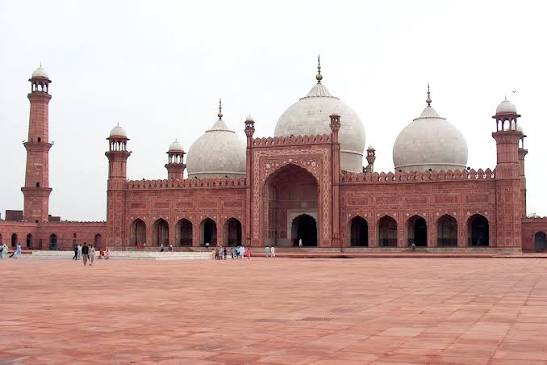
For centuries, the story of Lahore has been inseparable from the River Ravi. Long before the modern city sprawled across its banks, the Ravi shaped Lahore’s geography, economy, and sense of place. Nowhere is this connection more visible than at the Badshahi Mosque, one of the great architectural monuments of the Mughal world, which still stands at the historic edge of the city the river once defined.
A Monument of Imperial Ambition
The Badshahi Mosque was built between 1671 and 1673 on the orders of the Mughal emperor Aurangzeb, with construction overseen by Fidai Khan Koka (also known as Muzaffar Hussain), Aurangzeb’s foster brother and the governor of Lahore at the time. Raised in red sandstone with a vast courtyard and soaring minarets, it ranked among the largest mosques in the world at the time of its completion — a deliberate statement of imperial power and piety.
But scale alone does not explain the mosque’s lasting significance. Its placement within Lahore’s urban and natural landscape was just as deliberate as its architecture.
Positioned Between Fort and River
The mosque was raised on the western edge of Lahore’s walled city, adjoining the Lahore Fort. From this elevated site, the land historically fell away toward the Ravi, which in the Mughal period flowed much closer to the city than it does today. The river was never merely scenery — it was infrastructure and lifeblood, sustaining agriculture, enabling transport, and shaping daily life for the population that lived along its banks.
This proximity also fed into a broader Mughal ideal: Lahore as a city of gardens, water, and monumental building, in which architecture and landscape were conceived together rather than in isolation. The Badshahi Mosque, the Lahore Fort, and the gardens that surrounded them formed a unified imperial ensemble, with the Ravi supplying the natural counterpoint to their built grandeur.
A Landscape in Motion
Rivers, unlike monuments, do not stand still. Over the following centuries, the Ravi gradually shifted course, drawing farther away from Lahore’s historic core. Urban growth, environmental change, and the construction of barrages and other water infrastructure accelerated this separation. A visitor standing today in the courtyard of the Badshahi Mosque no longer senses the river’s presence the way a seventeenth-century courtier might have — the immediate, working relationship between mosque and river has faded with the water itself.
A Story Still Flowing
What remains is a layered historical memory rather than a visible landscape. The Badshahi Mosque endures as a testament to Mughal architectural ambition, while the Ravi represents the natural forces that once sustained and gave shape to the city around it. Together, they trace a fuller history of Lahore — one written not only in stone but in the movement of water, and in the long, evolving relationship between human design and the rhythms of a river.
Even as the Ravi’s waters have receded from the city’s heart, that history continues to run beneath Lahore’s identity, linking the present city to the imperial landscape from which it grew.