
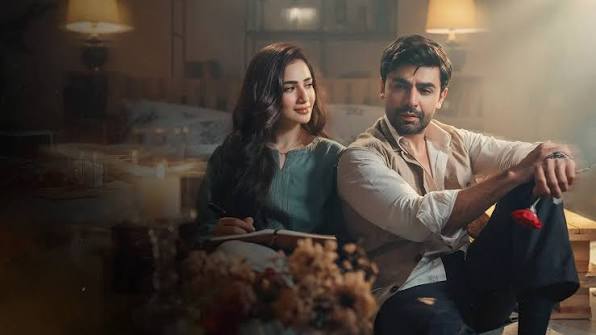
Farhan Saeed and Sana Javed’s Bus Tera Saath Ho concluded its 45-episode run this Monday, leaving audiences largely satisfied with how director Qasim Ali Mureed wrapped up the story. It may not have been a perfect drama, but at its best, it offered viewers plenty to enjoy—from strong performances and memorable characters to moments that genuinely packed an emotional punch.
Bus Tera Saath Ho had all the ingredients of a compelling family drama: an underdog hero, a strong female lead, family politics, generational guilt, betrayal, redemption, and enough villains to keep the plot moving. For much of its run, it delivered on those ingredients.
At its best, it was an engaging story anchored by performances that made even familiar situations compelling. At its weakest, however, it succumbed to the very problem that continues to plague Pakistani television—the inability to know when a story has said enough.
That was particularly evident toward the end. Forty-five episodes were too many for a narrative that had enough material to make a stronger impact in far less time. Still, Bus Tera Saath Ho deserves credit for what it got right. Here are its highs and lows.
The Highs
Farhan Saeed’s Anas—the ‘Cinderella’ man
Farhan Saeed’s portrayal of Anas was the heart of Bus Tera Saath Ho. He was television’s Cinderella man—someone who could endure humiliation, swallow his tears, and survive hardships without losing his sense of right and wrong.
What made Anas interesting was that his goodness never faded, even when those around him treated him badly. He could weep and suffer, but when it mattered, he could also stand up for the very family that wronged him—with one notable exception.
That balance kept Anas from becoming merely another long-suffering drama hero. Farhan played his vulnerability convincingly while giving him enough strength to make his journey from being bullied in his Taya’s house to standing up for himself satisfying.
Sana Javed’s Ansa—beauty, brains, and backbone
If Anas was the heart of the drama, Ansa was its backbone.
Sana Javed’s character was a welcome blend of beauty and brains, but more importantly, she gave Anas the strength he desperately needed. Without Sana, there is a good chance Anas would still be taking everyone’s abuse in his Taya’s house.
In a society where marriage is considered the happiest ending for any girl, Ansa arguably had even more to do afterward. When she and Anas got married, they were dealing with the nightmare of the AI-generated video. After moving in with him, she fought to reclaim her father’s house after her brother threw her out.
Sana handled both sides of the character well. Ansa wasn’t merely there to support the hero; she became a driving force in the story. Her million-dollar look made it even more believable.
Haris Waheed’s Shayan—the Gen Z brat
Haris Waheed’s portrayal of Shayan was the kind of character audiences love to hate—and perhaps recognize a little too easily.
A spoiled brat who always assumed his parents would rescue him, Shayan had perfected the art of getting into trouble and making Anas take the fall. His carefree attitude made him infuriating yet strangely relatable to Gen Z.
The best part was watching that confidence disappear as he was finally cornered in Dubai, then caught in Karachi, with no one willing to stand beside him.
Haris Waheed was brilliant. His mannerisms, comic timing, and entitled attitude kept him ahead of most of the supporting cast.
The veterans
The veteran cast was another major strength. Salman Shahid was brilliant as the caring Dada, a man still remorseful for his past decisions.
Faran Tahir could have been given more to do as Mursaleen, but given his relative newness to the local industry, better roles should follow. Saba Hameed was phenomenal, particularly after Shayan’s departure, and once again showed why she remains one of our most versatile actresses.
Shagufta Ejaz had limited screen time but made a considerable impact as the good Phupo—a rarity in Pakistani dramas, where female relatives are usually expected to be scheming or judgmental.
Mohammad Ahmed delivered one of the drama’s most memorable moments in the final episode. His appearance had the surprise quality of Jaga’s spirit suddenly appearing in Thundercats, before he delivered a speech that gave Ansa the reassurance she needed. It was a genuine tearjerker.
Tipu Sharif’s character, meanwhile, highlighted an uncomfortable reality: men who listen to their scheming wives until they lose the respect of everyone around them.
The music, script, and direction
Naveed Nashad’s OST and background score complemented the emotional tone and helped sell the more dramatic moments.
Sarah Raza’s script had a strong foundation. The conflict surrounding Anas gave the story its emotional core, while Ansa’s storyline added another dimension. The problem wasn’t a lack of material; it was an excess of it.
Qasim Ali Mureed kept the performances front and center and handled the emotional beats effectively. Yet even strong direction couldn’t fully overcome an overextended screenplay.
The Lows
The Shireen arc
Zoya Nasir is a good actress and did what the role required of her as Shireen. The problem was the character’s arc, not the performance.
Shireen began as a bullying cousin, and Zoya played that well. But once the story shifted to the Faham angle and, eventually, the “I can do it” material in the final episodes, the drama drifted from what actually mattered.
By then, viewers were invested in Anas and Ansa and wanted to see the consequences of their central conflict. Instead, the show repeatedly pulled them back into Shireen’s storyline. The repetitive dialogue didn’t help. At times, even a fast-forward button would have been welcome.
The toxic, Indian-soap-style Bhabi
Aliya Ali’s Bhabi seemed to have arrived from a different television universe. Loud, scheming, and constantly plotting, she seemed more inspired by an Indian soap than by the comparatively grounded Pakistani family drama around her.
The Cinderella-inspired elements added little and ultimately made the character exhausting rather than entertaining.
The length
This was perhaps the biggest problem. Bus Tera Saath Ho could have told its story in about 26 episodes, but it ran for 45.
The extra episodes didn’t necessarily add depth. More often, they introduced repetition, detours, and extended conflicts that diluted the central narrative.
HUM TV’s Aapki Izzat, which wrapped up during the run of Bus Tera Saath Ho, offers a lesson. It left an impact because it didn’t overstay its welcome. By the time it ended, viewers were talking about it—and wishing there had been more.
That is a much better problem for a drama to have.
Winter in summer
A production issue also became apparent: the drama was shot in winter but aired in summer. Watching characters dressed for cold weather while viewers were dealing with scorching temperatures created a clear visual disconnect.
It may seem minor, but details like this matter when a production is trying to maintain its illusion.
Too much happening
Ultimately, Bus Tera Saath Ho suffered from trying to do too much. One storyline led to another; secondary characters received extended arcs, and conflicts that could have been resolved quickly were repeatedly prolonged.
That hurt its drama in a competitive television landscape. Dar I Nijaat and Aapki Izzat eventually surpassed it in impact because they felt more focused.
The verdict
Bus Tera Saath Ho is not a bad drama. Far from it. It featured strong performances, memorable characters, and a central pair worth rooting for. Farhan Saeed, Sana Javed, and Haris Waheed were particularly effective, while the veteran cast added considerable weight.
But it also shows why Pakistani television needs to rethink its obsession with episode counts. A good story does not improve simply because it lasts longer.
Had Bus Tera Saath Ho been tightened to around 26 episodes and focused more firmly on Anas and Ansa, it could have been a much stronger drama.
Instead, it became a case of having too much of a good thing—with enough highs to make it worthwhile, but enough lows to keep it from reaching the heights its cast and central story deserved.