Pakistan’s Taxila and the Gandhara civilization span nearly 3,000 years of empires, scholars, and Buddhist art now being repatriated from abroad.
A king once opened his city gates to Alexander the Great without raising a sword. Inside those gates was the oldest university in the world, where 10,500 students from Babylon, Persia, Greece, Arabia and China came to study. Only three out of every ten applicants were accepted. Its courtyards were paved with colored glass tiles. The first human sculpture of the Buddha was carved in its workshops. The city sits in modern-day Pakistan, 35 kilometers from Islamabad. It is called Taxila.
On May 13, 2026, the United States returned more than 450 cultural artifacts to Pakistan during a ceremony at the Islamabad Museum. Most were taken from Taxila and the wider Gandhara region. The collection includes a 2nd-century CE Buddhapada sculpture worth 1.1 million dollars, Gandharan reliefs, Mehrgarh terracotta figurines over 5,000 years old, a Bodhisattva Maitreya statue, and a Gold Strato I coin from 105 to 85 BCE. Over the past decade, the US has repatriated 514 antiquities worth nearly 23 million dollars to Pakistan.
Taxila Ancient History and the Empires of Gandhara
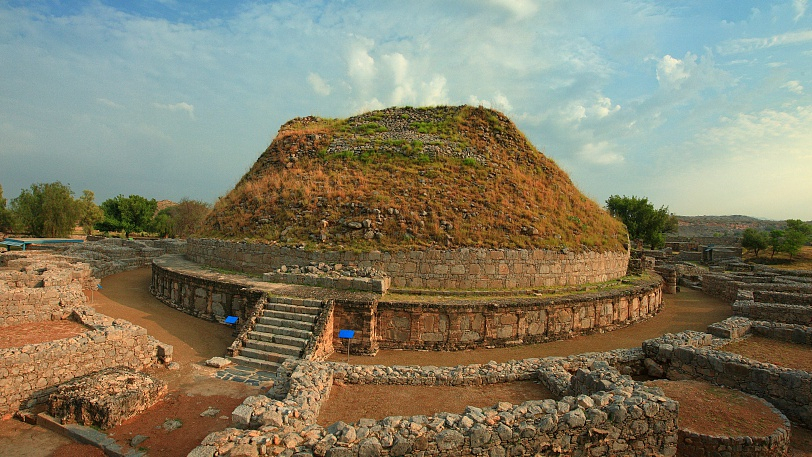
Taxila lies on the Pothohar Plateau, on the eastern bank of the Indus. UNESCO inscribed it as a World Heritage Site in 1980. The site spans more than 30 square kilometers and contains over 50 archaeological locations, including a Mesolithic cave and four successive city sites.
The earliest historic city, Bhir Mound, was founded around 600 BCE. Its winding streets, stone houses, and drainage systems are among the oldest urban planning on the subcontinent. King Ambhi welcomed Alexander here in 326 BCE without a fight. Alexander rested his army at Bhir Mound, accepted envoys from neighboring rulers, and replenished his treasury before pushing east toward the Jhelum, where he fought King Porus at the Battle of the Hydaspes.
Within a decade of Alexander’s death, Chandragupta Maurya took the city. His grandson Ashoka governed Taxila as a viceroy before becoming emperor. After his conversion to Buddhism following the Kalinga war, Ashoka built the Dharmarajika Stupa to house relics of the Buddha. Buddhist texts say its courtyard was paved with colored glass tiles.
Around 184 BCE, the Bactrian Greek king Demetrius founded Sirkap, the second city of Taxila. Sirkap followed the Hippodamian grid plan, named for the 5th-century BCE Greek architect Hippodamus of Miletus, considered the father of European urban planning. Within its walls stood Greek temples, Hindu shrines, Buddhist stupas, Jain sanctuaries, and a Zoroastrian temple at Jandial.
The Indo-Greek Kingdom that ruled this region lasted more than two hundred years. Its most famous king, Menander I, reigned in the 2nd century BCE from a capital called Sakala, identified by historians with modern-day Sialkot. Menander is remembered in Buddhist literature as Milinda, whose philosophical debates with the monk Nagasena are recorded in the text Milinda Panha. The Gold Strato I coin recently returned to Pakistan was minted by one of his successors.
The Indo-Scythians took the city around 80 BCE. The Parthians under King Gondophares rebuilt much of Sirkap in the 1st century CE. Then came the Kushans, who arrived around 30 CE and founded the third city, Sirsukh. Under King Kanishka the Great, Taxila and Gandhara became the center of an empire stretching from Central Asia to the Ganges. This was the era of the Buddhapada sculptures and Bodhisattva statues now being returned. Gandhara art, fusing Greek and Roman techniques with Buddhist subjects, gave the world the first human image of the Buddha. The faces seen on Buddhist statues across China, Japan, and Southeast Asia today all trace back to workshops in this region.
Taxila University Ruins and the End of the Ancient City
By 600 BCE, Taxila already housed what many historians consider the oldest university in the world. It was not a single building but a city-wide network of teachers, monasteries, and study halls. The Buddhist Jataka tales record that more than 10,500 students came here from across the known world. There were no exams and no degrees. A student chose a teacher and stayed until the master decided the training was complete.
The curriculum covered 64 to 68 subjects, including medicine, surgery, the Vedas, law, military science, archery, astronomy, mathematics, music, philosophy, and the decoding of secret messages. Panini, the 4th-century BCE Sanskrit grammarian whose work still shapes the study of the language, was a product of Taxila. Chanakya, who placed Chandragupta Maurya on the Mauryan throne and wrote the Arthashastra, taught here. Charaka, the father of Ayurvedic medicine, studied here. So did Jivaka, who later served as the personal physician of the Buddha.
The end came in the 5th century CE, when the White Huns under Toramana and Mihirakula sacked the monasteries and burned the libraries. When the Chinese pilgrim Xuanzang visited in the 7th century, he found the great viharas in ruins. Muhammad bin Qasim’s conquest of the Indus in 712 CE marked the final closure of Taxila as a major city.
British archaeologist Sir John Marshall began the modern excavations in 1913. Pakistani archaeologists continued the work after independence. The Taxila Museum on the site holds coins, jewelry, surgical instruments, Buddha sculptures, and inscriptions recovered from the ruins. The Taxila Institute of Archaeology and Civilizations at Quaid-i-Azam University in Islamabad leads academic study of the site. On International Museum Day 2026, the institute hosted an event under the global theme “Museums Uniting a Divided World.” Speakers included its director Dr. Sadeed Arif and former Director of the Department of Archaeology and Museums Dr. Tahir Saeed.
Pakistan’s Ministry of National Heritage and Culture says recovery efforts will continue. Federal Minister Aurangzeb Khan Khichi described the returned objects as “a part of Pakistan’s soul, history and civilizational identity” at the May 13 ceremony. US Assistant Secretary of State S. Paul Kapur called the repatriation a landmark in US-Pakistan cooperation.
The artifacts will now be preserved at the Islamabad Museum and the Sir Syed Memorial Museum, a short drive from the ruins where they began.