

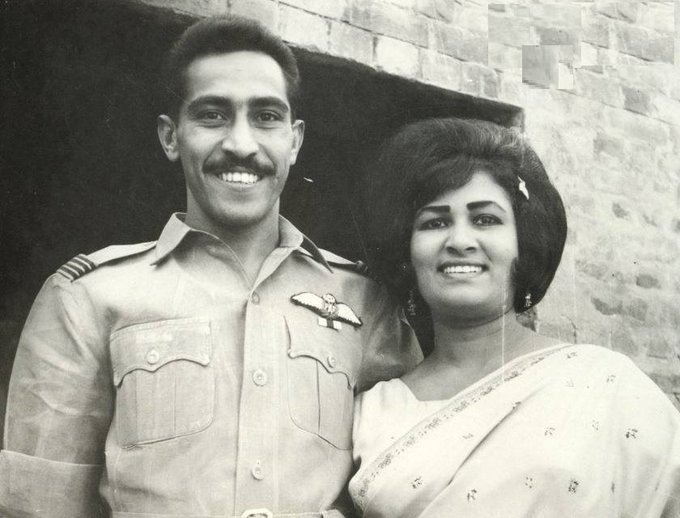
Group Captain Cecil Chaudhry was a Pakistani Christian war veteran whose service shaped both the country’s air defence and its conversation on minority rights.
“By faith I am a Christian, but my religion is humanity.”
That was how Group Captain Cecil Chaudhry once described himself. He was a Pakistani war hero, a school principal and a long-time campaigner for minority rights. He served in the 1965 and 1971 wars, won two of the country’s top gallantry awards, and spent his retirement working in education and human rights.
On April 13, the Pakistan Air Force marks the anniversary of his death each year. He is remembered as a Ghazi of the 1965 war and a combat leader whose conduct under fire is still cited as an example for younger pilots.
Cecil Chaudhry was born on August 27, 1941, in Dalwal, a village in the Salt Range of Punjab. His family was the only Roman Catholic household in the village. His father, F. E. Chaudhry, was a science teacher and one of Pakistan’s first photojournalists, who worked with The Pakistan Times for several decades.
The family later moved to Lahore. Cecil attended St. Anthony’s High School and went on to study physics at Forman Christian College. He joined the Air Scouts during his student years and earned his glider pilot wings in 1956. He entered the Pakistan Air Force Academy at Risalpur on March 12, 1958, through the 23rd General Duty Pilot course. He graduated on June 26, 1960, and was posted to No. 5 Squadron, then commanded by Squadron Leader Sarfraz Rafiqui.
Halwara 1965 War and Sitara-e-Jurat
On September 6, 1965, Cecil Chaudhry flew as No. 2 in a three-aircraft formation of F-86 Sabres on a strike mission against the Indian Air Force base at Halwara. The formation was led by Squadron Leader Sarfraz Rafiqui, with Flight Lieutenant Yunus Hussain as No. 3. According to the Pakistan Air Force Museum record, the formation was intercepted by ten Indian Hawker Hunter aircraft. During the engagement, Rafiqui’s guns jammed, and he handed over the lead to Cecil Chaudhry.
Cecil pressed the attack. The PAF Museum citation states that he destroyed two enemy Hunter aircraft approximately 60 miles inside Indian territory. Rafiqui and Yunus Hussain were both shot down. Cecil was the only pilot in the formation to return to base.
A week later, on September 13, 1965, he took part in the Pakistan Air Force attack on the Amritsar Radar Station, led by Wing Commander Anwar Shamim. On September 15, he pursued enemy bombers 150 miles inside Indian territory. He was awarded the Sitara-e-Jurat, the Star of Courage, for his role in these operations.
By 1971, Cecil Chaudhry was a squadron leader. His aircraft was hit by ground fire during operations along the eastern border. He ejected and was recovered by Pakistan Army troops of the 40 Punjab Regiment in the Zafarwal Sector. He returned to operational flying and completed additional missions during the war. He was awarded the Sitara-e-Basalat.
He later commanded two Mirage squadrons and the Combat Commanders School. He retired from active service on July 2, 1986, with the rank of group captain.
Cecil Chaudhry Education and Minority Rights Work
After retirement, Cecil Chaudhry moved into education. He served as principal of St. Anthony’s High School in Lahore for 14 years and later as principal of St. Mary’s Academy in Rawalpindi. He was associated with the Punjab Education Foundation and was a known advocate for the schooling of children with disabilities and from low-income backgrounds.
He worked closely with Shahbaz Bhatti, who later served as Pakistan’s Minister for Minority Affairs and was killed in 2011. From the early 1990s, Cecil served as Executive Secretary of the All Pakistan Minorities Alliance. He was also affiliated with the National Commission for Justice and Peace. He played a central role in a 14-year campaign that led to the restoration of Pakistan’s joint electorate system in 2002.
Cecil Chaudhry died of lung cancer in Lahore on April 13, 2012. His funeral was held at Sacred Heart Cathedral. The Diocese of Rawalpindi closed Catholic schools for ten days, and the Diocese of Lahore observed a five-day mourning period.
In 2014, the Government of Pakistan posthumously awarded him the Pride of Performance for his contributions to education and human rights. He is one of the few Pakistanis to hold both a top gallantry award and a top civilian award.
On November 30, 2014, a section of Lawrence Road in Lahore, adjacent to St. Anthony’s High School, was officially renamed Cecil Chaudhry Road. The renaming ceremony was attended by senior PAF officers, civil dignitaries, and members of the Christian community.
His daughter, Michelle Chaudhry, leads the Cecil and Iris Chaudhry Foundation, which continues his work in education and minority rights. His son, Cecil Shane Chaudhry, has worked internationally with Christian Solidarity Worldwide on minority issues in South Asia.
Stay tuned for more interesting updates!