

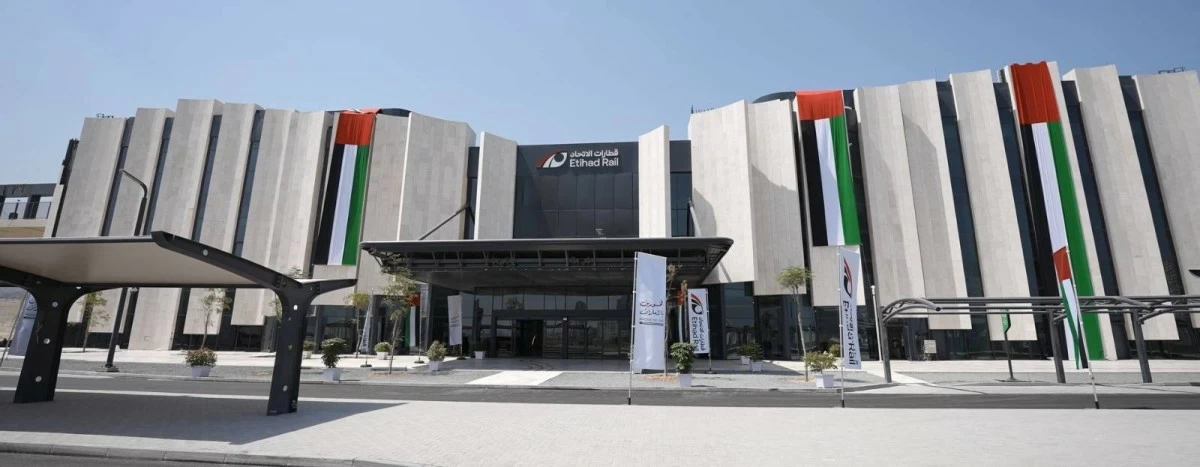
The UAE just got its first finished passenger train station. Etihad Rail has completed the Fujairah passenger station, the first of 11 stations on the country’s new national rail network.
Sheikh Hamad bin Mohammed Al Sharqi, Ruler of Fujairah, Sheikh Mohammed bin Hamad Al Sharqi, Crown Prince of Fujairah, and Sheikh Theyab bin Mohamed bin Zayed Al Nahyan, Chairman of Etihad Rail, visited the station on May 5, 2026, according to state news agency WAM.
The trio also boarded a train that took the delegation out of the station with the mountains of the emirate in the background. Passenger services across the UAE are expected to launch later this year.
Etihad Rail Fujairah Station Location
The Fujairah station sits in the Sakamkam neighborhood near Al Hilal City, on Fujairah’s east coast. It covers around 51,900 square meters and was built using over 20,800 cubic meters of concrete and more than 2,270 tonnes of steel, according to Etihad Rail. The station is 12 minutes from Fujairah International Airport, eight minutes from Fujairah city, five minutes from Sakamkam Fort, and six minutes from Umbrella Beach.
The exterior carries Etihad Rail’s signature cream and gray color scheme with red accents. Inside, the station features automated boarding barriers, an open-plan reception area, a premium lounge with plush seating, ticket machines, and a large network map showing the full Etihad Rail route. Once fully operational, the station will also house retail stores. Officials say the location was chosen so the station itself becomes a destination for travelers visiting Fujairah.
The Khaleej Times and Gulf News reported during media previews this week that the station is the first fully completed passenger station in the network but is not yet operational. Ticket prices, booking methods, and pickup points have not been disclosed.
UAE National Rail Network Routes and Passenger Services
The Etihad Rail network stretches 900 kilometers, running from Al Sila in Abu Dhabi’s western region to Fujairah on the east coast. Passenger services will connect 11 cities and regions across all seven emirates, including Abu Dhabi, Dubai, Sharjah, Ras Al Khaimah, Al Ruwais, Al Mirfa, Al Dhaid, and Madinat Zayed.
The first operational phase will connect Abu Dhabi, Dubai, and Fujairah. According to Etihad Rail, travel between Abu Dhabi and Dubai is projected at about one hour. The route between Abu Dhabi and Fujairah is expected to take around 90 minutes.
Etihad Rail has also announced a separate, electrified high-speed passenger service between Abu Dhabi and Dubai. That line aims to cut travel time between the two emirates to 30 minutes, though a launch date has not been confirmed. A map released by Dubai’s Roads and Transport Authority in April showed the future high-speed line passing the Expo 2020 site before reaching Al Jaddaf near Dubai Creek.
By 2030, Etihad Rail expects to serve approximately 36.5 million passengers a year.
Of the 13 trains designated for the passenger service, 10 have already arrived in the UAE and have completed testing and certification under international safety and quality standards. The trains feature contemporary interiors, full Wi-Fi connectivity, and individual power outlets at every seat. In October 2025, Etihad Rail entered a joint venture with global transport operator Keolis to manage passenger operations, including integrated links with buses, taxis, and parking. Adhraa Almansoori, Director of Public Policy and Sustainability at Etihad Rail, said passenger services will be introduced in carefully structured phases. Route planning has been guided by population density, passenger demand, and inter-emirate connectivity priorities.
The delegation that visited the Fujairah station this month also reviewed development projects in the village of Qidfa, led by the Emirates Council for Balanced Development. Plans for Qidfa include raising its profile to attract 100,000 tourists each year.
For residents, the Etihad Rail launch will mark the first time intercity rail travel becomes a serious alternative to driving or flying within the UAE. The 11-station network is expected to roll out in phases, with the Abu Dhabi–Dubai–Fujairah link coming first.