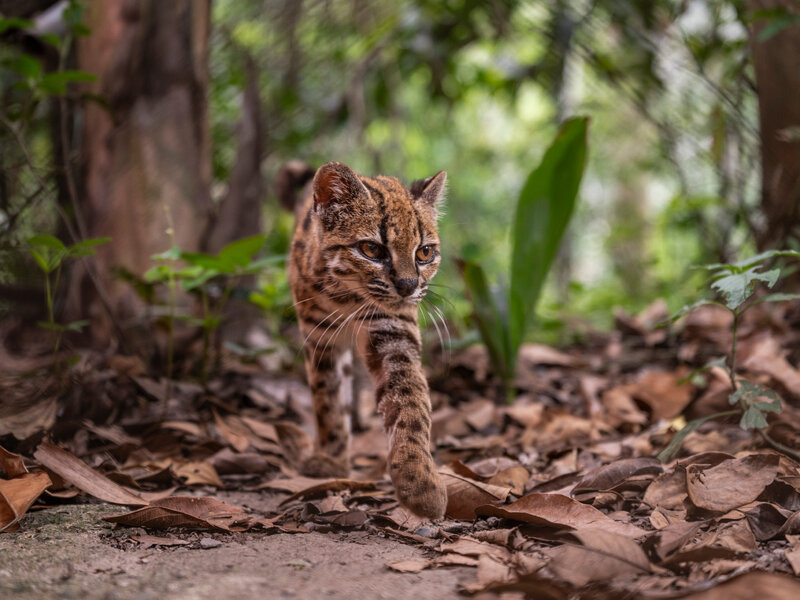
A tiny wild cat identified in Bolivia’s cloud forest is the first new feline species named in more than a century.
Scientists have identified a new species of wild cat in Bolivia, the first new feline described in more than 100 years. The animal, named Leopardus tilcayo, lives in the Bolivian Yungas, a band of cloud forest that runs along the eastern slope of the Andes where the mountains meet the Amazon basin.
The discovery was announced in the journal Current Biology and led by Bolivian biologist and National Geographic Explorer Paola Nogales-Ascarrunz. The tilcayo is slender and spotted, with rounded ears, and is slightly smaller than a typical house cat. It measures about 18 inches long and weighs roughly 3 pounds.
The last time a new living cat species was named was in 1923, with the Uruguayan pampas cat. That gap is what makes this find so significant. New mammal species are usually small and easy to overlook, so identifying a wild cat after a full century is a rare event in modern science.
How a “Weird Cat” Led to a Historic Wild Cat Discovery
The story began with an unusual phone call. In 2017, a wildlife sanctuary in the Yungas region contacted Nogales-Ascarrunz to say they had been handed what they described as a weird cat. The animal had come from a local man who found it as a kitten on a road near a forest and took it home, believing it was an ordinary domestic breed.
The man cared for the cat for about a year. Its wild instincts eventually became impossible to ignore, and once he could no longer manage it, he surrendered it to Senda Verde, a local animal refuge. That male cat, now around 10 years old, still lives at the sanctuary and is the only known individual of its kind in protective care.
Nogales-Ascarrunz, who leads the Bolivian Felid Research and Conservation Program, was intrigued when she first saw the animal. She noticed its features did not match existing descriptions, most of which were based on cats from Brazil. That mismatch set off nearly a decade of research to answer a simple question: what tiger cat does Bolivia actually have?
DNA Study Redraws the Wild Cat Family Tree
The tilcayo belongs to a group known as tiger cats, small spotted felines found across much of South America. For years, these cats were thought to be a single species, Leopardus tigrinus, because they looked so similar to one another.
To test that assumption, the research team analyzed DNA from 38 cats sampled across several South American countries, including eight museum specimens. The results were striking. Rather than one species, the tiger cats turned out to be five genetically distinct species, each with its own separate evolutionary history.
That finding does more than add a single name to the record. It effectively redraws the cat family tree, giving it far more branches than scientists previously recognized. The tilcayo emerged from this work as its own distinct species, native only to the Bolivian Yungas.
The name itself comes from local communities, who already knew the animal and called it tilcayo. The researchers adopted that local name for its scientific designation, Leopardus tilcayo.
Much about the cat remains a mystery. Scientists can confirm it lives in the Yungas cloud forest, one of the least studied areas in the Neotropical region, but they do not yet know what it eats, what preys on it, or how it reproduces. As Nogales-Ascarrunz put it, so many basic things are still unknown.
The team is now installing camera traps across the Yungas in the hope of documenting the elusive cat in the wild. Only two tilcayos have been found so far, and both have undergone whole genome sequencing. One male remains at the sanctuary, while a female was rescued and released back into the wild after being attacked by locals.
For a region rich in species found nowhere else on Earth, the discovery is a reminder of how much life still waits to be understood. It also highlights the ongoing threat of the illegal wildlife trade, which first brought this remarkable cat out of the forest and into human hands.