


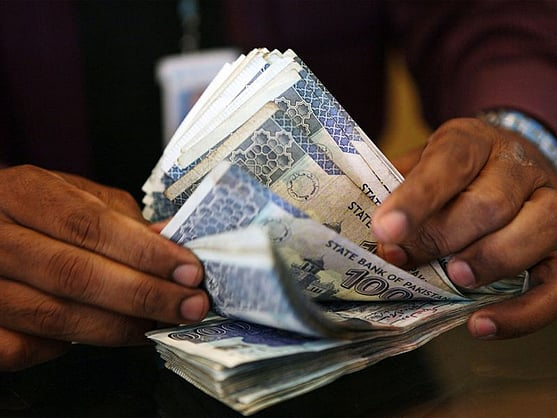
Nearly half of Pakistan’s record remittances now come from just two Gulf nations.
Pakistan received a record 41.6 billion dollars in workers’ remittances during the 2025-26 fiscal year, with Saudi Arabia and the United Arab Emirates accounting for nearly half of the total. Data released by the State Bank of Pakistan showed remittances rose 8.6 percent year-on-year from 38.3 billion dollars in the previous fiscal year, underscoring the Gulf’s central role in Pakistan’s economy and external finances.
Saudi Arabia remained the largest single source of inflows, contributing 9.78 billion dollars over the fiscal year. The UAE followed at 8.81 billion dollars, with the two Gulf nations together supplying close to half of all remittances sent home by overseas Pakistanis. The United Kingdom ranked third at 6.33 billion dollars, followed by European Union countries at 5.23 billion dollars.
The pattern held in June, the final month of the fiscal year. Saudi Arabia led with 829.6 million dollars, followed by the UAE at 792.2 million dollars, the UK at 514.9 million dollars, and the United States at 296.8 million dollars. Monthly remittances reached 3.5 billion dollars in June, up 2 percent from the same month a year earlier, though down 18.3 percent from May’s record 4.25 billion dollars. Analysts attributed the monthly decline to a high base after Eid-related transfers earlier in the year.
Why Saudi Arabia and UAE lead Pakistan remittances
The Gulf’s dominance reflects the size of the Pakistani workforce there. More than 15 million Pakistanis live abroad, with a large share in the six Gulf countries. Around two million Pakistanis live in the UAE alone, many working in Dubai and the Northern Emirates. A rise in overseas employment across Gulf Cooperation Council countries has expanded the base of Pakistanis sending money home.
Several other factors drove the increase. A crackdown on illegal hawala and hundi networks, along with reforms in exchange companies, encouraged more Pakistanis abroad to use formal banking channels. Relative stability in the rupee, trading around 278 to the US dollar, removed incentives to delay or divert transfers. Government-backed incentive programmes also supported inflows through most of the year, though these have since ended.
Why record remittances matter for Pakistan’s economy
Remittances have become the single largest pillar of external financial support for Pakistan’s economy. According to figures cited by Khaleej Times, the inflows now amount to roughly 20 times the country’s typical annual foreign direct investment and comfortably exceed the value of all of Pakistan’s merchandise exports.
That support proved important this year. The record inflows helped offset a 21.6 percent year-on-year increase in the trade deficit, which widened to 39.5 billion dollars, allowing Pakistan to maintain a current account surplus despite rising import payments. The State Bank’s foreign exchange reserves climbed to 18.4 billion dollars, up from 13 billion dollars a year earlier, even after sizeable external debt repayments.
SBP Governor Jameel Ahmad said the country’s current account was expected to post a slight surplus for the fiscal year, supported by strong remittances and services exports despite higher imports. Dr Khaqan Najeeb, former adviser to Pakistan’s Ministry of Finance, described workers’ remittances as a key source of external sector resilience during the year.
The outlook for Pakistan remittances from the Gulf
Pakistani officials welcomed the milestone. Prime Minister Shehbaz Sharif expressed gratitude to overseas Pakistanis, calling them a valuable asset and saying the rise reflected trust in government policies. Khurram Shehzad, adviser to the prime minister, described the annual inflow as a historic milestone that reinforced Pakistan’s external sector resilience and stronger foreign exchange buffers.
The State Bank expects workers’ remittances to reach 44 billion dollars in the 2026-27 fiscal year, and projects foreign exchange reserves will exceed 20.2 billion dollars by the end of December 2026. Some analysts have noted that future inflows will depend on conditions in the Gulf region, particularly any geopolitical tensions that could affect GCC labour markets, as well as the impact of recently ended remittance incentive schemes. For now, the figures confirm the Gulf, led by Saudi Arabia and the UAE, as the anchor of Pakistan’s remittance economy.