

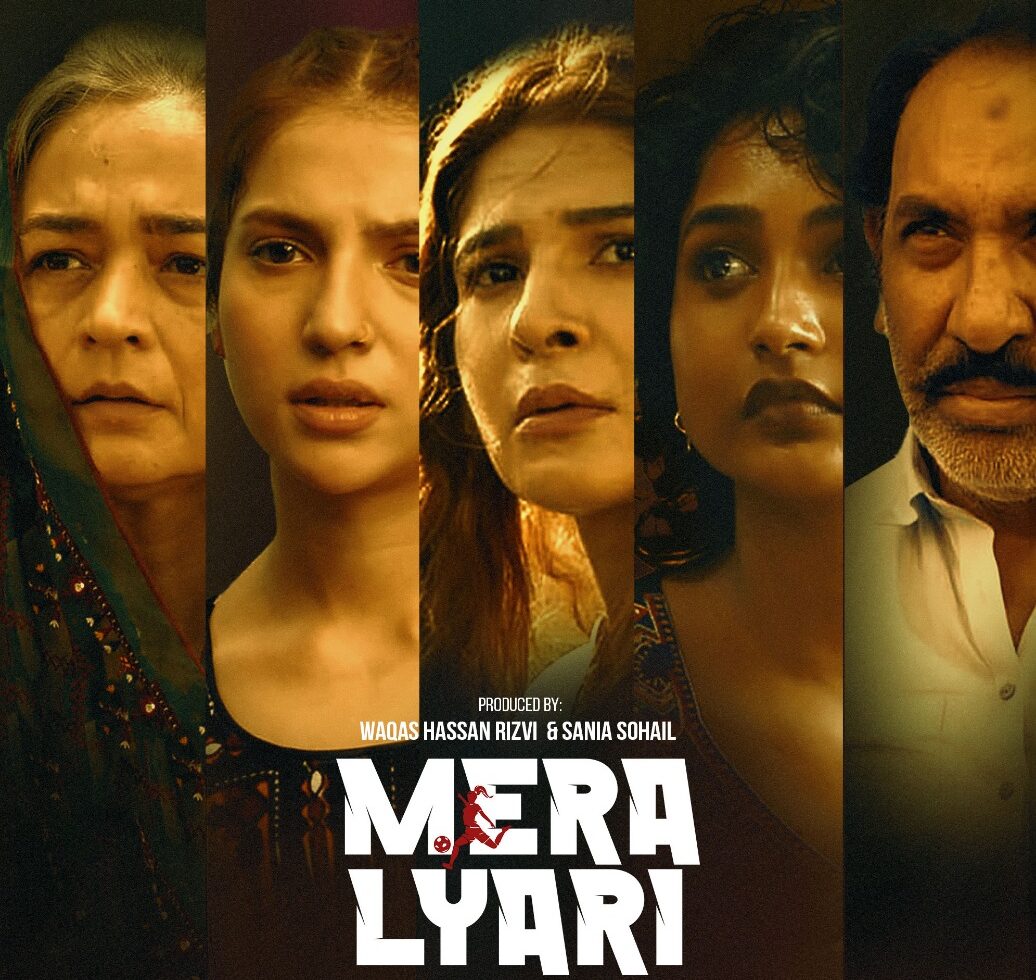
The release of Ayesha Omar and Abu Aleeha’s third venture, Mera Lyari, is a positive development in many ways. First, it reflects the duo’s resilience, as seen in Kukri and Taxali Gate, where they have a knack for making low-budget films that perform well. Second, they cast actors for their talent rather than for their star power. With Mera Lyari, they have ventured into sports, and despite its flaws, they have served both football and Lyari.
Like all sports films made in Pakistan, Mera Lyari focuses more on family than on football, which is its biggest flaw. In the 95-minute flick, there could have been more football and less family drama, but that’s what the makers believe the audience wants, and that’s what they deliver. It tackles universal themes of struggle, identity, and family pressure through football, and if it makes even one family change their mind, that would be as big a success as scoring big at the box office.
The release of Mera Lyari is also a major moment for filmmakers in the country, as it was made with the Sindh Government’s cooperation. From access to Lyari stadiums to facilities, the Sindh Government facilitated the makers without making a big deal of it. Truthfully, had it not been for their backing and the star power of Ayesha Omer and Dananeer Mobeen, the film might not have seen the light of day. Releasing it ahead of the FIFA World Cup was a good decision and might help the film in its festival run.
What is Mera Lyari about, and is it a response to Durandhar?
Behnaz Hussain (Ayesha Omar) is a Lyari-born footballer who wants to select talented girls from Lyari for the national team. However, the biggest obstacle to her quest is not limited facilities but family members who don’t want their daughters to play football, despite their talent. Afsaana (Dananeer Mobeen) and Kashmala (Trinette Lucas) are two such girls who face opposition from their families, and coach Behnaz tries to reason with them to no avail. However, when one such oppressor watches the girl in action, things change for the better.
Written and directed by Abu Aleeha and backed by Ayesha Omar, the film attempts to merge sports drama with social commentary, placing Lyari’s football culture at its center. While it doesn’t always balance those elements, it remains an important addition to Pakistan’s slowly expanding sports-film landscape.
Because the film is set in Karachi’s Lyari neighborhood, many believe it’s Pakistan’s answer to the Dhurandhar franchise, but in reality, it’s just another project set in Lyari, featuring folks from the area and, most importantly, football. No Football, No Lyari, and that’s where this film gets it right.
Strong Performances, Weak Match Control
The film stars Ayesha Omar in the lead role alongside Dananeer Mobeen, and both actors deliver committed performances. Dananeer, in particular, is the soul of the film. Her performance feels natural, restrained, and believable, elevating the entire project. Except for a couple of moments when the accent slips, she convincingly maintains the Baloch accent throughout the film. More importantly, she looks like someone who genuinely belongs on the football field. Unlike many sports films where actors merely pretend to play the game, Dananeer appears comfortable with the ball and moves with enough confidence to make the football sequences believable.
However, for a film centered on football, there is surprisingly less football than expected. It is not as though the sports aspect disappears completely, as happened in Nayaab, where the family drama overshadowed the cricket narrative, but Mera Lyari still spends too much time away from the field. Given the filmmakers’ access to Lyari, its football grounds, local teams, and facilities, a few more extended football sequences would have strengthened the film considerably.
The football scenes often feel fragmented because of excessive back-and-forth cuts, preventing viewers from fully immersing themselves in the game. Sports dramas thrive on rhythm, tension, and momentum, and the editing style here frequently interrupts that flow. Also, the character Kashmala is shown as a talented goalkeeper, but in all the shots featuring her, she comes across as clueless, placing her on par with Yumna Zaidi’s Nayab, who bowled like Haris Rauf in the crucial match and won on prayers, not talent.
One of the film’s biggest weaknesses is its background score during the training sequences. Sports cinema has long relied on emotionally charged montages to inspire audiences, but Mera Lyari misses a major opportunity. Instead of the pleasant but overly soft music used during practice scenes, the film needed something more energetic and motivational — the kind of “Eye of the Tiger” spirit that pushes audiences to feel the struggle, determination, and intensity of an athlete chasing a dream. The music often softens moments that should have felt powerful.
The emotional conflict between the father and daughter also takes far too long to resolve. Family tension is understandable in a story like this, especially in a conservative environment where girls pursuing sports can become a point of conflict, but the film unnecessarily stretches this narrative thread. At times, it feels as though the filmmakers were more comfortable shooting indoor domestic scenes because they were easier and cheaper to execute than large-scale football sequences. Once the father begins recognizing and praising his daughter’s talent, the conflict should have naturally moved toward resolution. Instead, the film continues revisiting the same emotional beats, slowing the pacing.
That said, the performances help keep the drama engaging. The scene between Ayesha Omar and model-turned-actress Trinette Lucas stands out as one of the film’s strongest moments. Both actors lend the scene emotional weight, and the direction during this exchange feels focused and mature. Ayesha Omar deserves credit not only for her acting but also for supporting a film that attempts something unconventional in Pakistani cinema. In an industry still dominated by formulaic romantic comedies and family melodramas, backing a football-centered film is itself a risk.
Nayyar Ejaz is one of the few actors in Pakistan who can play any character, from a Pathan to a Sindhi, without effort. He also does a good job in Mera Lyari, where he shows restraint as a rickshaw driver but becomes abusive at home, venting his frustrations on his wife and daughters, a feature of most lower-middle-class families. The character does realize his mistake, but it might have been too late for the audience who were hoping to see him remorseful during the football match, not in a forced scene at the very end.
Paras Masroor leaves a strong impression despite his limited screen time in the flashback sequences. His scenes carry emotional depth and provide some of the film’s most memorable moments. Samiya Mumtaz, meanwhile, delivers her role with sincerity, although she appears somewhat too mature for a character still hoping to have another child, specifically a son. Also, it would have been great if her character had taken a stand in a filmi manner, with dialogues countering hate, rather than just delivering routine lines in front of a packed stadium where it hardly mattered.
Adnan Shah Tipu’s character, however, feels tonally out of step with the rest of the film. If the intention was to create a tribute to the comedic energy of Ismail Tara’s unforgettable Fifty Fifty performances, then the effort can at least be appreciated from that perspective. Otherwise, the character fails to leave much impact and occasionally pulls the film away from its emotional core.
The film also struggles because it tries to address too many social issues simultaneously. The policeman refusing to pay his fare, the fake spiritual healer attempting to exploit a woman, and the doctor recommending powdered milk over breastfeeding are all relevant societal concerns. In another film, these moments could have carried meaningful weight. Here, however, they feel like distractions inserted into a checklist of social commentary rather than organic parts of the narrative. Every minute spent on these side issues is a minute taken away from football — the very element audiences came to watch.
The film’s final stretch includes another questionable creative decision. The voiceovers explaining why the mother takes her daughter to the stadium feel unnecessary because the emotions and motivations had already been conveyed moments earlier through dialogue and performance. Trusting the audience more would have made the climax more effective. Sometimes silence, expressions, and action communicate far more than repeated narration.
How Mera Lyari Gets the Spirit Right but Misses the Game
It would have been great if the makers had watched a few football films to understand what made them memorable. While Hollywood’s Victory featured a star-studded cast including Pelé and Michael Caine, it was Sylvester Stallone who saved the day as a goalkeeper, since that was the only thing his character could do. Similarly, the Bollywood film Goal had football action that resonated with the audience, even if it lacked logic, and a little of this and a little of that would have helped Mera Lyari. A football film with no kick sound in most scenes is either a TV drama or a telefilm, not a football film.
Despite its flaws, Mera Lyari deserves recognition for what it attempts. Pakistani cinema rarely ventures into sports storytelling, and even more rarely focuses on women in sports from underrepresented communities. The film offers authentic, sincere glimpses of Lyari’s football culture, even if it does not fully explore that world. International audiences, particularly those interested in grassroots sports stories and women’s empowerment narratives, may connect with the film more strongly than local viewers, who often expect either full-scale commercial entertainment or tightly polished storytelling.
The film’s low budget is evident, but that is not necessarily a criticism. In fact, low-budget films often recoup their investments precisely because they are made with manageable expectations. Mera Lyari is likely to do the same. More importantly, it may encourage filmmakers to pursue smaller, meaningful stories rather than wait endlessly for massive budgets and commercial formulas. Director Abu Aleeha, executive producer Ayesha Omar, and producers Sania Sohail and Waqas Hassan Rizvi deserve credit for proving that unconventional ideas can still reach the screen.
An Important Step for Pakistani Sports Cinema
It may not be the best sports film to come out of Pakistan, but it is certainly an important one. Not only does it highlight the challenges faced by women’s football in Pakistan, but it also encourages girls to break free and pursue their ambitions rather than surrender to societal pressure for no fault of their own.
In a country where sports films are a rarity, watching Mera Lyari felt refreshing. Before this film, the only notable sports films released in Pakistan were Main Hoon Shahid Afridi, Shah, and Nayaab. On the other hand, Bollywood’s most successful film ever – Dangal – was a sports film that not only conquered India but also China, a territory we are yet to explore.
Interestingly, another Pakistani football film, Maidaan, starring Faysal Qureshi, Vardah Aziz, and Dananeer Mobeen, has reportedly been in development for the past couple of years. After watching Mera Lyari, one can only hope that Uzma Zakaria’s project also reaches audiences and further fuels football storytelling in Pakistan ahead of the next FIFA World Cup. Pakistani cinema may still be far from mastering the sports genre, but films like Mera Lyari show that the passion and potential are certainly there