


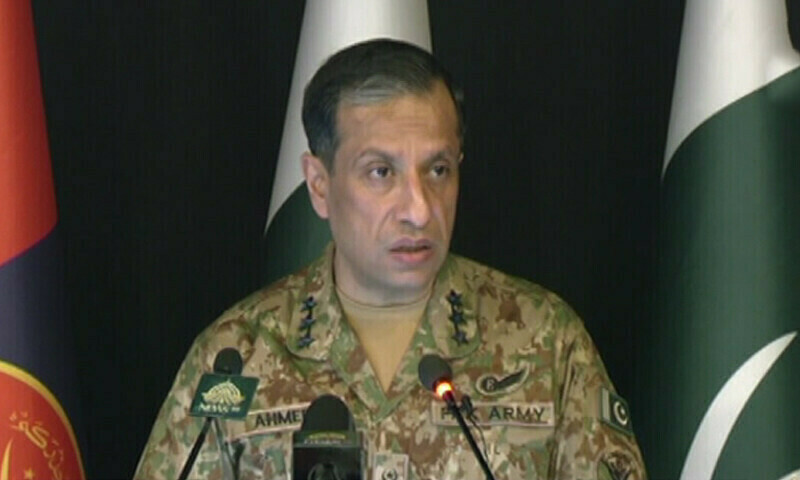
Pakistan’s military on Friday outlined its assessment of the country’s security situation, placing particular emphasis on counterterrorism efforts, governance challenges and the evolving situation in Balochistan. Addressing a detailed press conference, Inter-Services Public Relations (ISPR) Director General Lieutenant General Ahmed Sharif Chaudhry argued that Pakistan’s long-term security depends not only on military operations but also on effective governance and institutional reform.
A key theme of the briefing was the relationship between governance and national security. Referring to the National Action Plan, the military spokesperson described good governance as “quintessential” for Pakistan’s stability, arguing that the country’s growing population requires a broader debate on whether the existing administrative structure remains sufficient. He said any discussion on creating new administrative units should take place through constitutional procedures and reflect the will of the people.
Security Operations and Terrorism
Presenting operational statistics, the DG ISPR stated that security forces had conducted more than 40,000 intelligence-based operations during 2026, with the majority taking place in Balochistan. According to the figures shared, over 2,000 militants had been killed this year while security agencies were conducting nearly 200 intelligence-based operations daily.
He acknowledged that terrorism incidents remain high, particularly in Khyber Pakhtunkhwa and Balochistan, but argued that the increasing tempo of security operations reflected a more proactive counterterrorism strategy. The military also reported that more than 800 Pakistanis, including civilians and security personnel, had lost their lives in terrorist attacks during the year.
The DG ISPR maintained that Pakistan’s policy had shifted decisively against negotiations with militant organisations, saying the state would only accept compliance with the Constitution and the law.
Balochistan and the ‘Hard State’
A substantial portion of the press conference focused on Balochistan, where the military argued that the province’s security challenges extend beyond terrorism alone.
The DG ISPR said Pakistan needed to function as what he termed a “hard state”, clarifying that this referred to equal enforcement of the Constitution and law rather than military rule. He argued that constitutional obligations, including loyalty to the state and obedience to the law, must accompany demands for rights, citing Article 5 of the Constitution to support his position.
The military spokesperson attributed many of Balochistan’s longstanding governance issues to entrenched elitism and the preservation of the status quo by influential tribal and political interests. He further alleged that these dynamics were being exploited by hostile external actors seeking to destabilise the province.
External Support and Information Warfare
The DG ISPR reiterated Pakistan’s longstanding allegations regarding external support for militant violence, claiming that Afghanistan-based militant sanctuaries and Indian involvement were contributing to instability in Balochistan. He revealed that the Afghan Taliban regime continued to provide support and sanctuary to militant groups operating against Pakistan.
The military spokesperson further claimed there was increasing coordination between what the government designates as Fitna-al-Khawarij—its term for the banned Tehreek-i-Taliban Pakistan (TTP)—and Fitna-al-Hindustan, the designation used for Balochistan-based militant groups that receive Indian backing. While describing the two groups as ideologically different, he maintained that they were now conducting coordinated operations aimed at destabilising Pakistan.
The DG ISPR also outlined the military’s ongoing counterterrorism campaign, stating that security forces are currently conducting Operation Shaban, which has evolved into Operation Al-Azm. He added that most operations in Balochistan are being carried out jointly by the Pakistan Army, Frontier Corps and police. Additionally, he said Operation Ghazab lil-Haq was under way against the Afghan Taliban. He also noted that more than 2.6 million Afghan nationals had been repatriated from Pakistan, including around 600,000 during 2026.
The military spokesperson also described what he termed an organised information warfare campaign accompanying militant attacks. According to the DG ISPR, incidents are first “seeded” and framed by initiators before being amplified through social media accounts, Indian media outlets and eventually sections of the international media. He cited the July 16 Mastung convoy attack as an example, accounts associated with the Baloch Yakjehti Committee (BYC), the banned Balochistan Liberation Army (BLA) and overseas political actors played a role in amplifying the incident online.
The military spokesperson also presented figures relating to missing persons, development spending and security deployments, arguing that narratives of deprivation overlooked government investment in the province. According to the briefing, billions of rupees have been allocated for infrastructure, policing, education and socioeconomic development, while new Frontier Corps formations and enhanced police capacity are intended to strengthen security across the province.
Kashmir and Domestic Stability
Responding to questions regarding recent protests in Azad Jammu and Kashmir, the DG ISPR reiterated Pakistan’s official position that Kashmir remains the country’s “jugular vein”. Referring to the Joint Awami Action Committee protests, he said the state had encouraged political participation through constitutional and electoral processes, while stressing that only the state possesses the legitimate monopoly on the use of force.
Overall, the press conference presented the military’s view that Pakistan’s security challenges require a combination of sustained counterterrorism operations, stronger governance, institutional reforms and socioeconomic development. While highlighting operational successes against militant groups, the briefing also underscored the military’s argument that constitutional governance and administrative effectiveness remain essential components of the country’s long-term stability.